Tilings with Factor: $\frac{1+ \sqrt{5}}{2}$
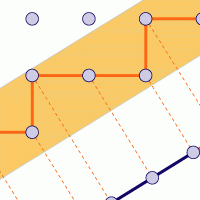
The classical example to explain the cut and project
method (see figure, lower part): In the standard square lattice $\mathbb{Z}^2$, choose a stripe with slope
$\frac{1}{\tau}$ (where tau is the golden ratio $\frac{1+\sqrt{5}}{2}$ ) of a certain width $\cos(\arctan(\frac{1}{\tau})) + …
Finite Rotations Polytopal Windowed Tiling Canonical Substitution Tiling One Dimensional Parallelogram Tiles Self Similar Substitution Mld Class Fibonacci
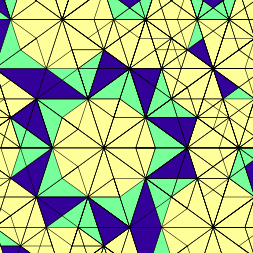
A substitution rule where the tiles are allowed to overlap. The image left indicates, that the yellow and the green tiles do overlap. It is unknown whether these tilings are mld to the Penrose Rhomb tilings.
Finite Rotations Euclidean Windowed Tiling Polytopal Tiles
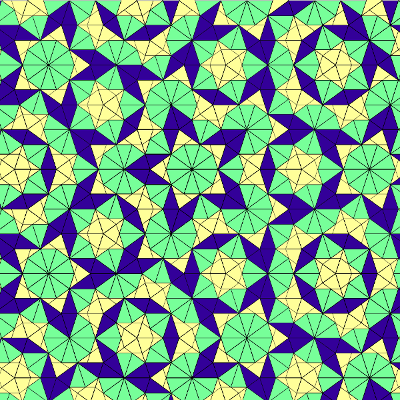
As Overlapping Robinson Triangles I, this is a variant of the Penrose Rhomb tiling, using only one prototile, and the tiles are allowed to overlap. Here, the overlap happens after applying the substitution rule twice on one tile.
Finite Rotations Polytopal Tiles
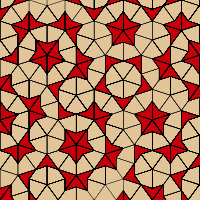
A classic, using a kite (blue) and a dart (orange) as prototiles. See Penrose Rhomb for more details.
Without Decoration Finite Rotations Polytopal Windowed Tiling Polytopal Tiles Mld Class Penrose