Substitutions
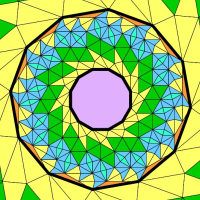
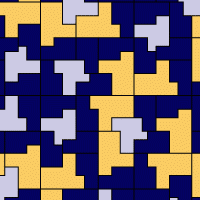
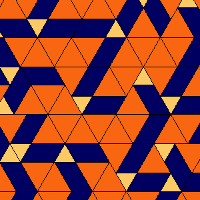
A substitution rule that gives rise to an aperiodic tiling with dense tile orientations and 12-fold rotational symmetry. The inflation factor is $\sqrt{5+2\sqrt{3}}$. The tiling has finite local complexity with respect to rigid motions.
Finite Local Complexity Polytopal Tiles Self Similar Substitution Infinite Rotations
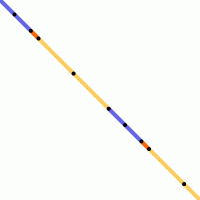
A one dimensional substitution rule with a two component Rauzy Fractal. For a second example and more details see infinite component Rauzy fractal.
One Dimensional Euclidean Windowed Tiling Self Similar Substitution
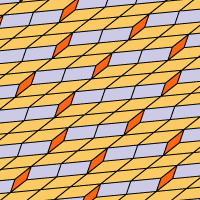
In the cut and project scheme for the 2-component Rauzy Fractal, just interchange the roles of direct space and internal space: The Rauzy fractal and its decomposition define a plane substitution for fractal tiles. Here we replace the fractal tiles with appropriate parallelograms. This plane tiling …
Border Forcing
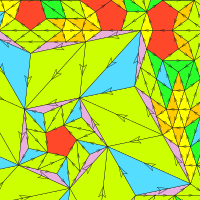
A substitution rule that gives rise to an aperiodic tiling with dense tile orientations and 5-fold rotational symmetry. The inflation factor is $\sqrt{6+\sqrt{5}}$. The tiling has finite local complexity with respect to rigid motions.
Finite Local Complexity Polytopal Tiles Self Similar Substitution Infinite Rotations
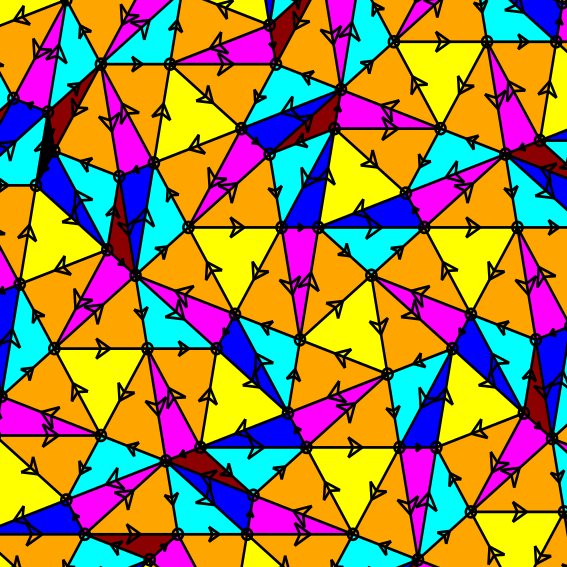
The 9-fold Needle Deltoid tiling was derived by K.P. Nischke using methods similar to the tilings in [ND96] . However, this tiling lacks full 9-fold symmetry.
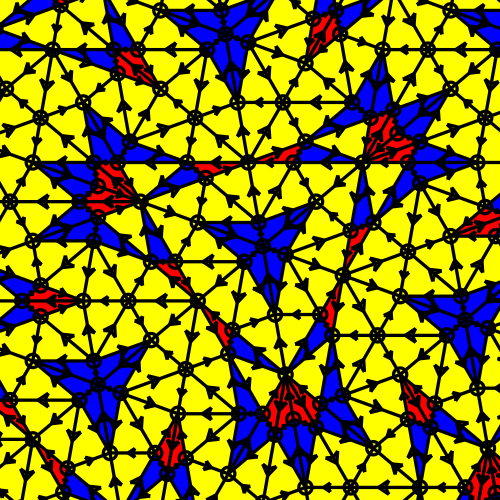
The 9-fold Vampire Deltoid tiling was derived by K.P. Nischke using methods similar to the tilings in [ND96] . However, this tiling lacks full 9-fold symmetry.
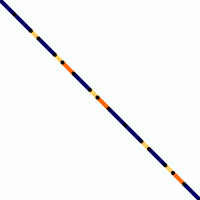
A classic simple substitution rule with Rauzy Fractal:
One Dimensional Euclidean Windowed Tiling Self Similar Substitution Polytopal Tiles
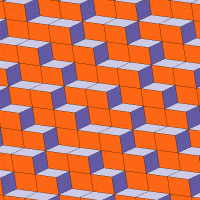
The dual tiling of the 1D tiling a->ab, b->c, c->a, resp. the version with polygonal tiles.
Finite Rotations Euclidean Windowed Tiling Polytopal Windowed Tiling Canonical Substitution Tiling Polytopal Tiles Parallelogramm Tiles
In 1977 Robert Ammann discovered a number of sets of aperiodic prototiles, i.e., prototiles with matching rules forcing nonperiodic tilings. These were published as late as 1987 in [GS87] , where they were named Ammann A2 (our Ammann Chair), Ammann A3, Ammann A4 and Ammann A5 (better known as Ammann …
Without Decoration Finite Rotations Euclidean Windowed Tiling Polytopal Tiles Self Similar Substitution
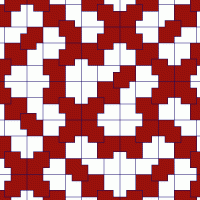
One of the tilings discovered R. Ammann in 1977, when he found several sets of aperiodic prototiles, i.e., prototiles with matching rules forcing nonperiodic tilings. These were published much later, in 1987, in [GS87] , where they were named Ammann A2 (our Ammann Chair), Ammann A3, Ammann A4, and …
With Decoration Finite Rotations Polytopal Windowed Tiling Canonical Substitution Tiling Parallelogram Tiles Self Similar Substitution Mld Class Ammann
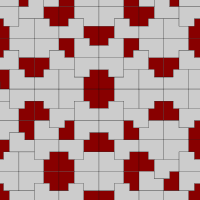
One of the tilings discovered by R. Ammann in 1977, published in [GS87] . The other ones (published there) are Ammann A3, Ammann A4, and Ammann A5 (better known as Ammann Beenker). The inflation factor of this substitution is quite small. It is the square root of the golden ratio, approx 1.272. …
Without Decoration Finite Rotations Polytopal Windowed Tiling Polytopal Tiles Self Similar Substitution
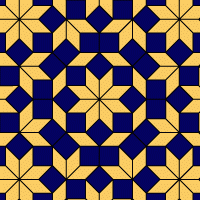
In 1977 R. Ammann found several sets of aperiodic tiles. This one (his set A5) is certainly the best-known of those. It allows tilings with perfect 8fold symmetry. The substitution factor is $1+\sqrt{2}$ - sometimes called the ‘silver mean’ - which was the first irrational inflation factor known …
With Decoration Finite Rotations Polytopal Windowed Tiling Canonical Substitution Tiling Rhomb Tiles Mld Class Ammann Matching Rules
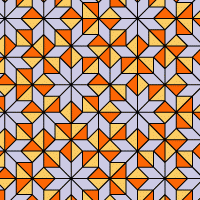
A self-similar version of the Ammann-Benker tiling. The colours of the triangles in the rule image indicate the orientation of the triangles: the orange triangle is just the ochre triangle reflected. Hence the rhomb supertile has two axes of mirror symmetry.
With Decoration Finite Rotations Euclidean Windowed Tiling Polytopal Windowed Tiling Canonical Substitution Tiling Polytopal Tiles Parallelogramm Tiles Self Similar Substitution
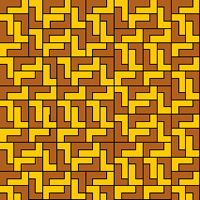
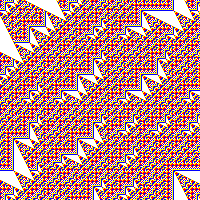
Denote the elements of the field F4 by {0, 1, w, w + 1}, where w satisfies the following equation with coefficients in F2: w2 + w + 1 = 0. Bat in Cone is a recurrent double sequence defined by a(i, 0) = a(0, j) = 1 and a(i, j) = f( a(i, j-1), a(i-1, j-1), a(i-1, j) ), where f(x, y, z ) = x + x2 + w …
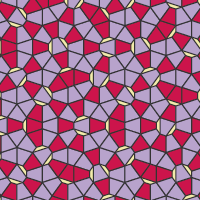
A substitution tiling with three prototiles. The substitution rule is given for only two of the three tiles. The third tile (yellow) is substituted by nothing.
The discoverer gives credits to Veit Elser for suggesting the shape of the tiles.
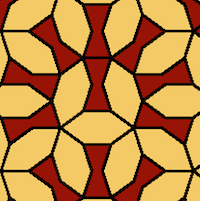
One of several substitution tilings found and submitted in February 2016 by L. Andritz with fivefold symmetry using tiles inspired by Islamic Girih patterns.
Despite the similarities the tiling is different to the “Tie and Navette” tiling as discussed in [Lue1990] and [LL1994] .
Finite Rotations Model Set Polytopal Tiles Self Similar Substitution Finite Local Complexity Girih
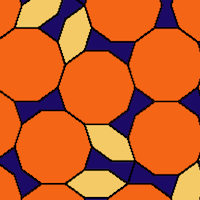
A tiling with fivefold symmetry using tiles inspired by Islamic Girih patterns.
Finite Rotations Polytopal Tiles Self Similar Substitution Finite Local Complexity Girih
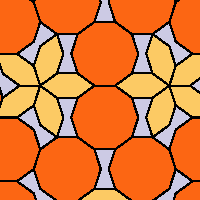
One of several substitution tilings found by L. Andritz with fivefold symmetry using tiles inspired by Islamic Girih patterns.
Finite Rotations Polytopal Tiles Self Similar Substitution Finite Local Complexity Girih
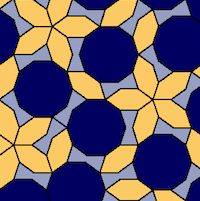
One of several substitution tilings found by L. Andritz with fivefold symmetry using tiles inspired by Islamic Girih patterns.
Finite Rotations Polytopal Tiles Self Similar Substitution Finite Local Complexity Girih
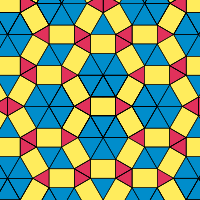
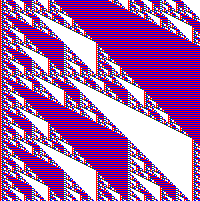
Denote the elements of the field $F_{4}$ by ${0, 1, w, w + 1}$, where w satisfies the following equation with coefficients in $F2: w^{2} + w + 1 = 0$.
Bumerang is a recurrent double sequence defined by $a(i, 0) = a(0, j) = 1$ and $a(i, j) = f(a(i, j-1), a(i-1, j-1), a(i-1, j) )$,
where $f(x, y, z ) …
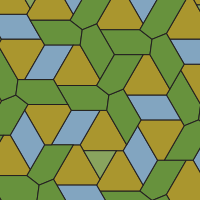
A substitution for the aperiodic hat monotile found in 2022 and published in [SMCG2024] , see also [BGS2023] . The “metatiles” in the first paper have some free parameter. Most of these parameters yield a substitution that is not selfsimilar. Here we show the selfsimilar version of the substitution …
Aperiodic Monotile Self Similar Substitution
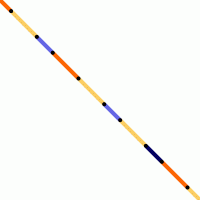
The substitution rule a1->a1 b1, a2->b2 a2, b1->a2, b2->a1. The tilings generated become Fibonacci tilings under the projection a1,a2->a and b1,b2->b. Alternatively one can simply remove the colour labels on the tiles. The name comes from the projection structure of the tiling. The expansion …
Euclidean Windowed Tiling Polytopal Windowed Tiling Canonical Substitution Tiling One Dimensional Polytopal Tiles Parallelogram Tiles Self Similar Substitution Mld Class Fibonacci
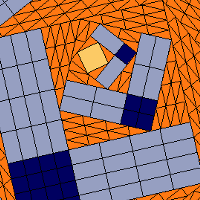
The substitution system uses 4 letters. With:
$x = \frac{\pi}{7}$, $c = \cos(x)$ and $s = \sin(x)$
They are: two squares of side lengths $1$ and $2-c-s$; a rectangle with sides $c+s$ and $2-c-s$: and a right triangle with legs $c$ and $s$.
The substitution is indicated in the figure. Up to our …
Self Similar Substitution Infinite Rotations
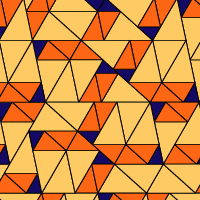
Part of an infinite series, where most tilings in this series are not flc, this one is the exception.
The reason is that the inflation factor is a - real - PV number.
By an argument in [PR] this forces flc.
Interestingly, the shape of the tiles can vary.
That is, there is one free parameter $l$ , …
Finite Rotations Euclidean Windowed Tiling Polytopal Tiles Self Similar Substitution
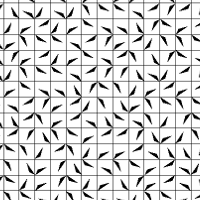
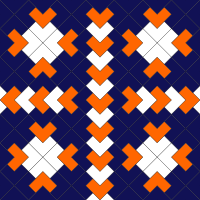
The chair tiling, as most tilings presented here, is nonperiodic. But there is a strong resemblance to periodic tiling. For instance, the set of vertex points in the tiling obviously spans a square lattice. Moreover, it is possible to detect large subsets in the tiling which are fully periodic. For …
Finite Rotations P Adic Windowed Tiling Polytopal Tiles Rep Tiles Self Similar Substitution Mld Class Chair
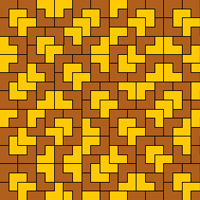
A more or less obvious variant of the chair substitution.
Finite Rotations Polytopal Tiles Self Similar Substitution
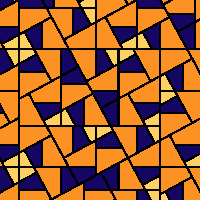
A member of an infinite family of substitution rules for similar quadrangles possessing two right interior angles at opposite vertices. A big copy of such a quadrangle can be divided into (smaller) similar quadrangles in several ways. Some of them are compatible with a substitution rule. This one is …
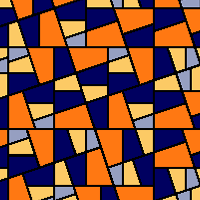
One of several substitution tilings found by L. Andritz using similar right-angled quadrilaterals.
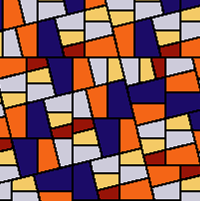
One of several substitution tilings found by L. Andritz using similar right-angled quadrilaterals.
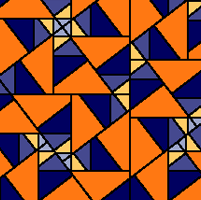
One of several substitution tilings found by L. Andritz using similar right-angled quadrilaterals.
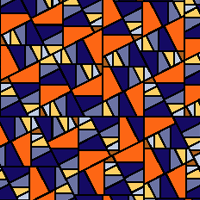
One of several substitution tilings found by L. Andritz using similar right-angled quadrilaterals.
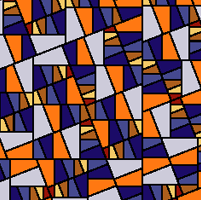
One of several substitution tilings found by L. Andritz using similar right-angled quadrilaterals.
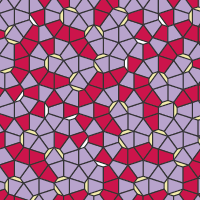
A substitution tiling with three prototiles.
The substitution rule is given for only two of the three tiles.
The third tile (yellow) is substituted by nothing.
The discoverer gives credits to Veit Elser for suggesting the shape of the tiles.
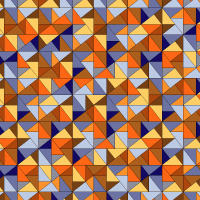
In order to generate the golden triangle tilings by matching rules, L. Danzer and G. van Ophuysen found this substitution for coloured prototiles. The list of its vertex stars serves as matching rules. For more details, see golden triangle and the references there.
Without Decoration Finite Rotations Euclidean Windowed Tiling Polytopal Tiles Self Similar Substitution
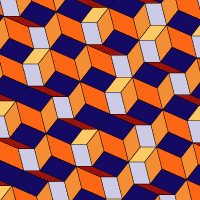
This tiling and Nautilus are dual tilings generated by non-PV morphisms. As such they are the first step in a generalisation of the work of G. Rauzy, P. Arnoux, S. Ito and others for PV substitution rules. The work that developed out of G. Rauzy’s seminal paper [Rau82] .
The inflation factor for …
Finite Rotations Euclidean Windowed Tiling
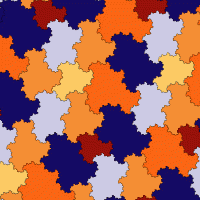
A volume hierarchic version of Conch.
Finite Rotations Euclidean Windowed Tiling Self Similar Substitution
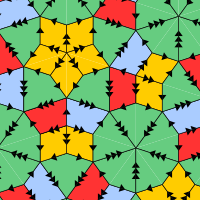
The tiling shares a mld-class with the Penrose Tilings, e.g. Penrose Rhomb, Penrose kite-dart and Penrose Pentagon boat star).
The inflation factor is the square of the golden mean $(\frac{\sqrt{5}}{2} + \frac{1}{2})^{2} = \frac{\sqrt{5}}{2} + \frac{3}{2} = 2.618033988\ldots$.
In contrast to the …
Without Decoration Finite Rotations Polytopal Windowed Tiling Canonical Substitution Tiling Mld Class Penrose
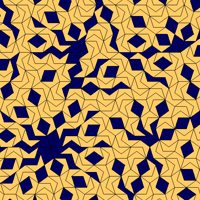
The ochre tile - the “crown” - is an amazingly versatile tile to play with. This substitution is one possible substitution using it.
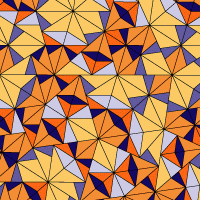
A pinwheel substitution rule with cubic scaling. As the scaling and the rotations for the tiles are all given by algebraic units, every vertex of the tiling lies within a finitely generated Z-module.
Infinite Rotations Infinite Local Complexity Polytopal Tiles Self Similar Substitution
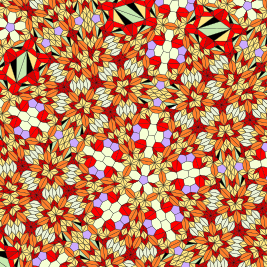
10-fold cyclotomic aperiodic tiling with dense tile orientations (CAST DTO).
Finite Local Complexity Polytopal Tiles Self Similar Substitution Infinite Rotations
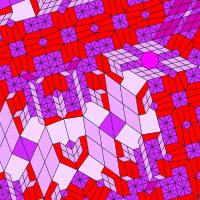
8-fold cyclotomic aperiodic tiling with dense tile orientations (CAST DTO).
Finite Local Complexity Polytopal Tiles Self Similar Substitution Infinite Rotations
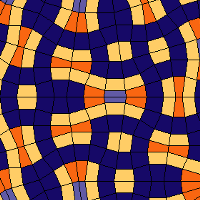
In order to generalize Danzer’s 7-fold tiling to n-fold symmetry,
where n>5 is odd, L. Danzer and D. Frettlöh introduced trapezoidal tiles,
each one the union of two triangles with edge lengths of the form $\sin(k \frac{\pi}{n})$.
It needs some further effort, including the introduction of three …
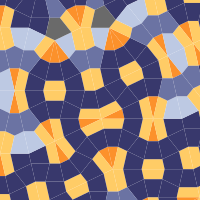
In order to generalize Danzer’s 7-fold tiling to n-fold symmetry,
where n>5 is odd, L. Danzer and D. Frettlöh introduced trapezoidal tiles,
each one the union of two triangles with edge lengths of the form $\sin(k \frac{\pi}{n})$.
It needs some further effort, including the introduction of three …
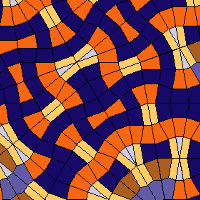
In order to generalize Danzer’s 7-fold tiling to n-fold symmetry,
where n>5 is odd, L. Danzer and D. Frettlöh introduced trapezoidal tiles,
each one the union of two triangles with edge lengths of the form $\sin(k \frac{\pi}{n})$.
It needs some further effort, including the introduction of three …
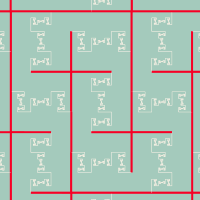
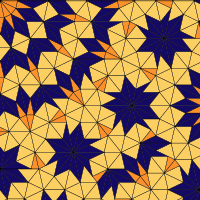
A substitution tiling with three triangles as prototiles,
based on 7-fold symmetry.
The four different edge lengths occurring are $\sin(\frac{\pi}{7})$, $\sin(\frac{2\pi}{7})$,
$\sin(\frac{3\pi}{7})$, $\sin(\frac{2\pi}{7}) + \sin(\frac{3\pi}{7})$,
The inflation factor is …
Without Decoration Finite Rotations Polytopal Tiles Self Similar Substitution Matching Rules
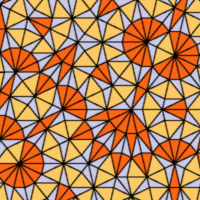
A tiling based on 7-fold (resp. 14-fold) symmetry [ND96].
The inflation factor is $1+{\sin(\frac{2\pi}{7})}/{\sin(\frac{\pi}{7})}$.
The three different edge lengths are proportional to
$\sin(\frac{\pi}{7})$, $\sin(\frac{2\pi}{7})$,
$\sin(\frac{3\pi}{7})$.
On a first glance, there seems to exist a …
Without Decoration Finite Rotations Polytopal Tiles Self Similar Substitution
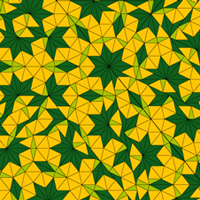
Substitution tiling with isosceles triangles as prototiles allow several variations: For each tile in the first order supertiles, one can choose whether it is a left-handed or a right-handed version. By playing around with these possibilities, one obtains this variant from Danzer’s 7-fold.
Finite Rotations Polytopal Tiles Self Similar Substitution Generalized Robinson Triangles
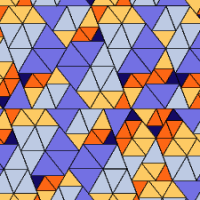
Part of an infinite series of triangle susbstitutions described by L.Danzer. Most of them are not flc, this one being one of the simplest examples in this series. The substitution factor is of algebraic degree 5. The positions where one can ‘see’ the non-flc property are fault-lines throughout the …
Finite Rotations Polytopal Tiles Self Similar Substitution
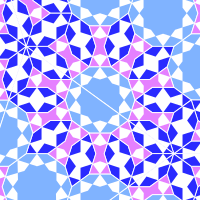
The substitution tiling was derived from a mosaic at the Darb-i Imam Shrine in Isfahan, Iran. While the shrine dates back from 1453, [Lau2018] argues that the mosaic was created much later between 1715 - 1717.
The tiling relies on the regular decagon and two hexagons and has individual dihedral …
Finite Local Complexity Finite Rotations Polytopal Tiles Self Similar Substitution Girih
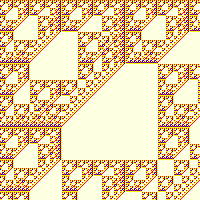
Denote the elements of the field $F_{4}$ by $\{0, 1, w, w + 1\}$, where w satisfies the following equation with coefficients in $F_{2}: w^{2} + w + 1 = 0$.
Diamond is a recurrent double sequence defined by $a(i, 0) = a(0, j) = 1$ and $a(i, j) = f(a(i, j-1), a(i-1, j-1), a(i-1, j))$,
where $f(x, y, …
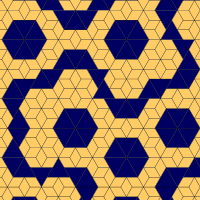
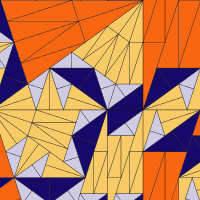
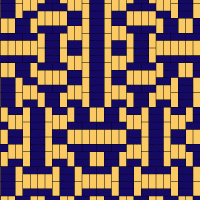
Also known as ’table tiling’. In [Sol97] was shown that its dynamical spectrum has a continuous component. Thus it cannot be a cut and project tiling. The same was shown in [Rob99] , where a topological model of the dynamical system of the domino tilings is obtained.
Polyomio Tiling Finite Rotations Polyomio Tilings Rep Tiles Self Similar Substitution
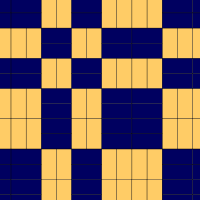
A simple variant of the domino tilings (aka table tilings).
C. Goodman-Strauss pointed out in [Goo98] the following. B. Solomyak
proved in Sol98,
that for each nonperiodic substitution tiling the substitution rule is invertible:
One can tell from $\sigma(T)$ its predecessor $T$ uniquely. But this is …
Finite Rotations P Adic Windowed Tiling Polytopal Tiles Parallelogram Tiles Polyomio Tiling Rep Tiles Self Similar Substitution

A generalization of the domino substitution. There are several possibilities to play with 1x2 rectangles (dominos) in order to generate non-periodic tilings.
The decorative lining shows here how the prototile gets turned and mirrored for this example. The two rules are actually exactly the same. For decoration the horizontal tile was colored purple.
Finite Rotations Polytopal Tiles Polyomio Tiling Rep Tiles Self Similar Substitution
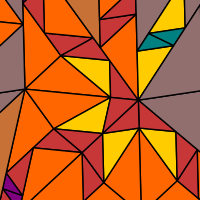
Tiling submitted by Andrew Hudson.
The scaling factor is the smallest PV number, the Plastic Number which is a root of the polynomial $x^3 - x - 1 = 0$.
Self Similar Substitution Plastic Number Infinite Rotations
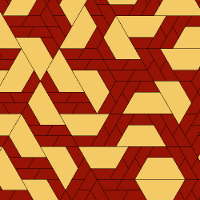
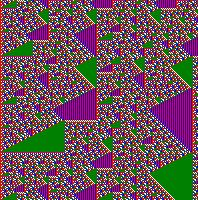
Denote the elements of the field $F_{4}$ by $\{0, 1, w, w + 1\}$,
where $w$ satisfies the following equation with coefficients in $F_{2}: w^{2} + w + 1 = 0$.
Dragonul is a recurrent double sequence defined by $a(i, 0) = a(0, j) = 1$ and $a(i, j) = f(a(i, j-1), a(i-1, j-1), a(i-1, j))$,
where $f(x, …
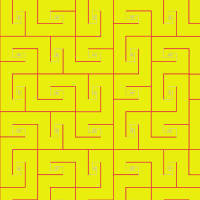
A relative of the Squiral tiling. The boundary of the prototile has infinitely many line segments, but it has still finite length. A relative of this tiling is Dampflok, where the boundary of the prototile has infinite length, even though it consists of line segments (and accumulation points) only.
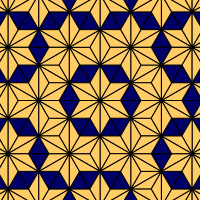
A substitution tiling found by Bill Kalahurka, Texas, in 2009 (?). It is mld to T2000 by L. Danzer in 2000.
Finite Rotations P Adic Windowed Tiling Polytopal Tiles Rep Tiles Self Similar Substitution Two Dimensional
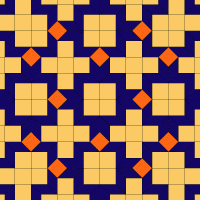
In his PhD thesis, E. Harriss classified all substitution tilings which are canonical projection tilings.
Here one example is shown, derived from the cut and project scheme of the Ammann-Beenker tilings.
Finite Rotations Euclidean Windowed Tiling Polytopal Windowed Tiling Canonical Substitution Tiling Polytopal Tiles Parallelogram Tiles
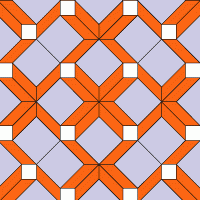
In his PhD thesis, E. Harriss classified all substitution tilings which are canonical projection tilings.
Here one example is shown, derived from the cut and project scheme of the Ammann-Beenker tilings.
Finite Rotations Euclidean Windowed Tiling Polytopal Windowed Tiling Canonical Substitution Tiling Polytopal Tiles Parallelogram Tiles
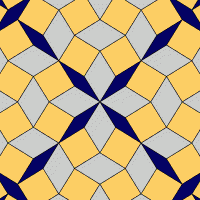
In his PhD thesis, E. Harriss classified all substitution tilings which are canonical projection tilings.
Here one example is shown, derived from the cut and project scheme of the Ammann-Beenker tilings.
Finite Rotations Euclidean Windowed Tiling Polytopal Windowed Tiling Canonical Substitution Tiling Polytopal Tiles Parallelogram Tiles Rhomb Tiles
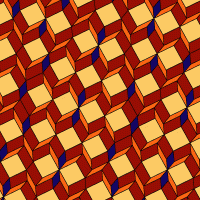
In his PhD thesis, E. Harriss classified all substitution tilings which are canonical projection tilings.
Here one example is shown, derived from the cut and project scheme of the Ammann-Beenker tilings.
Finite Rotations Euclidean Windowed Tiling Polytopal Windowed Tiling Canonical Substitution Tiling Polytopal Tiles Parallelogram Tiles
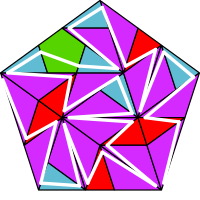
The FASS-curve of the pentagon bases on an aperiodic substitution tiling with four substitution rules and appropriate decorations.
The substitution tiling was derived from the Robinson Triangle Tiling.
Its inflation factor is the golden mean $\frac{\sqrt{5}}{2} + \frac{1}{2} = 1.618033988\ldots$.
Polytopal Tiles Self Similar Substitution With Decoration FASS_curve
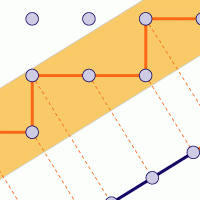
The classical example to explain the cut and project
method (see figure, lower part): In the standard square lattice $\mathbb{Z}^2$, choose a stripe with slope
$\frac{1}{\tau}$ (where tau is the golden ratio $\frac{1+\sqrt{5}}{2}$ ) of a certain width $\cos(\arctan(\frac{1}{\tau})) + …
Finite Rotations Polytopal Windowed Tiling Canonical Substitution Tiling One Dimensional Parallelogram Tiles Self Similar Substitution Mld Class Fibonacci
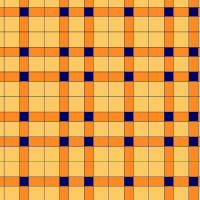
The 2dim analogue of the famous Fibonacci tiling in one dimension.
It is just the Cartesian product of two Fibonacci tilings $F_{1}$, $ F_{2} : \{ T_{1} \times T_{2}\ |\ T_{i}\ in\ F_{i}\}$.
Obviously, it can be generated by a substitution with three prototiles.
It shares a lot of nice features with …
Finite Rotations Euclidean Windowed Tiling Polytopal Windowed Tiling Polytopal Tiles Parallelogram Tiles Rhomb Tiles Self Similar Substitution
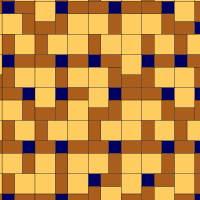
A simple variant of Fibonacci times Fibonacci, the latter arising from the one-dimensional Fibonacci tiling.
Finite Rotations Polytopal Tiles Parallelogram Tiles Rhomb Tiles Self Similar Substitution
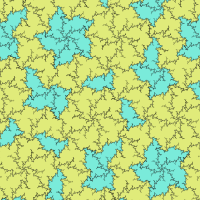
A fractalized version of the Penrose Kite and Dart tilings. Unlike Kite and Dart, this version is a selfsimilar substitution.
Self Similar Substitution
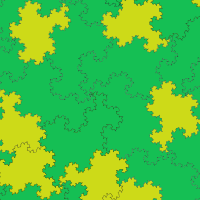
A selfsimilar version of a substitution with Penrose rhombs, but without reflections. These tilings are mld to the Penrose Rhomb tilings, even though they lack their mirror symmetry.
Self Similar Substitution
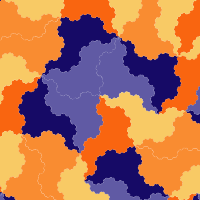
It is hard to find substitution tilings with dense tile orientations (like the pinwheel tiling) that uses a single prototile with fractal boundary. The fractal version of he pinwheel tiling by Frank and whittaker uses 13 different prototiles.
An extensive computer search revealed that there are only …
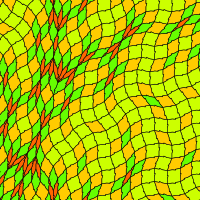
This tiling is a generalization of the Godreche-Lancon-Billard Binary first derived by T. Hibma and later worked out in detail by S. Pautze.
All interior angles are integer multiples of $\frac{\pi}{n}$.
For $n=5$ it is identical to the Godreche-Lancon-Billard Binary tiling with 2 prototiles.
For odd …
Finite Rotations Polytopal Tiles Parallelogramm Tiles Rhomb Tiles Finite Local Complexity
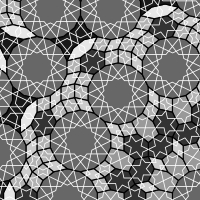
A tiling resembling Islamic Girih patterns but using 14-fold
symmetry rather than 8- or 10- or 12-fold.
Its inflation factor is $1 + \cos(\frac{\pi}{14}) \csc(\frac{\pi}{7}) + 2 \cos(\frac{3 \pi}{14}) \csc(\frac{\pi}{7}) = 6.850855...$
which is a unit but not a PV number.
It uses 11 prototiles …
Finite Local Complexity Finite Rotations Polytopal Tiles Self Similar Substitution Girih
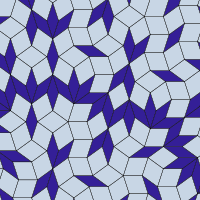
In [Lan88], energetic properties of certain decorations of Penrose Rhomb tilings were studied.
A $\frac{\pi}{5}$, $3\frac{\pi}{5}$}, or in {$2\frac{\pi}{5}$, $4\frac{\pi}{5}$}.
(‘Binary’ because …
Finite Rotations Polytopal Tiles Parallelogramm Tiles Rhomb Tiles Finite Local Complexity
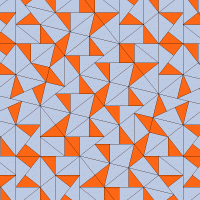
Using the prototiles of the golden triangle tiling, this substitution yields tilings where the tiles occur in infinitely many orientations. The inflation factor is $\tau + 1 = 2.618033988 \ldots $, the square of the golden mean. This is a PV number of algebraic degree 2. The expansion contains no …
Finite Local Complexity Polytopal Tiles Self Similar Substitution Infinite Rotations
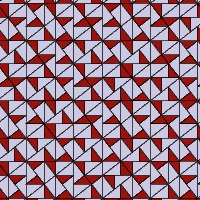
The substitution can be expressed by using the real inflation factor $\sqrt{\tau} = 1.272\ldots$, where $\tau=\frac{\sqrt{5}+1}{2}$ is the golden mean. This factor is not a PV number. Nevertheless, the tiling is pure point diffractive, and it is a cut and project tiling, see [Gel97]
, [Dv00]
. Thus …
With Decoration Finite Rotations Polytopal Windowed Tiling Polytopal Tiles Self Similar Substitution
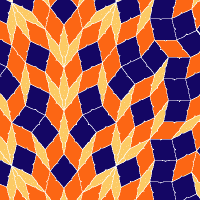
Whereas it is simple to generate rhomb tilings with n-fold symmetry by the cut and project method, it can be hard to find a substitution rule for such tilings. Here we see a rule for n=7. This one was later generalized by E. Harriss to arbitrary n.
Finite Rotations Canonical Substitution Tiling Polytopal Tiles Parallelogram Tiles Rhomb Tiles Harrisss Rhomb
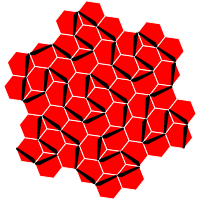
The Gosper Curve is a FASS-curve which can be derived by a substitution tiling with one substitution rule and appropriate decorations.
The inflation factor $q$ is $sqrt(7)$.
Finite Local Complexity Polytopal Tiles Self Similar Substitution With Decoration Limitperiodic FASS_curve
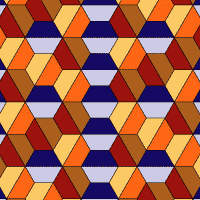
This one is easily seen to be limitperiodic: A large portion of the tiling is periodic. Thus it is a cut and project tiling. A detailed description of the corresponding cut and project scheme is contained in [Fre02].
The substitution occurs already in [GS87], see Exercise 10.1.3.
Finite Rotations P Adic Windowed Tiling Polytopal Tiles Rep Tiles Self Similar Substitution
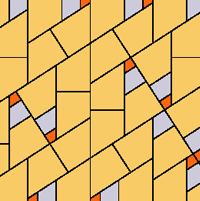
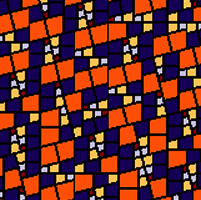
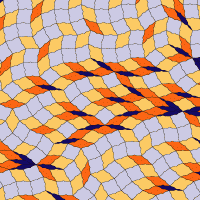
Finite Rotations Polytopal Tiles Parallelogram Tiles Rhomb Tiles Harrisss Rhomb
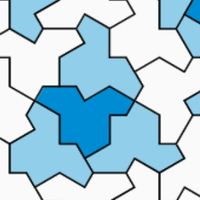
A pretty simple aperiodic monotile found in 2022 and published in [SMCG2024] . The tile is a tridecagon (13-gon) built from 16 basic triangles with edge lengths $1,2, \sqrt{3}$. The shape alone ensures that every tiling of the plane you can build from this tile will be aperiodic. In this sense it …
Aperiodic Monotile
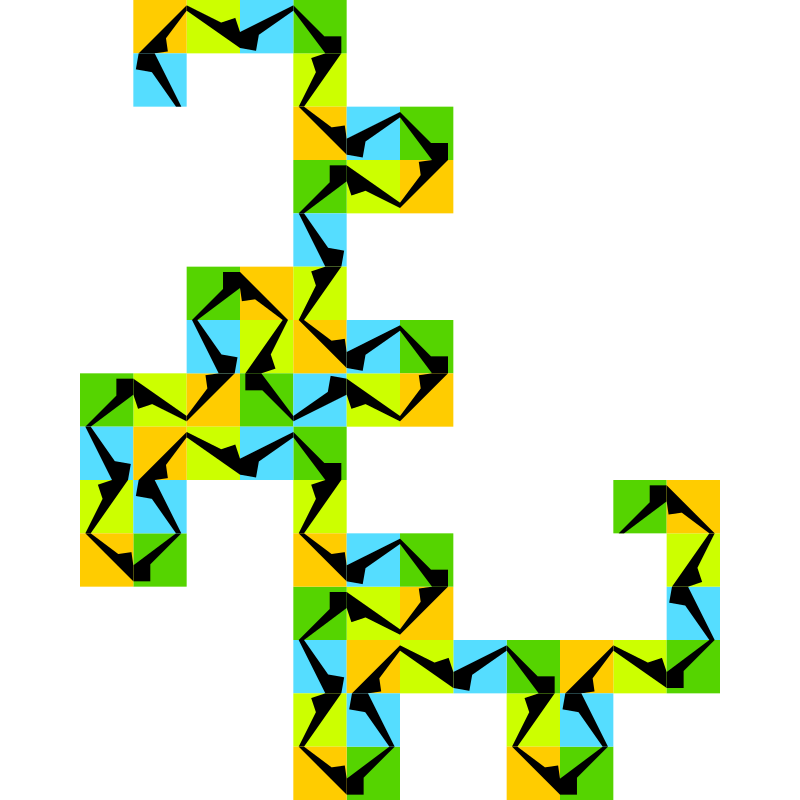
The original Heighway Dragon Curve as described in [gar1967] , can be derived by a substitution tiling with one substitution rule and appropriate decoration. However, it is not a FASS-curve because it is not self avoiding. With the results in [pau2021] it is possible to derive a substitution tiling …
Finite Local Complexity Polytopal Tiles Self Similar Substitution With Decoration Limitperiodic FASS_curve
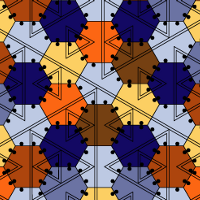
In 2009 Joan Taylor (Burnie, Tasmania) found a decoration of the hexagon, which - together with few local matching rules - allows only aperiodic tilings of the plane. This was probably the best example of an aperiodic monotile before the discovery of the Hat tiling. This decorated hexagonal tile, …
Aperiodic Monotile Self Similar Substitution
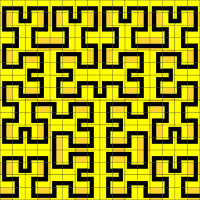
The Hilbert Curve is one of the earliest FASS-curves. The original algorithm in [hil1891] bases on one substitution rule and an additional rule which describes how the substitutes have to be connected. As briefly mentioned in [pau2021] it is also possible to create the Hilbert Curve by a …
Finite Local Complexity Polytopal Tiles Self Similar Substitution With Decoration Limitperiodic FASS_curve
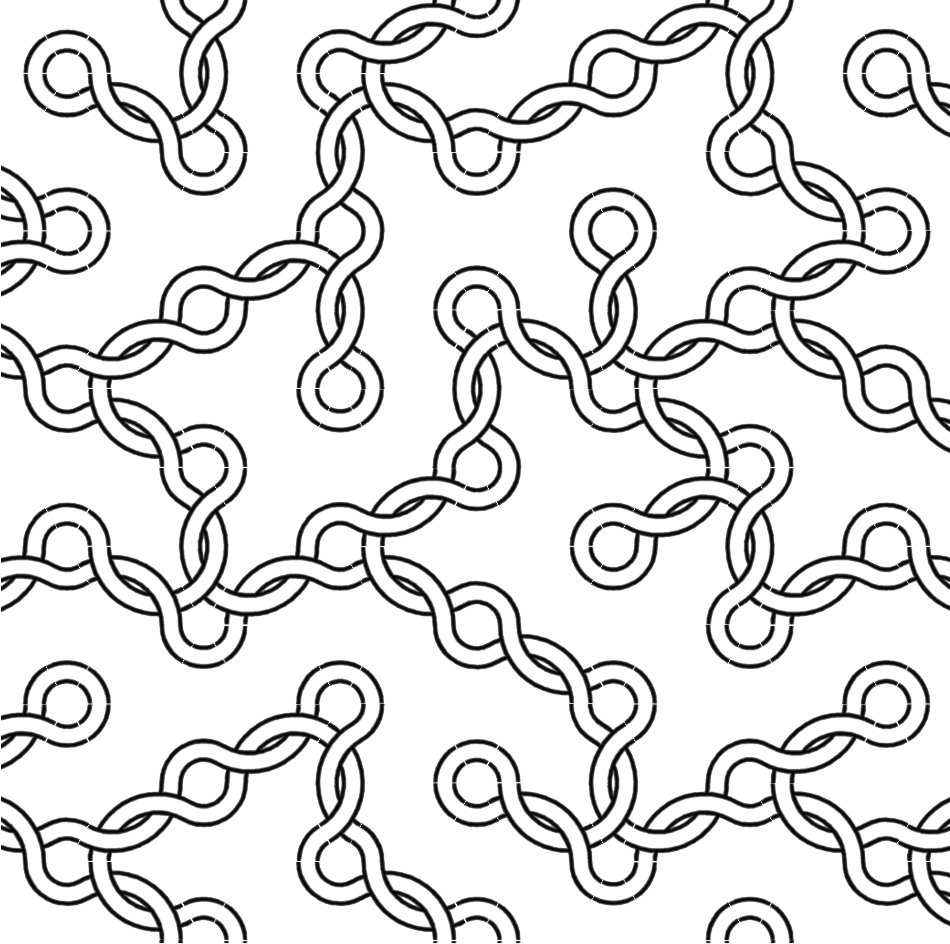
An artistic version of the 3-fold version of the 4-fold Hofstetter 4fold tilings. For details see there.
P Adic Windowed Tiling Polytopal Tiles
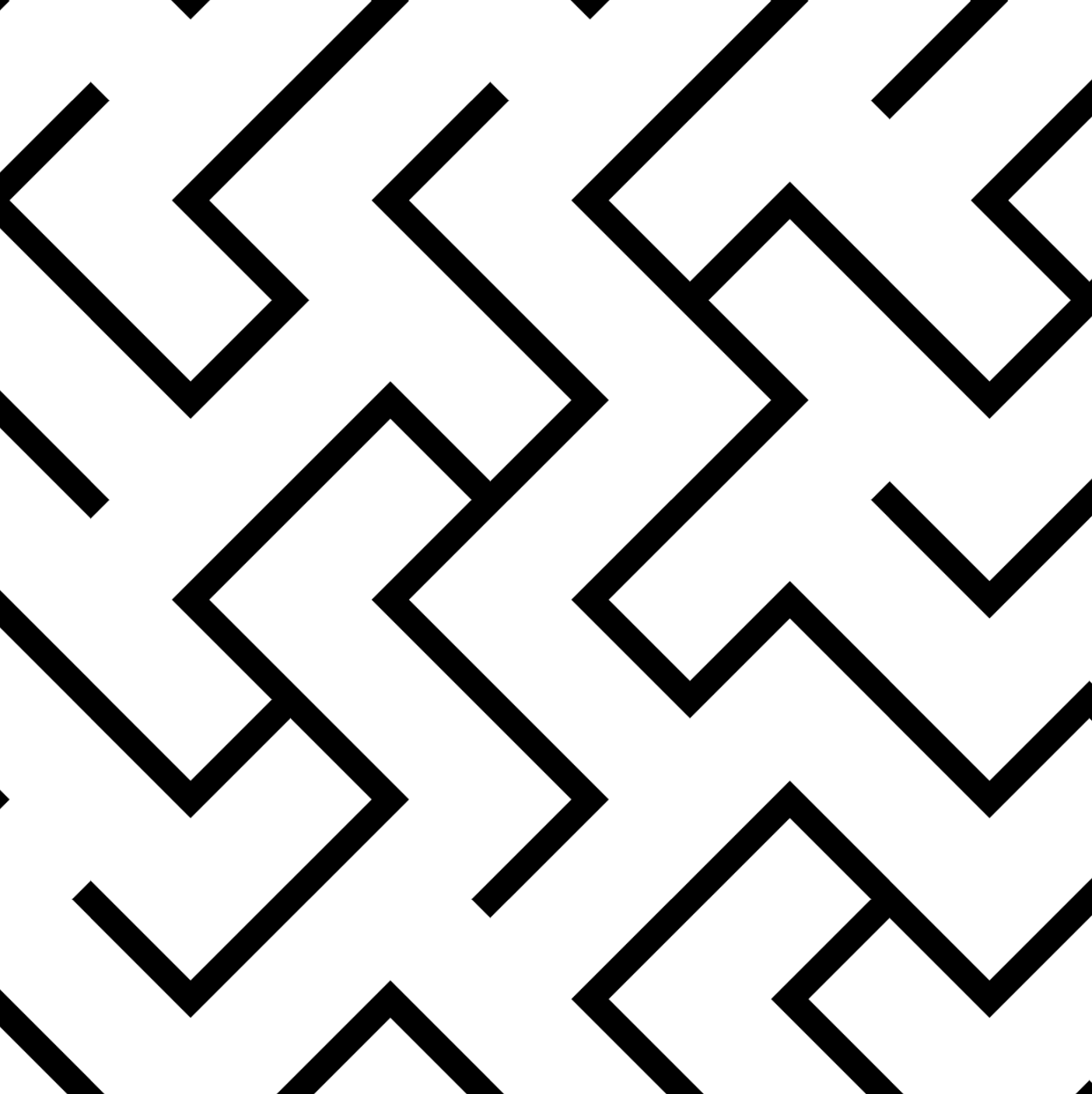
An artistic version of the Hofstetter 4fold tilings. For details see there.
P Adic Windowed Tiling Polytopal Tiles
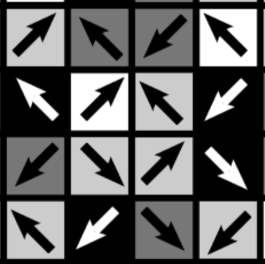
A decorated version of the Hofstetter 4fold tilings. This version can be generated by a proper substitution rule. It was shown in [FH15] that this version is aperiodic, as well as limitperiodic. For more details see Hofstetters 4-fold.
P Adic Windowed Tiling Polytopal Tiles
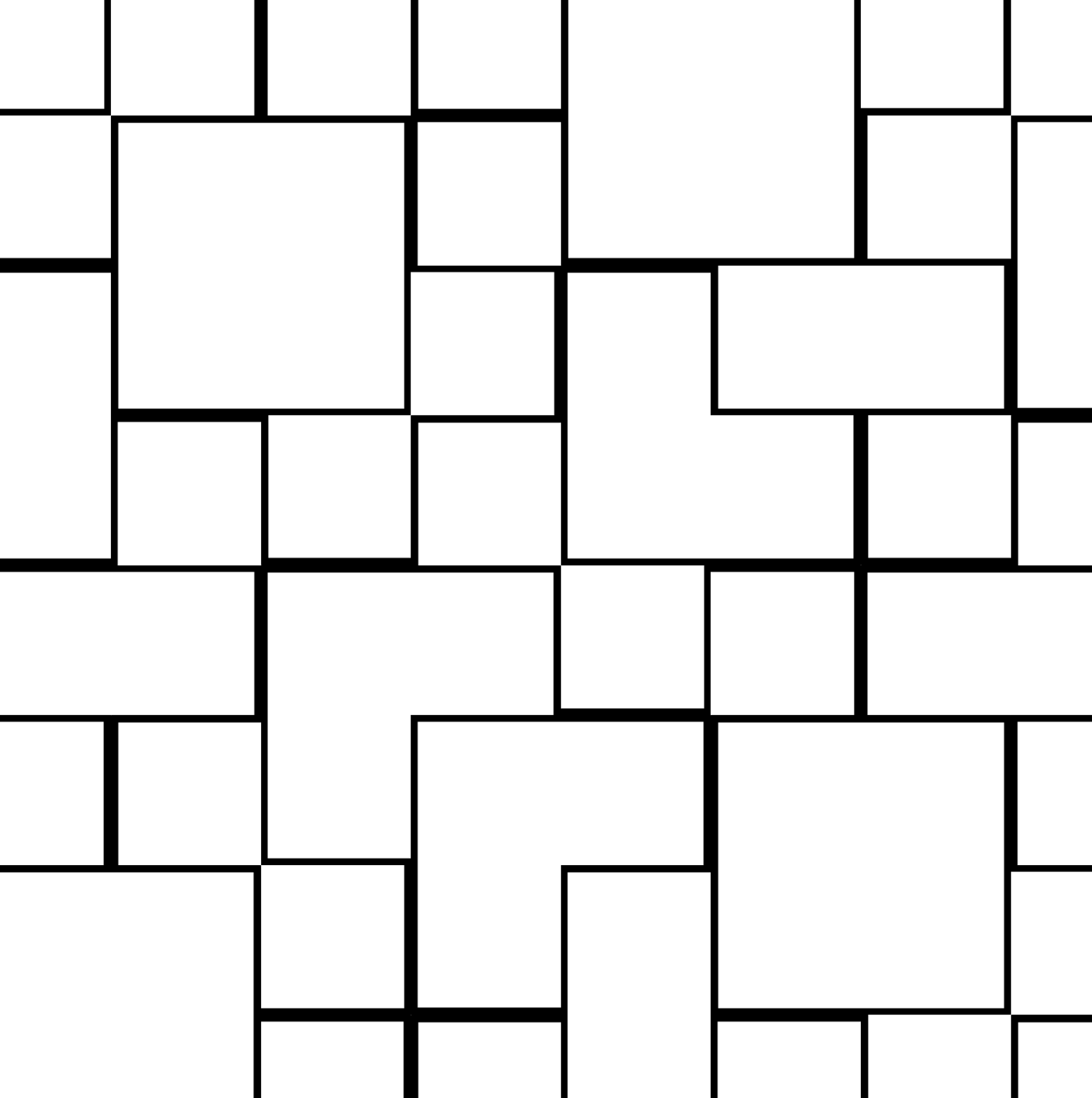
The Viennese Artist Hofstetter Kurt found a new iteration method that produces aperiodic tilings. The idea is illustrated in the figure below: one starts with a single square tile of edge length one. A second square tile of the same size is put below the first one, such that its SW corner is …
P Adic Windowed Tiling Polytopal Tiles
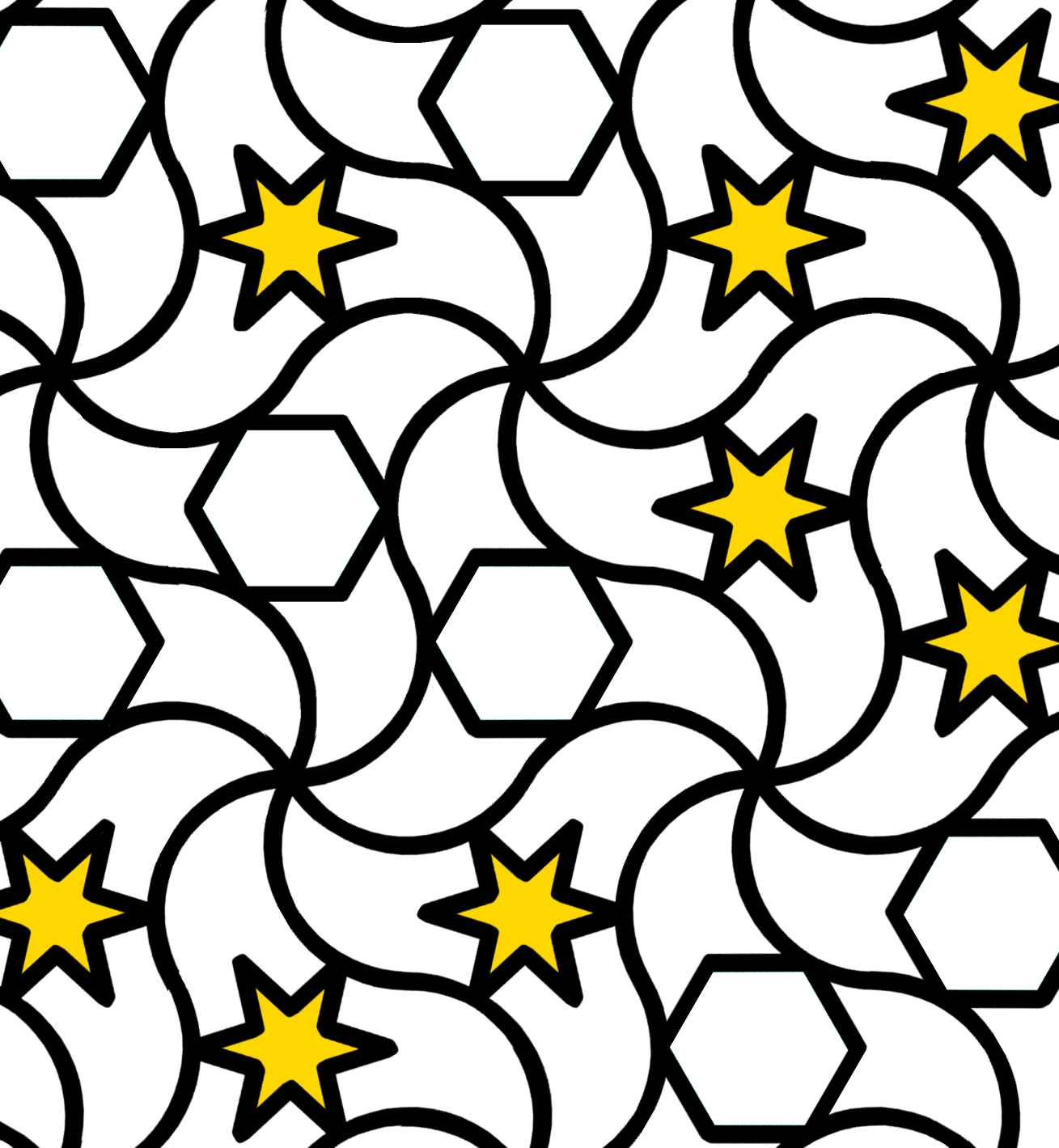
An artistic version of the 6-fold version of the 4-fold Hofstetter 4fold tilings, inspired by islamic patterns. For details see there.
P Adic Windowed Tiling Polytopal Tiles
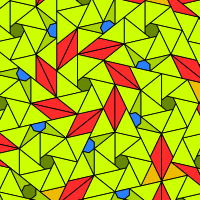
Tiling submitted by Andrew Hudson.
The scaling factor is $\frac{\sin(\frac{3\pi}{n})}{\sin(\frac{\pi}{n})}+\frac{\sin(\frac{2\pi}{n})}{\sin(\frac{\pi}{n})}$.
All tiles appear in one chirality only, so markings were omitted.
Self Similar Substitution Finite Rotations
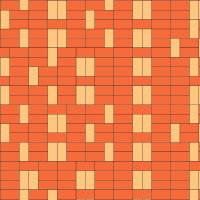
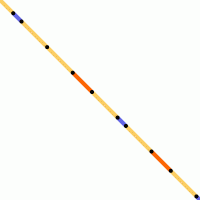
An invertible substitution rule with a disconnected Rauzy Fractal. For two letter substitution rules the Rauzy fractal is connected if and only if the substitution is invertible. In fact as the window is one dimensional for these tilings it is an interval. It was hoped that the connectedness …
One Dimensional Euclidean Windowed Tiling Self Similar Substitution Polytopal Tiles
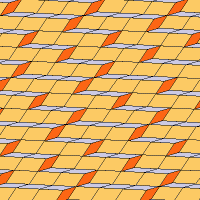
Finite Rotations Euclidean Windowed Tiling Polytopal Windowed Tiling Canonical Substitution Tiling Polytopal Tiles Parallelogram Tiles
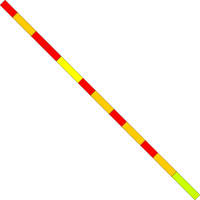
An one-dimensional substitution rule that uses an infinite number of prototiles.
The inflation factor is $2.5$.
The substitution rules are given by:
$T_{0}\rightarrow T_{0},T_{1}$
$T_{1}\rightarrow T_{0},T_{0},T_{2}$
$T_{2}\rightarrow T_{0},T_{1},T_{3}$
$T_{k}\rightarrow T_{0},T_{k-1},T_{k+1}$ …
One Dimensional Self Similar Substitution
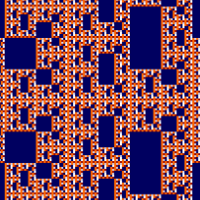
Denote the elements of the field $F_{4}$ by $\{0, 1, w, w + 1\}$, where $w$ satisfies the following equation with coefficients in $F_{2}: w^{2} + w + 1 = 0$.
Infinity is a recurrent double sequence defined by $a(i, 0) = a(0, j) = 1$ and $a(i, j) = f(a(i, j-1), a(i-1, j-1), a(i-1, j))$,
where $f(x, …
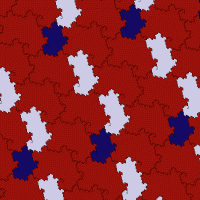
As well as showing that there are substitution rules with any Perron
inflation factor, in [Ken96]
, R. Kenyon
gives an explicit construction for the Perron numbers that satsify:
$xn - a xn-1 + b x + c$, where $a, b$, and $c$ are natural numbers.
This is an example of that method given in that paper. …
Finite Rotations Self Similar Substitution Kenyons Construction
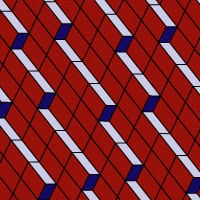
A polygonal version of Kenyon (1,2,1). The boundary is generated by the morphism $a \to b, b \to c, c \to c a' b' b'$ (where $x'$ is the inverse of $x$).
Finite Rotations Polytopal Windowed Tiling Canonical Substitution Tiling Parallelogram Tiles Kenyons Construction
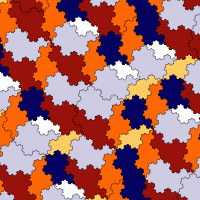
A substitution rule shown on R. Kenyon’s homepage: http://www.math.brown.edu/~rkenyon/gallery/gallery.html with inflation factor that satisfies: $x^4+x+1 = 0$.
Finite Rotations Self Similar Substitution
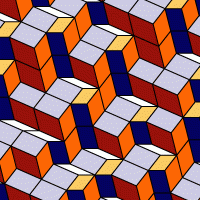
A polygonal version of Kenyon 2. The edges are generated by the morphism: a->b, b->c, c->d, d-> b’a’ (where x’ is the inverse of x).
Finite Rotations Euclidean Windowed Tiling Polytopal Tiles Parallelogram Tiles Kenyon's Construction
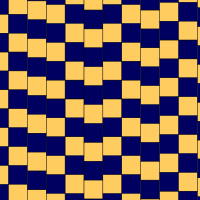
A simple substitution, yielding a tiling which is not of finite local complexity (flc). The substitution maps the single prototile, a unit square, to three columns of three squares each, where the third column is shifted by an irrational amount t. In higher iterates of the substitution, there are …
Polytopal Tiles Parallelogram Tiles Rhomb Tiles
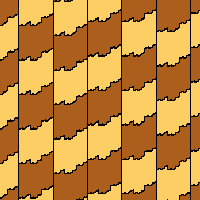
A simple substitution rule, generating tilings which don’t possess flc. The fractally shaped tiles make it a selfsimilar-substitution. Despite the fractal apperance, the dimension of the boundary of the prototile is one almost everywhere: the boundary of the tile consists of lines almost everywhere …
Rep Tiles Self Similar Substitution
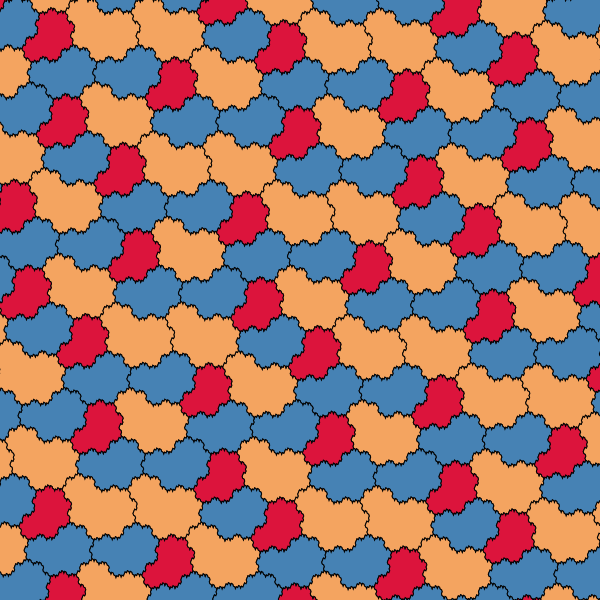
The substitution $a \rightarrow ab, b \rightarrow cb, c \rightarrow a$ is the composition of the one with the smallest PV scaling factor, $a \rightarrow bc, b \rightarrow a, c \rightarrow b$, and its mirror image, $a \rightarrow cb, b \rightarrow a, c \rightarrow b$. As such, it is MLD to its own …
Euclidean Windowed Tiling One Dimensional Self Similar Substitution
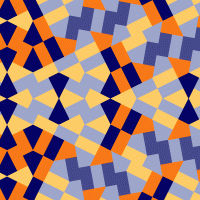
This is a variation of the pinwheel substitution. The kite-domino tilings are mld to the pinwheel tilings. The two prototiles are made of two pinwheel triangles, glued together at their long edge. There are two ways to do so, one gives a kite (a quadrilateral with edge lengths 1,1,2,2) and a domino …
With Decoration Finite Local Complexity Polytopal Tiles Self Similar Substitution Mld Class Pinwheel
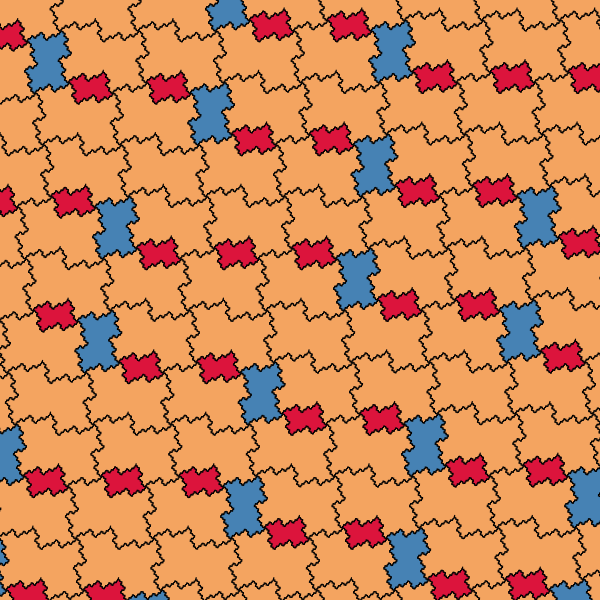
The substitution $a \rightarrow aca, b \rightarrow a, c \rightarrow b$ has palindromic and thus mirror symmetric variant of the Kolakoski-(3,1) substitution, which is in the same MLD class, along with the further variants A (mirror symmetric) and B (with its mirror image). The scaling factor …
Euclidean Windowed Tiling One Dimensional Self Similar Substitution
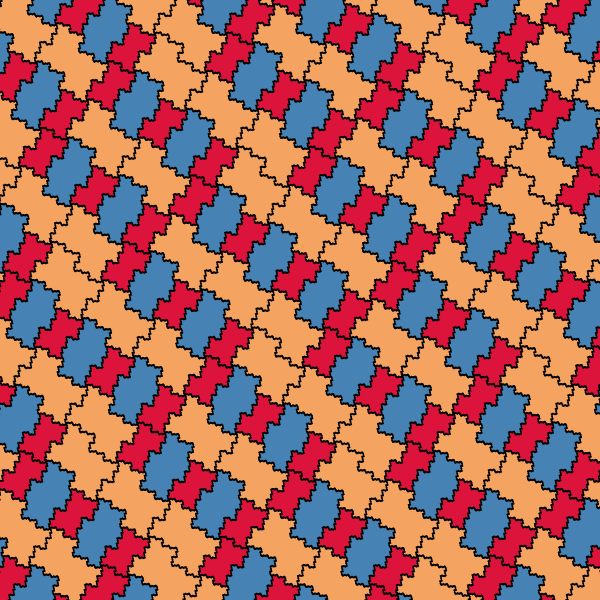
The substitution $a \rightarrow bcc, b \rightarrow ba, c \rightarrow bc$ is a member of the MLD class of the [Kolakoski-(3,1) sequence] (/substitution/kolakoski-3-1/). As the reversed substitution generates the same hull, it is mirror symmetric. The scaling factor $\lambda \approx $ 2.20557 is the …
Euclidean Windowed Tiling One Dimensional Self Similar Substitution
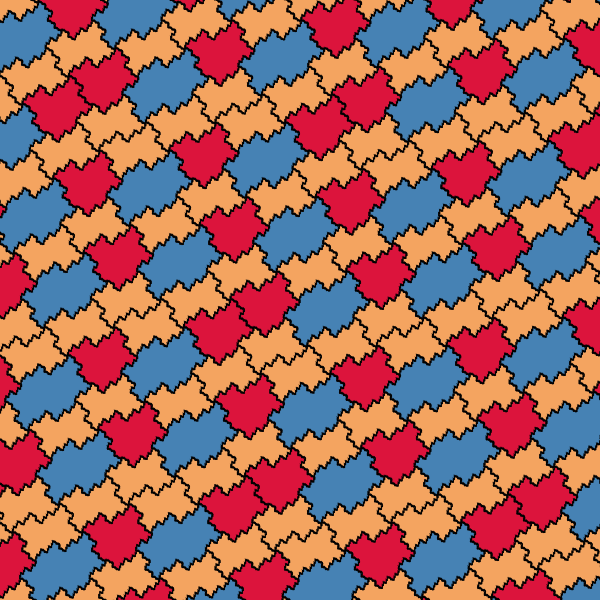
The substitution $a \rightarrow abcc, b \rightarrow a, c \rightarrow bc$ is a member of the MLD class of the [Kolakoski-(3,1) sequence] (/substitution/kolakoski-3-1/). The scaling factor $\lambda \approx $ 2.20557 is the largest root of $x^3-2x^2-1=0$.
This substitution has a simple dual, with three …
Euclidean Windowed Tiling One Dimensional Self Similar Substitution
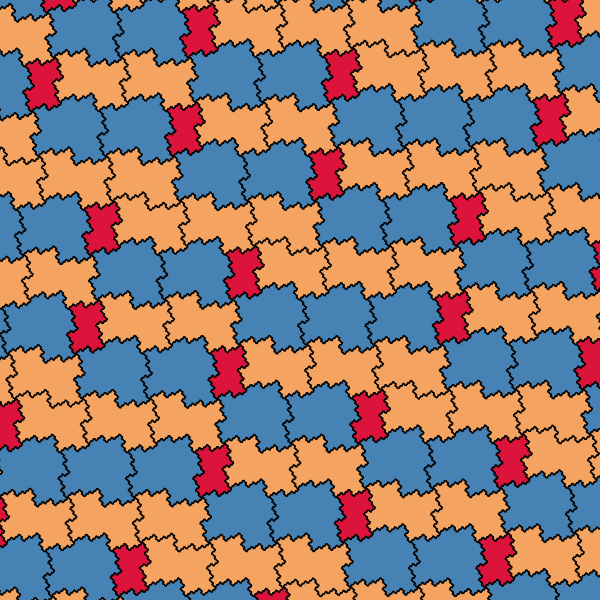
The substitution $a \rightarrow abc, b \rightarrow ab, c \rightarrow b$ is closely related to the Kolakoski-(3,1) sequence, and is one of the examples whose windows (dual tiles, Rauzy fractals) have been analysed in detail [BaS04] . It is MLD to the mirror symmetric variant given by the palindromic …
Euclidean Windowed Tiling One Dimensional Self Similar Substitution
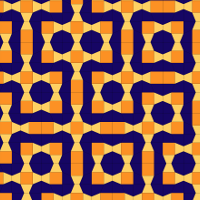
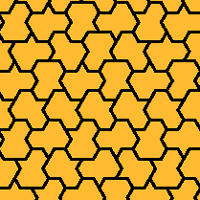
A substitution yielding tilings with statistical 6-fold symmetry, with inflation factor 2. It is not known whether this one is a cut and project tiling or not. If it is, it has necessarily a p-adic internal space.
Finite Rotations Polytopal Tiles
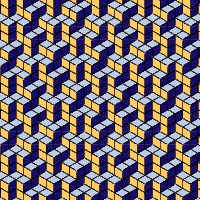
A substitution tiling with inflation factor sqrt(3), using a single prototile, namely a 60º rhomb. The substitution sends one rhomb to seven rhombs (instead of three, as one would expect from the inflation factor), thus the tiles in higher iterations do overlap. But the substitution is chosen in a …
Finite Rotations P Adic Windowed Tiling Polytopal Tiles Parallelogram Tiles Rhomb Tiles
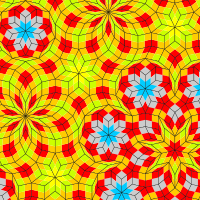
A tiling with 7-fold symmetry and a lot of locally 7-fold symmetric
patches. There are only three tile shapes, but nine different
prototiles. The inflation factor
is a PV number:
$2+2\cos\left(\frac{\pi}{7}\right)+2\cos\left(\frac{2\pi}{7}\right) = 5.04891733952231\ldots$
which is the largest root of $x^{3}-6x^{2}+5x-1$.
Polytopal Tiles Self Similar Substitution Finite Local Complexity Rhomb Tiles Finite Rotations
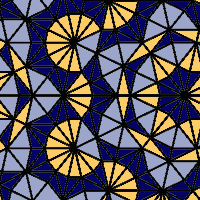
A substitution for three triangular prototiles, based on 7-fold symmetry.
The lengths of the edges of the tiles are $\sin(\frac{\pi}{7})$, $\sin(\frac{2\pi}{7})$, $\sin(\frac{3\pi}{7})$.
These tilings are essentially different from Danzer’s 7-fold examples, see for instance Danzer’s 7-fold.
Finite Rotations Polytopal Tiles Self Similar Substitution Finite Local Complexity
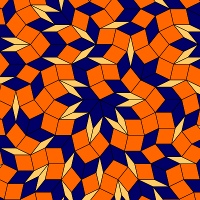
Finite Rotations Polytopal Tiles Self Similar Substitution Rhomb Tiles Finite Local Complexity
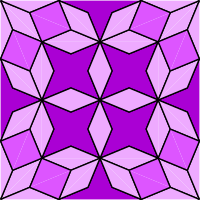
J. Millar discovered a set of tilings with patches of dihedral symmetry $D_2n$ and inflation multiplier $\sqrt{2 + 2 \cos(\frac{\pi}{n})}$, which is the same inflation multiplier as of the Generalized Godreche-Lancon-Billard Binary.
All interior angles of all prototiles are integer multiples of …
Finite Rotations Polytopal Tiles Finite Local Complexity
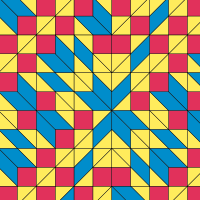
A simple substitution rule, using three Tangram pieces as prototiles.
Finite Rotations Polytopal Tiles Self Similar Substitution
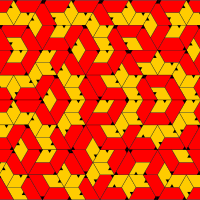
The Monnier Trapezium and Diamond tiling uses two prototiles,
a trapezium and a rhomb. The inflation multiplier is $2$.
By changing the chiralities of the prototiles within the first level
supertiles several further variants can be derived.
Finite Local Complexity Polytopal Tiles Self Similar Substitution With Decoration Limitperiodic
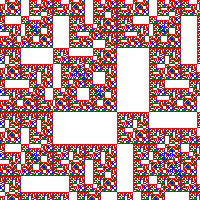
Denote the elements of the field $F_{4}$ by $\{0, 1, w, w + 1\}$, where $w$ satisfies the following equation with coefficients in $F_{2}: w^{2} + w + 1 = 0$.
Mothman is a recurrent double sequence defined by $a(i, 0) = a(0, j) = 1$ and
$a(i, j) = f(a(i, j-1), a(i-1, j-1), a(i-1, j))$,
where $f(x, y, …
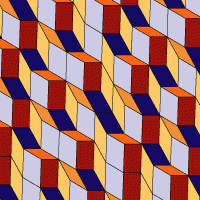
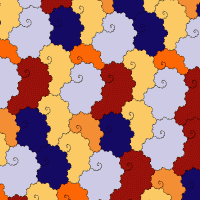
A volume hierarchic version of Nautilus
Finite Rotations Euclidean Windowed Tiling Self Similar Substitution
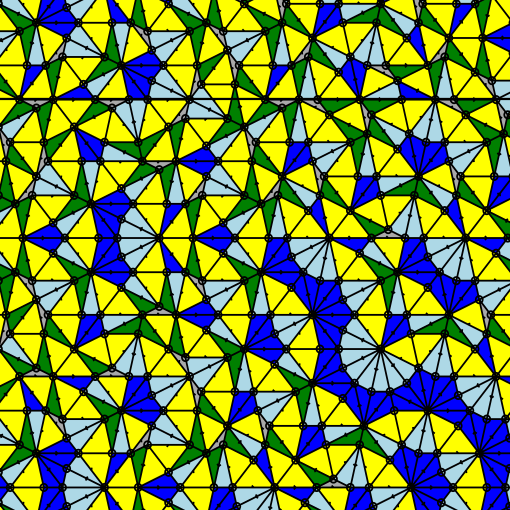
The Nischke-Danzer-Deltoid 7-fold-2-1 was discussed and derived in [ND96] .
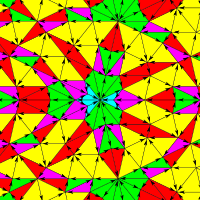
The Nischke-Danzer-Deltoid 7-fold-2-2 was discussed and derived in [ND96] but not shown. A figure with the tiling can be found in [Pau2017] .
Polytopal Tiles Self Similar Substitution Finite Local Complexity Finite Rotations Nischke Danzer Deltoid
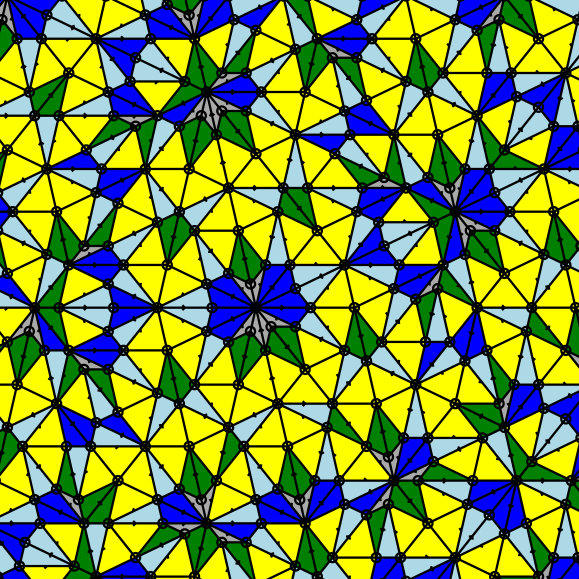
The Nischke-Danzer-Deltoid 7-fold-3-1 was discussed and derived in [ND96] .
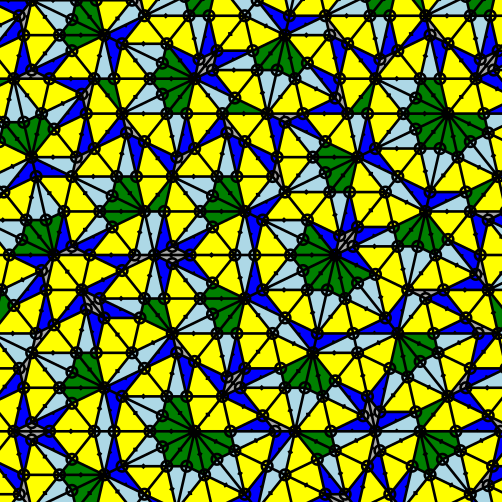
The Nischke-Danzer-Deltoid 7-fold-3-2 was discussed and derived in [ND96] .
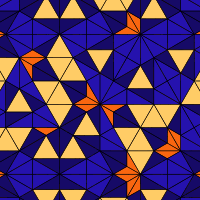
The Nischke-Danzer-Deltoid 6-fold-2-2 was discussed and derived in [ND96] .
Polytopal Tiles Self Similar Substitution Finite Local Complexity Finite Rotations Nischke Danzer Deltoid Limitperiodic

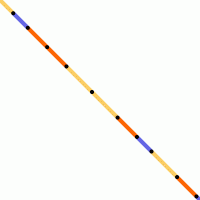
A companion to infinite component Rauzy fractal. As mentioned for that rule, it was hoped that the result for two symbol substitution rules that the window is connected if and only if the rule is invertible. This substitution rules is not invertible and yet the Rauzy fractal is connected:
Euclidean Windowed Tiling One Dimensional Polytopal Tiles Self Simmilar Substitution
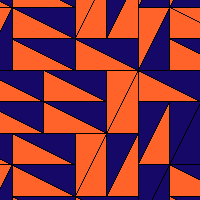
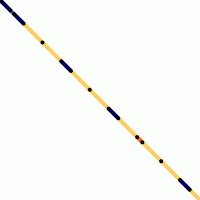
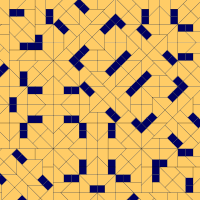
A substitution tiling with statistical eight-fold symmetry. This example answers a question of L. Danzer, whether there is a substitution tiling with substitution matrix with entries 1,2,2,5.
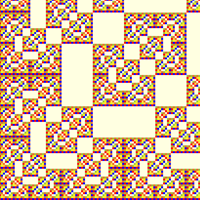
Denote the elements of the field $F_4$ by $\{0, 1, w, w + 1\}$, where $w$ satisfies the following equation with coefficients in $F_2: w2 + w + 1 = 0$.
Open Peano is a recurrent double sequence defined by $a(i, 0) = a(0, j) = w + 1$ and $a(i, j) = f(a(i, j-1), a(i-1, j-1), a(i-1, j))$, where $f(x, y, …
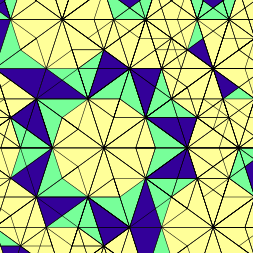
A substitution rule where the tiles are allowed to overlap. The image left indicates, that the yellow and the green tiles do overlap. It is unknown whether these tilings are mld to the Penrose Rhomb tilings.
Finite Rotations Euclidean Windowed Tiling Polytopal Tiles
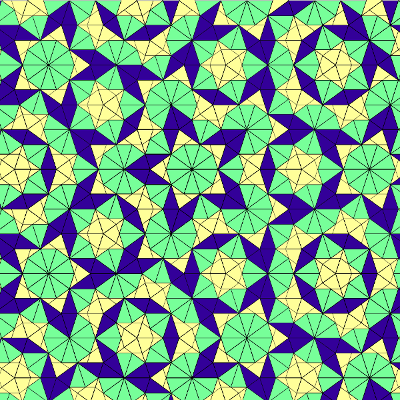
As Overlapping Robinson Triangles I, this is a variant of the Penrose Rhomb tiling, using only one prototile, and the tiles are allowed to overlap. Here, the overlap happens after applying the substitution rule twice on one tile.
Finite Rotations Polytopal Tiles
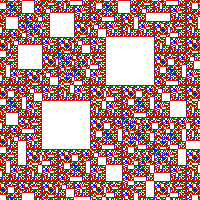
Denote the elements of the field $F_4$ by $\{0, 1, w, w + 1\}$, where $w$ satisfies the following equation with coefficients in $F_2: w^2 + w + 1 = 0$.
Pairs of Squares is a recurrent double sequence defined by $a(i, 0) = a(0, j) = 1$ and $a(i, j) = f(a(i, j-1), a(i-1, j-1), a(i-1, j))$,
where $f(x, …
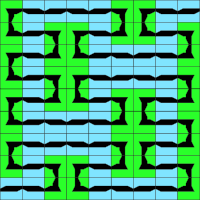
The Peano Curve is one the earliest known FASS-curves. The original algorithm in [pea1890] bases on one substitution rule and an additional rule which describes how the substitutes have to be connected. As briefly mentioned in [pau2021] it is also possible to create the Peano Curve by a …
Finite Local Complexity Polytopal Tiles Self Similar Substitution With Decoration Limitperiodic FASS_curve
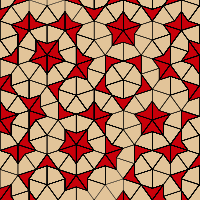
A classic, using a kite (blue) and a dart (orange) as prototiles. See Penrose Rhomb for more details.
Without Decoration Finite Rotations Polytopal Windowed Tiling Polytopal Tiles Mld Class Penrose
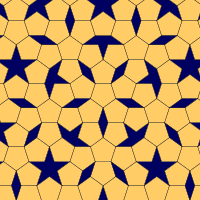
One manifestation of the famous Penrose tilings. In fact, this is the first manifestation found by Penrose, the Penrose rhomb, the Penrose kite-dart and the Robinson triangle tilings are refinements of this one. (You may also click ‘Penrose’ below ‘MLD-class’ above to see the others.) Their …
Finite Rotations Polytopal Tiles Mld Class Penrose
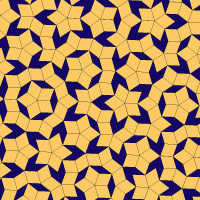
Certainly the most popular substitution tilings. Discovered in 1973 and 1974 by R. Penrose in - at least - three versions (Rhomb, Penrose kite-dart and Penrose Pentagon boat star), all of them forcing nonperiodic tilings by matching rules. It turns out that the three versions are strongly related: …
Without Decoration Finite Rotations Polytopal Windowed Tiling Canonical Substitution Tiling Rhomb Tiles Mld Class Penrose Matching Rules
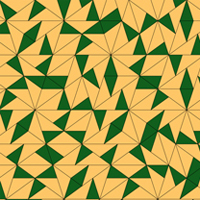
A simple variant of the Robinson triangle substitution. This substitution uses no reflections. The resulting tilings are not longer vertex-to-vertex, but still flc.
Finite Rotations Polytopal Tiles Self Similar Substitution
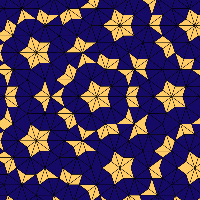
The Robinson Triangle substitution is just one out of several possibilities to play with the triangle versions of the Penrose tilings. Another one is the Tübingen Triangle substitution. Here is an example where the obtuse triangle is the smaller prototile, and the acute triangle is the larger one. …
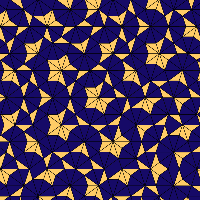
The Robinson Triangle substitution is just one out of several possibilities to play with the triangle versions of the Penrose tilings. Another one is the Tübingen Triangle substitution. Here is an example where the obtuse triangle is the smaller prototile, and the acute triangle is the larger one. …
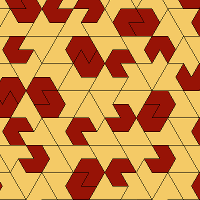
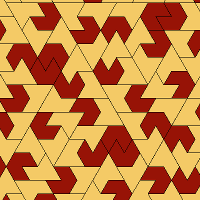
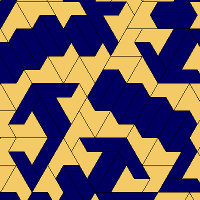
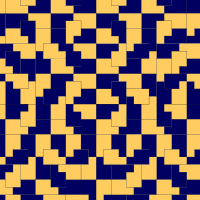
A substitution arising from a polyomio rep-tile. This one is made of five unit squares, thus the name. The tiles are coloured blue or ochre, according to their chirality (left-handed vs right-handed).
Finite Rotations Polytopal Tiles Polyomio Tilings Rep Tiles Self Similar Substitution
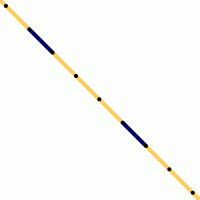
In some sense, the simplest cut and project tiling. It arises from the symbolic substitution a -> ab, b -> aa. Its internal space are the 2-adic integers.
P Adic Windowed Tiling One Dimensional Rep Tiles Self Similar Substitution
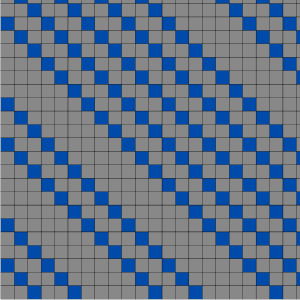
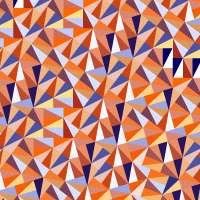
This substitution tiling is the example of substitution tilings with infinite rotations. Its statistical and dynamical properties were studied in several papers by C. Radin, see for instance [Rad92] , [Rad97] . In particular, it was shown that the orientations of triangles in the pinwheel tiling are …
With Decoration Finite Local Complexity Saduns Generalised Pinwheels Polytopal Tiles Self Similar Substitution Mld Class Pinwheel Infinite Rotations
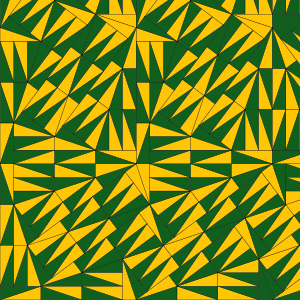
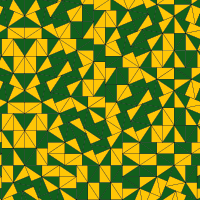
The pinwheel tiling has several straight forward variants. Here is one with 13 tiles.
Finite Rotations Polytopal Tiles Self Similar Substitution
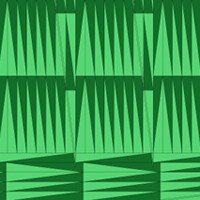
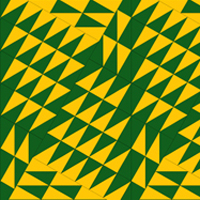
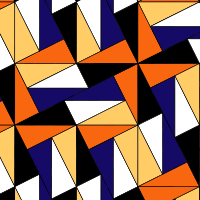
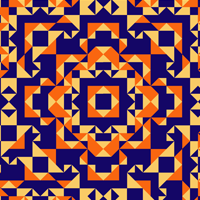
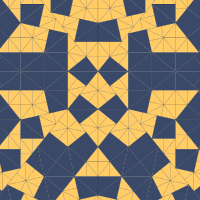
One member of an infinite series of tilings generated by a more general construction than a tile-substitution, [Sad98]. In particular, Sadun’s construction yields tilings with infinitely many prototiles, as well as with finitely many prototiles. Each tiling in this series is described by two …
Infinite Rotations Infinite Local Complexity Saduns Generalised Pinwheels Polytopal Tiles Self Similar Substitution
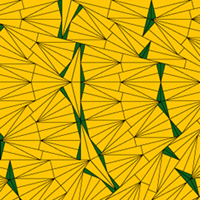
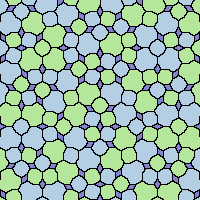
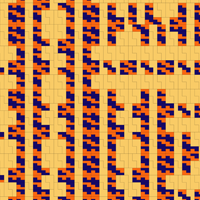
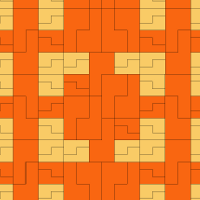
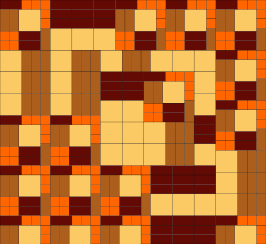
A plane substitution tiling which does not possess flc. It arises from the 1-dimensional substitution a -> abbb, b -> a, which inflation factor is not a PV-number. In the last sentence, ‘arises’ is to be understood as follows: Whenever one has a 1-dimensional substitution, it defines a d-dimensional …
Polytopal Tiles Parallelogram Tiles Self Similar Substitution

A variation of the Robinson Triangle substitution where the tiles are decorated in order to produce striking visual effects. The idea came from the design of Aperiodic 2012 in Cairns, Australia. Other variants can be found in psychedelic-penrose-variant-2, psychedelic-penrose-variant-3, …
Finite Rotations Polytopal Tiles Self Similar Substitution

A variation of the Robinson Triangle substitution where the tiles are decorated in order to produce striking visual effects. The idea came from the design of Aperiodic 2012 in Cairns, Australia. Other variants can be found in psychedelic-penrose-variant-1, psychedelic-penrose-variant-3, …
Finite Rotations Polytopal Tiles Self Similar Substitution

A variation of the Robinson Triangle substitution where the tiles are decorated in order to produce striking visual effects. The idea came from the design of Aperiodic 2012 in Cairns, Australia. Other variants can be found in psychedelic-penrose-variant-1, psychedelic-penrose-variant-2, …
Finite Rotations Polytopal Tiles Self Similar Substitution

A variation of the Robinson Triangle substitution where the tiles are decorated in order to produce striking visual effects. The idea came from the design of Aperiodic 2012 in Cairns, Australia. Other variants can be found in psychedelic-penrose-variant-1, psychedelic-penrose-variant-2, …
Finite Rotations Polytopal Tiles Self Similar Substitution

A variation of the Robinson Triangle substitution where the tiles are decorated in order to produce striking visual effects. The idea came from the design of Aperiodic 2012 in Cairns, Australia. Other variants can be found in psychedelic-penrose-variant-1, psychedelic-penrose-variant-2, …
Finite Rotations Polytopal Tiles Self Similar Substitution
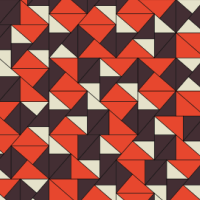
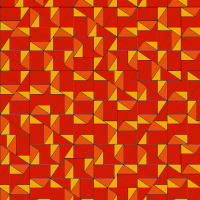
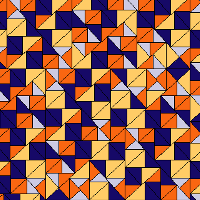
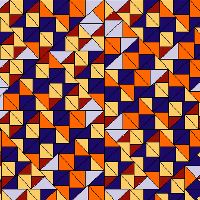
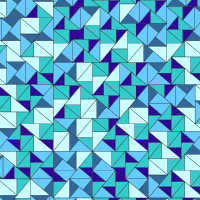
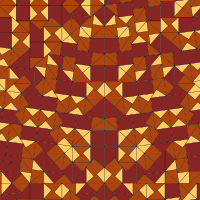
A simple example of an infinite series of substitutions with tilings of statistical circular symmetry. It is shown in [Frettloeh:STWCS not found], that all tilings in this series posses statistical circular symmetry. The substitution factors are $s2m$, where s is the largest root of $xm-xk-1$. Each …
Finite Local Complexity Polytopal Tiles Self Similar Substitution
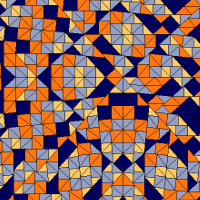
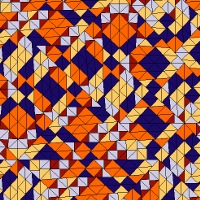
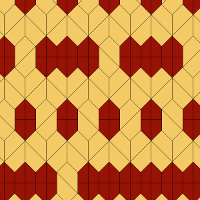
A variant of semi-detached house. In contrast to the latter, this one is a model set with p-adic internal space.
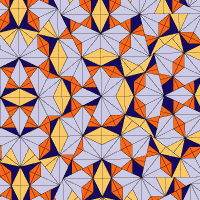
One of the rare examples of a tiling where the prototiles occur in infinitely many orientations. Apart from the pinwheel tiling and its generalizations [Sad98] there are only a few examples known which show infinite rotations.
The inflation factor of this one is a complex algebraic PV number of …
Infinite Rotations Infinite Local Complexity Polytopal Tiles Self Similar Substitution
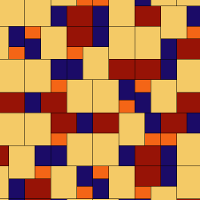
Imagine a rectangle which can be decomposed into three proportional rectangles. The three rectangles have different sizes. The smallest one has the same orientation as the primitive rectangle. The other two rectangles have a 90 degrees with respect to the large rectangle. Starting with the smallest …
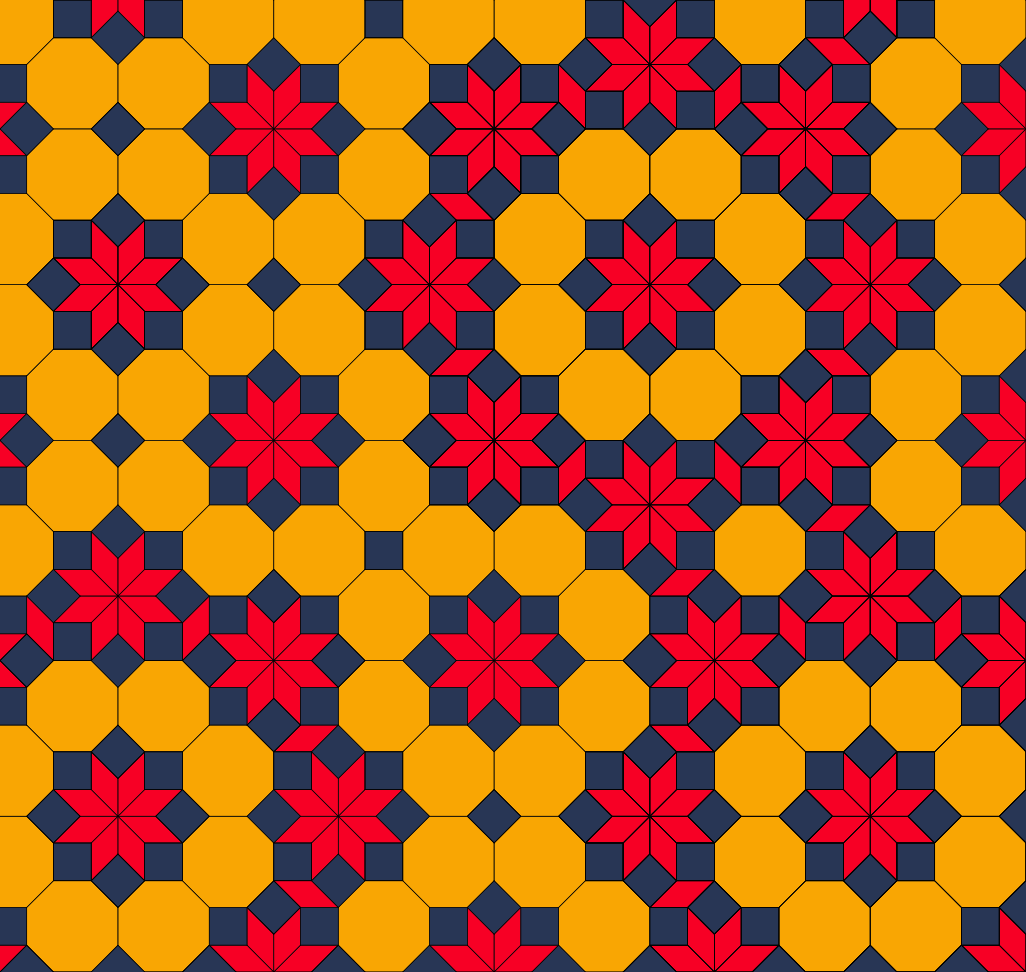
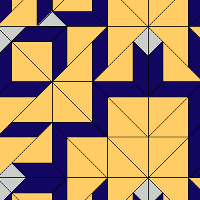
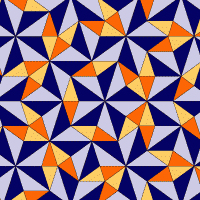
A variation of the Penrose rhomb tilings, suggested by R. M. Robinson. The rhombs are cut into triangles, thus making the substitution volume hierarchic. Thus, this one is obviously mld with the other Penrose tilings. For more details, see Penrose rhomb tilings. Each triangle comes either left- or …
Without Decoration Finite Rotations Polytopal Windowed Tiling Polytopal Tiles Self Similar Substitution Mld Class Penrose Generalized Robinson Triangles
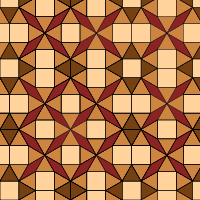
A substitution rule for a tiling with prototiles based on 12-fold dihedral symmetry. However, the tilings show only 4-fold dihedral symmetry. In contrast to the usual suspects related to 12-fold symmetry, like the shield tilings or the Socolar tilings, the inflation factor of this one is not an …
Finite Rotations Polytopal Tiles
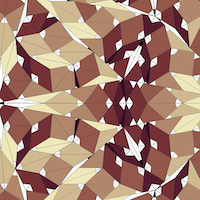
A substitution rule that gives rise to a non-periodic tiling $\mathcal{T}_{17}$ with $17$-fold dihedral symmetry. The substitution factor is $\mu_{17}=1/(2\sin(\pi/34))$.
The tiling $\mathcal{T}_{17}$ is obtained by assigning orientations to relevant tiles in the 1-order supertiles to ensure the …
Finite Rotations Polytopal Tiles Self Similar Substitution Generalized Robinson Triangles
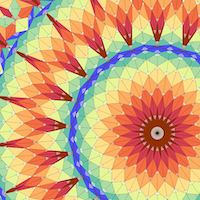
The substitution rule is similar to Say-awen 17-fold. It is invariant under $21-$fold dihedral symmetry and has infinite local complexity. The substitution factor is $\mu_{21}=1/(2\sin(\pi/42))$, which is non-Pisot with minimal polynomial $p_{21}(x)=x^6-8x^5+8x^4+6x^3-6x^2-x+1$.
Finite Rotations Polytopal Tiles Self Similar Substitution Generalized Robinson Triangles
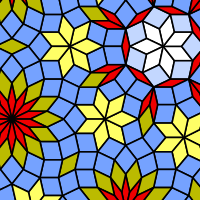
Schaad’s 7-fold is a variation of Madison’s 7-Fold, hence it shares many properties with it. It allows for tilings with global 7-fold symmetry and a lot of locally 7-fold symmetric patches. There are three tile shapes, but only seven instead of nine different prototiles. The inflation factor is a PV …
Polytopal Tiles Self Similar Substitution Finite Local Complexity Rhomb Tiles Finite Rotations
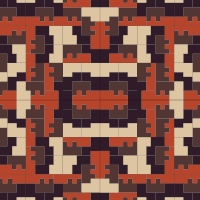
A substitution tiling using four different prototiles, as described by [LS12].
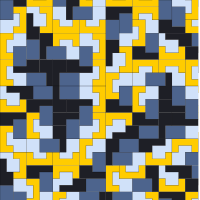
A substitution tiling using four different prototiles, as described by [LS12].
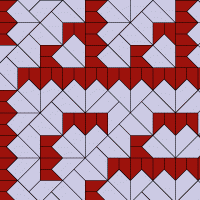
A simple substitution rule with inflation factor 2, using two prototiles only. A glimpse on the image hopefully explains the name. The translation module is a square lattice, which is a hint that the semi-detached house tilings may be a model set with p-adic internal space. This question (model set or not) was raised in [Fre02] and was answered in [FS] .
Finite Rotations Polytopal Tiles Self Similar Substitution
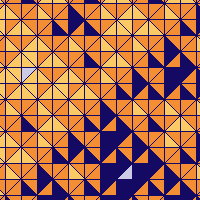
This one is mld to the semi-detached house tiling. A view at the latter (hopefully) explains the name. This version was realized in order to prove (or disprove) that the semi detached house tiling is a cut and project tiling with p-adic internal space. This is not the case, as was shown in [FS].
Finite Rotations Polytopal Tiles Parallelogram Tiles Rhomb Tiles Self Similar Substitution
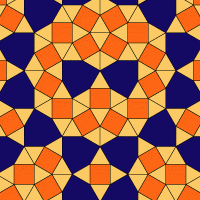
In connection with physical quasicrystals, the most interesting 2dim tilings are based on 5-, 8-, 10- and 12-fold rotational symmetry. This 12-fold tiling was studied by F. Gähler, in particular its cut and project scheme, the local matching rules and diffraction properties [Gah88]. The window of …
With Decoration Finite Rotations Euclidean Windowed Tiling Polytopal Windowed Tiling Polytopal Tiles Mld Class Shield and Socolar Matching Rules
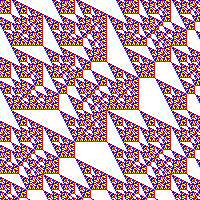
Denote the elements of the field $F_4$ by $\{0, 1, w, w + 1\}$, where $w$ satisfies the following equation with coefficients in $F_2: w^2 + w + 1 = 0$.
Single Bat is a recurrent double sequence defined by $a(i, 0) = a(0, j) = 1$ and $a(i, j) = f(a(i, j-1), a(i-1, j-1), a(i-1, j))$,
where $f(x, y, z) …
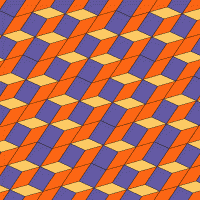
Finite Rotations Euclidean Windowed Tiling Polytopal Tiles Polytopal Windowed Tiling Canonical Substitution Tiling Parallelogram Tiles Plastic Number
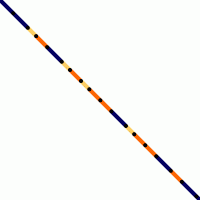
The three letter substitution rule whose scaling is the smallest PV number, the Plastic Number which is a root of the polynomial $x^3 - x - 1 = 0$.
Though it might not look it at first glance, the Rauzy fractal is connected.
This can be shown using the method of A. Siegel described in [Sie04].
The Rauzy fractal:
One Dimensional Euclidean Windowed Tiling Self Similar Substitution Polytopal Tiles Plastic Number
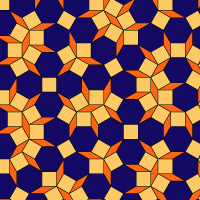
In connection with physical quasicrystals, the most interesting 2dim tilings are based on 5-, 8-, 10- and 12-fold rotational symmetry. This 12-fold tiling was studied thoroughly in [Soc89], where J. Socolar described the generating substitution as well as the local matching rules and the cut and …
Euclidean Windowed Tiling Polytopal Windowed Tiling Polytopal Tiles Parallelogram Tiles Canonical Substitution Tiling Mld Class Shield and Socolar Matching Rules
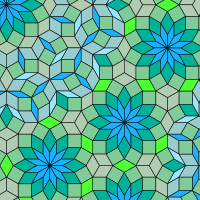
Socolar found the basis for this tiling already in 1987, but recently added a substitution tiling. An interesting feature is that there exists a context-independent Ammann bar decoration of the tiles, similar to the one in the original Socolar 12-fold but with different relative phases, and hence a fairly simple set of matching rules.
Polytopal Tiles
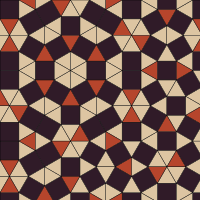
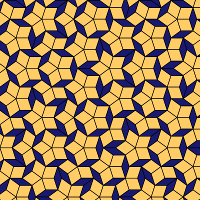
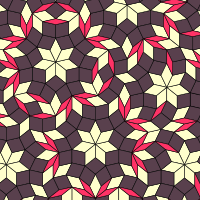
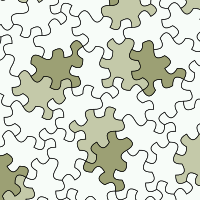
The Spectre tiling was derived from the Hat tiling. While the aperiodic monotiles of the Hat tiling appear in two chiralities, the aperiodic monotiles of the Spectre tiling have the same chirality. As the Hat tiling this one is also not really a substitution tiling.
The patch was generated with the …
Aperiodic Monotile
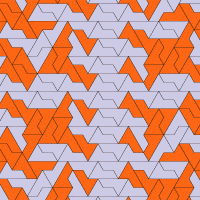
A classical example of a substitution with inflation factor 2. It arises from the well-known related rep-tile. It is not easy to see that this one is limitperiodic. This was shown in [LM01] , thus this one is a cut and project tiling, and therefore pure point diffractive. The prototile is not mirror …
With Decoration Finite Rotations P Adic Windowed Tiling Polytopal Tiles Rep Tiles Self Similar Substitution
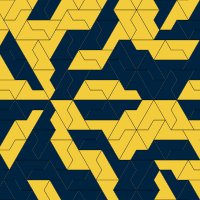
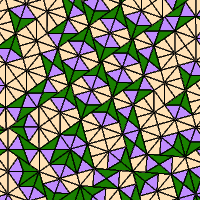
A substitution rule with inflation factor $\sqrt{6}$, using three triangles as prototiles.
Like the pinwheel tilings, one of the first examples showing statistical circular symmetry,
but being flc w.r.t. Euclidean motions.
Infinite Rotations Finite Local Complexity Polytopal Tiles Self Similar Substitution
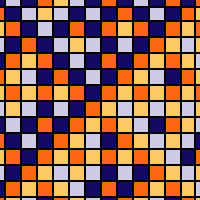
MLD to the more popular chair tiling, this version allows a simple translation into a coloured lattice: Replace each square of type i (1,2,3, or 4) with its midpoint, and assign to it colour i. Then each set of all points of colour i is a model set with internal p-adic space with p=2. This was first shown in [BMS98], a general framework is given in [LMS03].
With Decoration Finite Rotations P Adic Windowed Tiling Polytopal Tiles Self Similar Substitution Parallelogram Tiles Rhomb Tiles Mld Class Chair
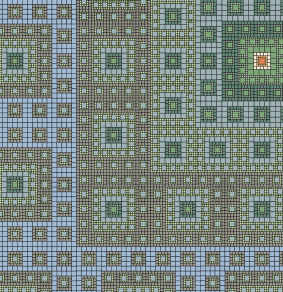
Nowadays (2019) there are several generalizations of a tile substitution. One was introduced already in Sad98 Even though his idea produces a welath of examples, most of these have not yet been well studied.
The idea is to give a rule how to substitute a prototile and apply this rule always to the …
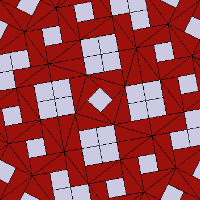
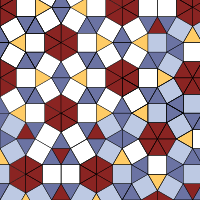
The substitution tilings which are most relevant as models for physical quasicrystals are 5-fold, 8-fold, 10-fold and 12-fold symmetric ones. In the 5-fold (resp. 10-fold) case, there are the variations of the Penrose rhomb tilings and the Tuebingen triangle, for the 8-fold case there are the …
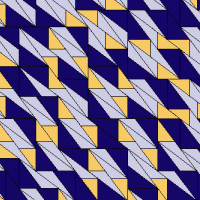
One possible version of a substitution rule with a free parameter: The upper tip of the three triangles can be shifted arbitrarily in horizontal direction, the result is always a self-similar substitution.
The inflation multiplier is the smallest PV number, the Plastic Number which is a root of the polynomial $x^3 - x - 1 = 0$.
Self Similar Substitution Polytopal Tiles Plastic Number
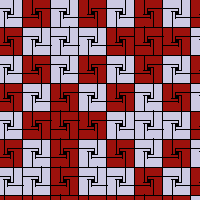
This substitution arises from a reptile with infinitely many straight edges, cf. [GS87]. It answers the question ‘Are there selfsimilar substitution tilings where the prototiles have infinitely many straight edges?’ positively. The colours of the tiles indicate their chirality. The substitution rule …
Finite Rotations Rep Tiles
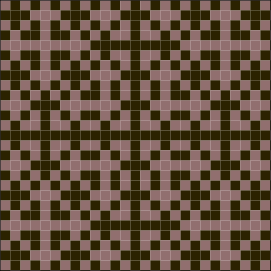
This is the block version of the Squiral tiling. The graphic was created by Leif Borgstedt.
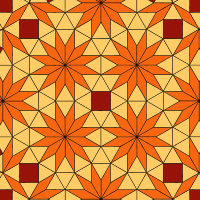
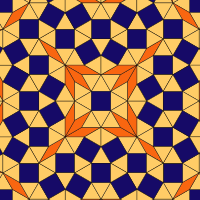
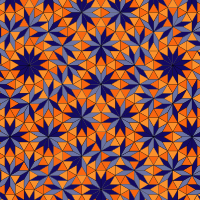
A 12-fold substitution tiling without squares (most other 12-fold tilings do use squares, search for “12-fold” to see them).
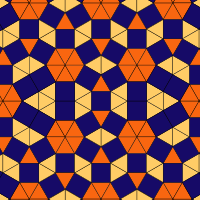
A substitution rule for a tiling with prototiles based on 12-fold dihedral symmetry. However, the tilings show only 6-fold dihedral symmetry, in contrast to the usual suspects related to 12-fold symmetry, like the shield tilings or the Socolar tilings.
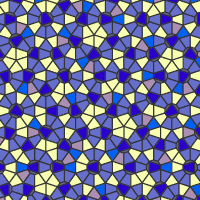
A substitution tiling with six trapezoidal prototiles. The substitution rule is given for only five of the six tiles. The sixth tile (yellow) is substituted by nothing.
The discoverer gives credits to Veit Elser for suggesting the shape of the tiles.
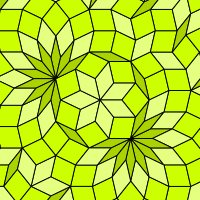
J. Kari and M. Rissanen derived a set of rhomb substitution tilings in [KR2016] with n-fold dihedral symmetry.
- All substitution rules have dihedral
$D_{2}$symmetry. - All edges of the substitution rules are equal and also have dihedral
$D_{2}$symmetry. - All interior angles of all prototiles are …
Polytopal Tiles Self Similar Substitution Finite Local Complexity Finite Rotations Rhomb Tiles
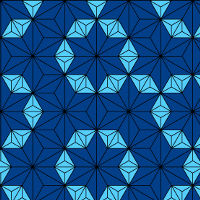
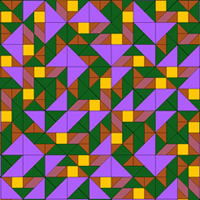
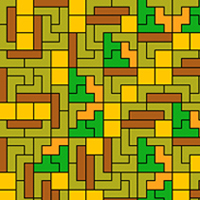
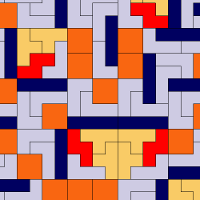
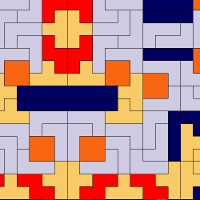
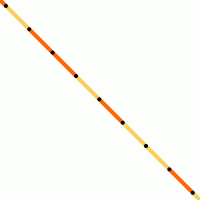
A classic. A lot of detail can be found in [JS99].
One Dimensional Self Similar Substitution
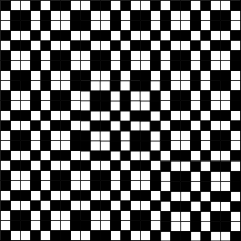
This is the 2D version of the one-dimensional Thue Morse tiling due to Shelomo Ben-Abraham et.al. The graphic was created by Leif Borgstedt.
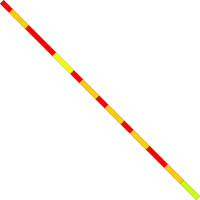
An one-dimensional substitution rule that uses an infinite number of proto tiles and yields a transcendental inflation multiplier.
The inflation factor is approximately $2.7899$.
The substitution rules are given by:
$T_{0}\rightarrow T_{0},T_{1}$
$T_{1}\rightarrow 3T_{0},T_{2}$
$T_{2}\rightarrow …
One Dimensional Self Similar Substitution
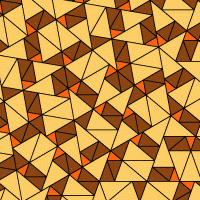
One example in a series of substitutions with inflation factor $\sqrt{s}$, where $s^m-s^k-1=0$.
The parameters m and k are arbitrary integers with m>k, m>2, k>0.
It seems that all these tilings show statistical circular symmetry. Click on ‘Infinite rotations’ above in order to see more examples of …
Infinite Rotations Finite Local Complexity Polytopal Tiles Self Similar Substitution
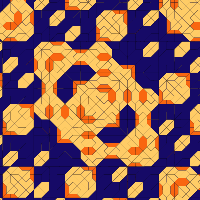
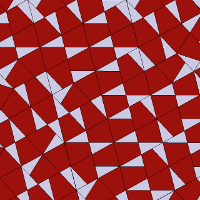
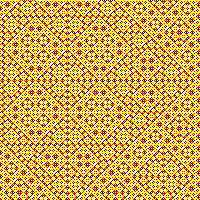
Denote the elements of the field $F_4$ by $\{0, 1, w, w + 1\}$, where $w$ satisfies the following equation with coefficients in $F_2: w^2 + w + 1 = 0$.
Treasure is a recurrent double sequence defined by $a(i, 0) = a(0, j) = 1$ and $a(i, j) = f(a(i, j-1), a(i-1, j-1), a(i-1, j))$,
where $f(x, y, z) = …
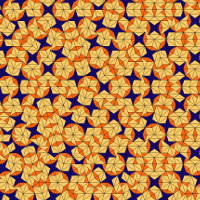
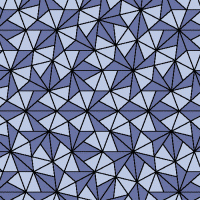
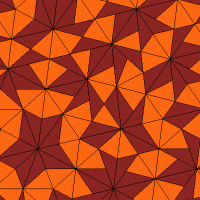
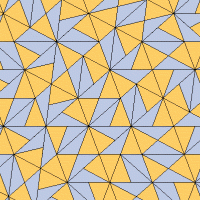
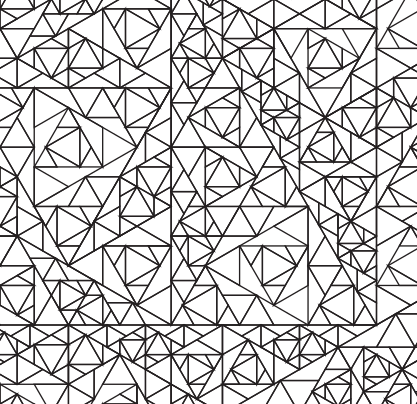
Nowadays (2019) there are several generalizations of a tile substitution. One was introduced already in Sad98 Even though his idea produces a welath of examples, most of these have not yet been well studied.
The idea is to give a rule how to substitute a prototile and apply this rule always to the …
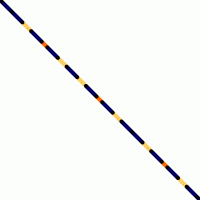
The three letter substitution rule analysed by G. Rauzy in [Rau82] . The Rauzy fractal for this tiling is the Rauzy fractal.
Euclidean Windowed Tiling One Dimensional Polytopal Tiles Self Similar Substitution
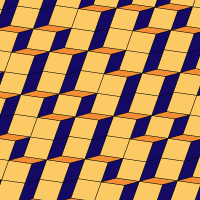
Finite Rotations Euclidean Windowed Tiling Polytopal Windowed Tiling Canonical Substitution Tiling Polytopal Tiles Parallelogram Tiles Self Similar Substitution
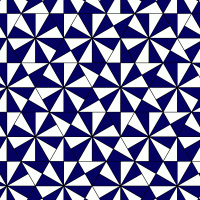
A simple rule to generate nonperiodic tilings with one prototile, a triangle with angles 30°, 60°, 90°. It looks pretty much periodic: the hexagonal patches cover 75% of the plane, and this part is clearly periodic. The triangles in between the hexagons destroy the periodicity. But, by the …
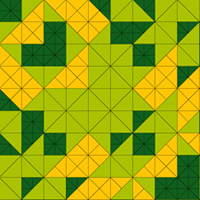
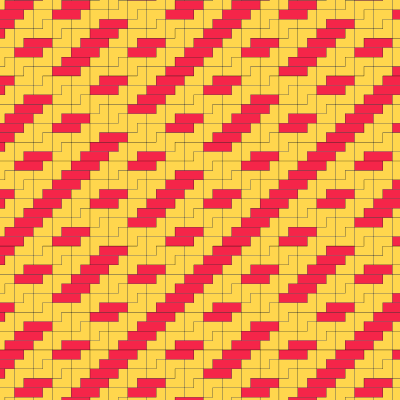
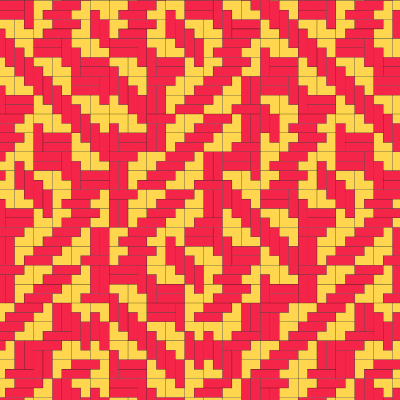
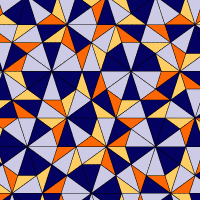
Beside the Penrose rhomb tilings (and its variations), this is a classical candidate to model 5-fold (resp. 10-fold) quasicrystals. The inflation factor is - as in the Penrose case - the golden mean, $\frac{\sqrt{5}}{2} + \frac{1}{2}$. The prototiles are Robinson triangles, but these tilings are not …
Finite Rotations Polytopal Windowed Tiling Polytopal Tiles Self Similar Substitution
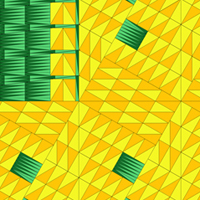
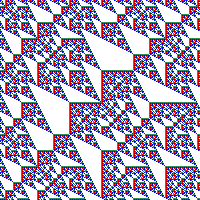
Denote the elements of the field $F_4$ by $\{0, 1, w, w + 1\}$, where $w$ satisfies the following equation with coefficients in $F_2: w^2 + w + 1 = 0$.
Vampire is a recurrent double sequence defined by $a(i, 0) = a(0, j) = 1$ and $a(i, j) = f(a(i, j-1), a(i-1, j-1), a(i-1, j))$,
where $f(x, y, z) = …
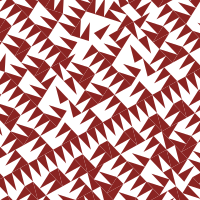
A simple rule with just one prototile that generates tilings with statistical circular symmetry. The image use two colours for the aesthetic effect only. The substitution do not even use reflections, so the tilings consist of ‘right-handed’ tiles only.
Infinite Rotations Polytopal Tiles Rep Tiles Self Similar Substitution
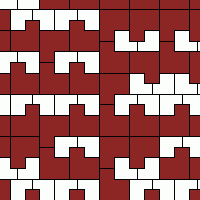
A substitution rule with inflation factor $\sqrt2$ and two prototiles.
This makes it a candidate for being a model set with p-adic internal space.
This has not been checked so far, but in principle it is possible by the methods in [LMS03] or [FS].
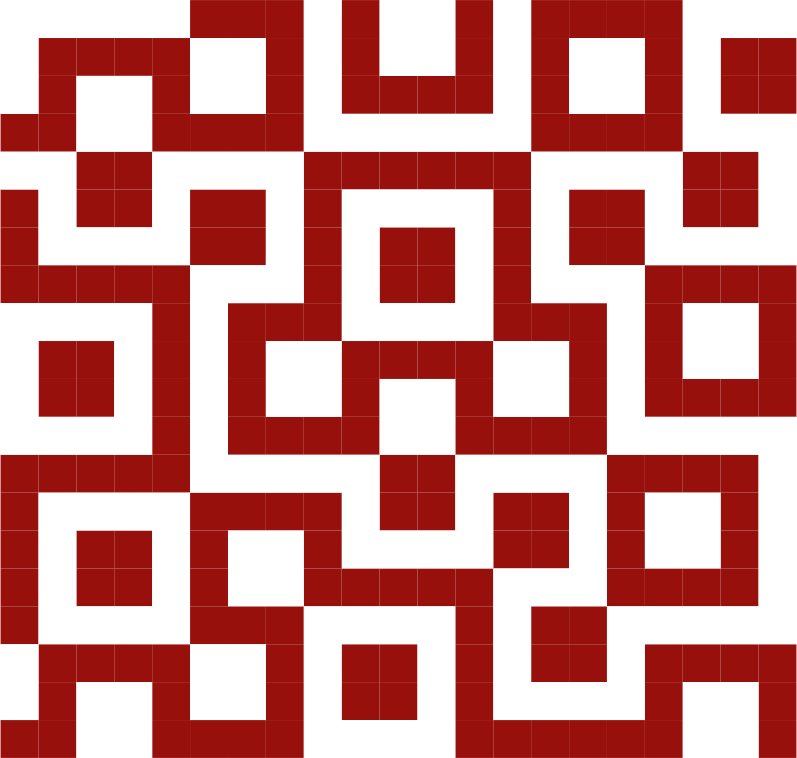
This Wanderer tiling is the first of an infinite series of substitution tilings by Joan Taylor based on paper-folding sequences. It uses a single square tile with four distinct rotations and two distinct reflections. Here we use colours to distinguish left-handed (brown) from right-handed (white) …
Limitperiodic Polytopal Tiles Rep Tiles Self Similar Substitution
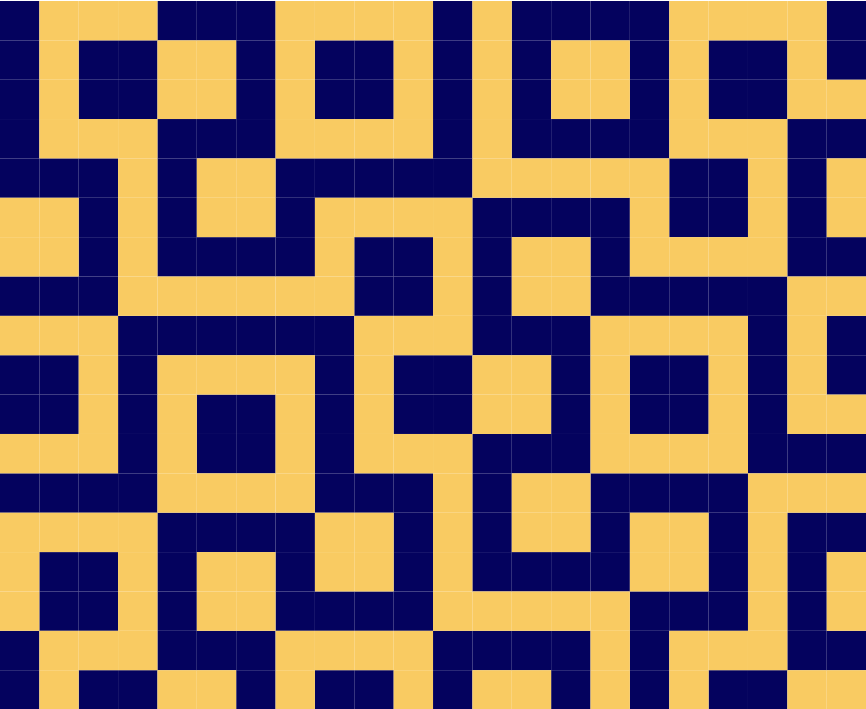
This Wanderer tiling is one in an infinite series of substitution tilings by Joan Taylor based on paper-folding sequences. It uses a single square tile with four distinct rotations and two distinct reflections. Here we use colours to distinguish vertical (blue) from horizontal (ochre) tiles. In the …
Limitperiodic Polytopal Tiles Rep Tiles Self Similar Substitution
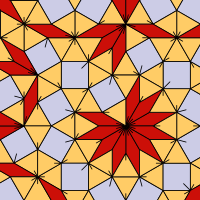
The source of the tiling can be found in [WSI95] Fig. 2 (iii) and Fig. 3.
Its inflation factor is $2+\sqrt{3}$ and it has finite local complexity with respect to rigid motions.
Unfortunately the corresponding substitution rules given in Fig. 2 (iii) of the paper are not unique. For some time the …
Finite Rotations Polytopal Tiles Self Similar Substitution Finite Local Complexity
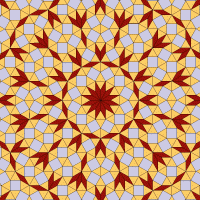
This is a variant of Watanabe Ito Soma 12-fold, with more symmetry.
Finite Rotations Polytopal Tiles
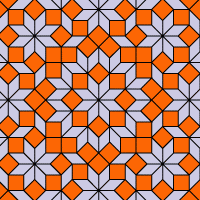
This tiling was originally introduced in [WSI87]
, however the description given there admits several substitution rules. This is the version given explicitly in [WSI95]
.
This is an example of a cut and project with a mixed internal space, a product of Euclidean and $p$-adic spaces, namely $\mathbb{R}^2 \times \mathbb{Q}_2$.
Finite Rotations Model Set Rhomb Tiles Polytopal Tiles Self Similar Substitution Finite Local Complexity
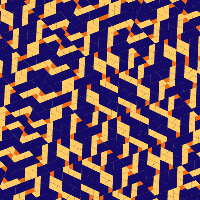
A reference to the shape of the trays in the Westend Cafeteria of Bielefeld University (before 2010).
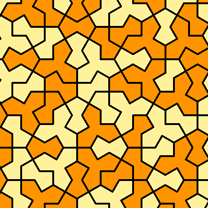
There is a very simple rule to transform the wheel tiling into the shield tiling: Replace each edge in the tiling by an edge orthogonal to it, of equal length, such that the old and new edge intersect in their midpoints. Applying this rule to the wheel tiling yields the shield tiling and vice versa. This is a very simple example of tilings which are mld.
With Decoration Finite Rotations Euclidean Windowed Tiling Polytopal Windowed Tiling Polytopal Tiles Mld Class Shield and Socolar