Finite Local Complexity (FLC)
A tiling has finite local complexity (flc) if it contains only finitely many types of patches with diameter less than some given R>0. ‘Types of patches’ is to be read either as congruence classes of patches, or as translation classes of patches. For instance, the pinwheel tiling is not flc w.r.t. translation classes, but it is flc w.r.t. congruence classes. In our classification, this qualifies the pinwheel tiling to be stored under infinite rotations, and there under finite local complexity. Equivalently, one may define flc by requiring that the tiling contains only finitely many n-coronae for a fixed n, or finitely many vertex stars. Here again, one has to consider the distinction between ‘up to congruence’ and ‘up to translation’.
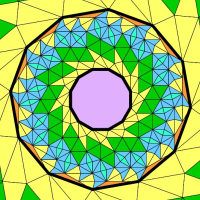
A substitution rule that gives rise to an aperiodic tiling with dense tile orientations and 12-fold rotational symmetry. The inflation factor is $\sqrt{5+2\sqrt{3}}$. The tiling has finite local complexity with respect to rigid motions.
Finite Local Complexity Polytopal Tiles Self Similar Substitution Infinite Rotations
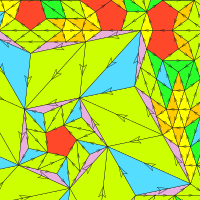
A substitution rule that gives rise to an aperiodic tiling with dense tile orientations and 5-fold rotational symmetry. The inflation factor is $\sqrt{6+\sqrt{5}}$. The tiling has finite local complexity with respect to rigid motions.
Finite Local Complexity Polytopal Tiles Self Similar Substitution Infinite Rotations
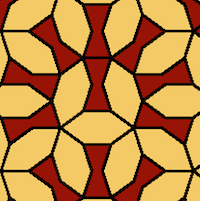
One of several substitution tilings found and submitted in February 2016 by L. Andritz with fivefold symmetry using tiles inspired by Islamic Girih patterns.
Despite the similarities the tiling is different to the “Tie and Navette” tiling as discussed in [Lue1990] and [LL1994] .
Finite Rotations Model Set Polytopal Tiles Self Similar Substitution Finite Local Complexity Girih
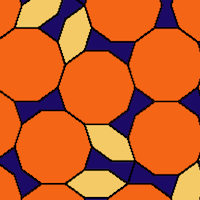
A tiling with fivefold symmetry using tiles inspired by Islamic Girih patterns.
Finite Rotations Polytopal Tiles Self Similar Substitution Finite Local Complexity Girih
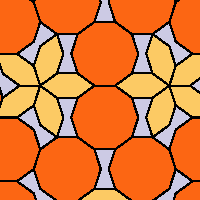
One of several substitution tilings found by L. Andritz with fivefold symmetry using tiles inspired by Islamic Girih patterns.
Finite Rotations Polytopal Tiles Self Similar Substitution Finite Local Complexity Girih
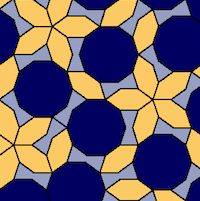
One of several substitution tilings found by L. Andritz with fivefold symmetry using tiles inspired by Islamic Girih patterns.
Finite Rotations Polytopal Tiles Self Similar Substitution Finite Local Complexity Girih
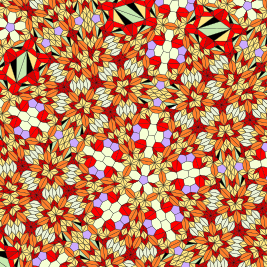
10-fold cyclotomic aperiodic tiling with dense tile orientations (CAST DTO).
Finite Local Complexity Polytopal Tiles Self Similar Substitution Infinite Rotations
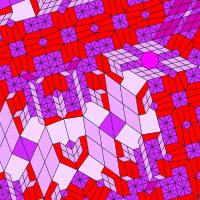
8-fold cyclotomic aperiodic tiling with dense tile orientations (CAST DTO).
Finite Local Complexity Polytopal Tiles Self Similar Substitution Infinite Rotations
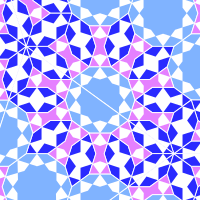
The substitution tiling was derived from a mosaic at the Darb-i Imam Shrine in Isfahan, Iran. While the shrine dates back from 1453, [Lau2018] argues that the mosaic was created much later between 1715 - 1717.
The tiling relies on the regular decagon and two hexagons and has individual dihedral …
Finite Local Complexity Finite Rotations Polytopal Tiles Self Similar Substitution Girih
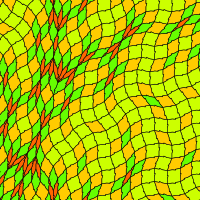
This tiling is a generalization of the Godreche-Lancon-Billard Binary first derived by T. Hibma and later worked out in detail by S. Pautze.
All interior angles are integer multiples of $\frac{\pi}{n}$.
For $n=5$ it is identical to the Godreche-Lancon-Billard Binary tiling with 2 prototiles.
For odd …
Finite Rotations Polytopal Tiles Parallelogramm Tiles Rhomb Tiles Finite Local Complexity
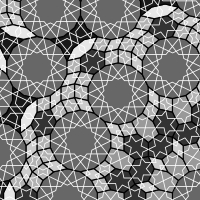
A tiling resembling Islamic Girih patterns but using 14-fold
symmetry rather than 8- or 10- or 12-fold.
Its inflation factor is $1 + \cos(\frac{\pi}{14}) \csc(\frac{\pi}{7}) + 2 \cos(\frac{3 \pi}{14}) \csc(\frac{\pi}{7}) = 6.850855...$
which is a unit but not a PV number.
It uses 11 prototiles …
Finite Local Complexity Finite Rotations Polytopal Tiles Self Similar Substitution Girih
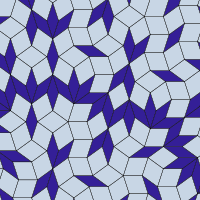
In [Lan88], energetic properties of certain decorations of Penrose Rhomb tilings were studied.
A $\frac{\pi}{5}$, $3\frac{\pi}{5}$}, or in {$2\frac{\pi}{5}$, $4\frac{\pi}{5}$}.
(‘Binary’ because …
Finite Rotations Polytopal Tiles Parallelogramm Tiles Rhomb Tiles Finite Local Complexity
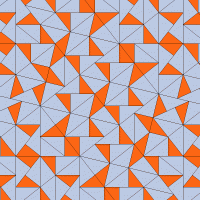
Using the prototiles of the golden triangle tiling, this substitution yields tilings where the tiles occur in infinitely many orientations. The inflation factor is $\tau + 1 = 2.618033988 \ldots $, the square of the golden mean. This is a PV number of algebraic degree 2. The expansion contains no …
Finite Local Complexity Polytopal Tiles Self Similar Substitution Infinite Rotations
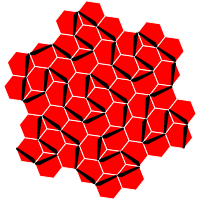
The Gosper Curve is a FASS-curve which can be derived by a substitution tiling with one substitution rule and appropriate decorations.
The inflation factor $q$ is $sqrt(7)$.
Finite Local Complexity Polytopal Tiles Self Similar Substitution With Decoration Limitperiodic FASS_curve
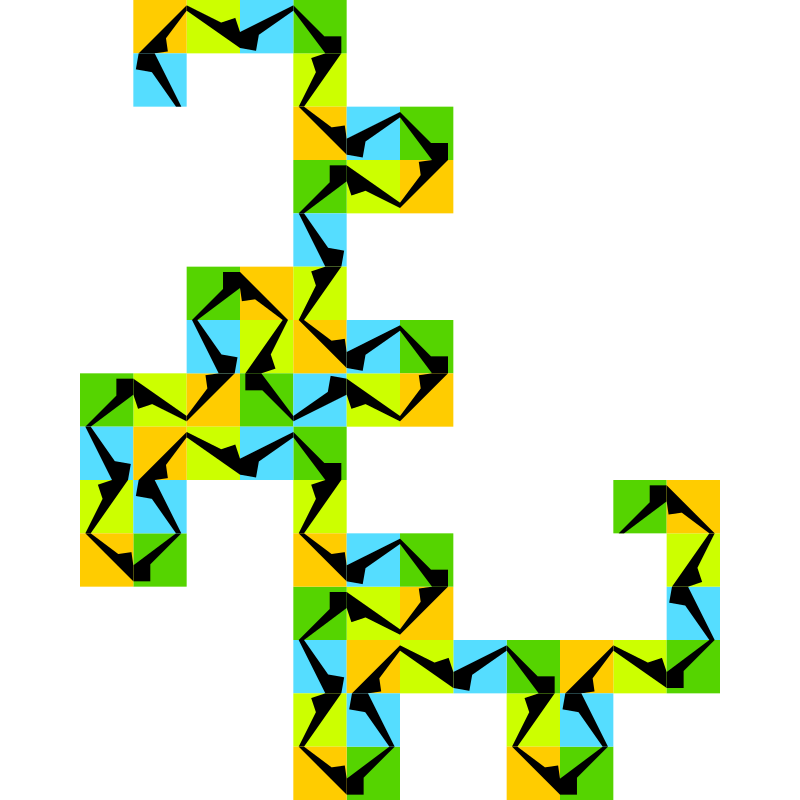
The original Heighway Dragon Curve as described in [gar1967] , can be derived by a substitution tiling with one substitution rule and appropriate decoration. However, it is not a FASS-curve because it is not self avoiding. With the results in [pau2021] it is possible to derive a substitution tiling …
Finite Local Complexity Polytopal Tiles Self Similar Substitution With Decoration Limitperiodic FASS_curve
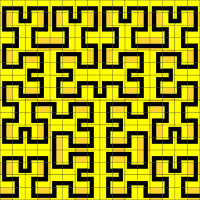
The Hilbert Curve is one of the earliest FASS-curves. The original algorithm in [hil1891] bases on one substitution rule and an additional rule which describes how the substitutes have to be connected. As briefly mentioned in [pau2021] it is also possible to create the Hilbert Curve by a …
Finite Local Complexity Polytopal Tiles Self Similar Substitution With Decoration Limitperiodic FASS_curve
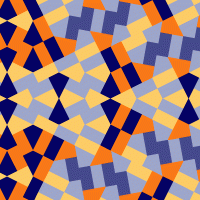
This is a variation of the pinwheel substitution. The kite-domino tilings are mld to the pinwheel tilings. The two prototiles are made of two pinwheel triangles, glued together at their long edge. There are two ways to do so, one gives a kite (a quadrilateral with edge lengths 1,1,2,2) and a domino …
With Decoration Finite Local Complexity Polytopal Tiles Self Similar Substitution Mld Class Pinwheel
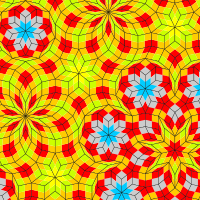
A tiling with 7-fold symmetry and a lot of locally 7-fold symmetric
patches. There are only three tile shapes, but nine different
prototiles. The inflation factor
is a PV number:
$2+2\cos\left(\frac{\pi}{7}\right)+2\cos\left(\frac{2\pi}{7}\right) = 5.04891733952231\ldots$
which is the largest root of $x^{3}-6x^{2}+5x-1$.
Polytopal Tiles Self Similar Substitution Finite Local Complexity Rhomb Tiles Finite Rotations
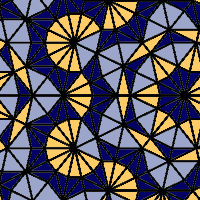
A substitution for three triangular prototiles, based on 7-fold symmetry.
The lengths of the edges of the tiles are $\sin(\frac{\pi}{7})$, $\sin(\frac{2\pi}{7})$, $\sin(\frac{3\pi}{7})$.
These tilings are essentially different from Danzer’s 7-fold examples, see for instance Danzer’s 7-fold.
Finite Rotations Polytopal Tiles Self Similar Substitution Finite Local Complexity
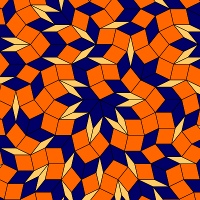
Finite Rotations Polytopal Tiles Self Similar Substitution Rhomb Tiles Finite Local Complexity
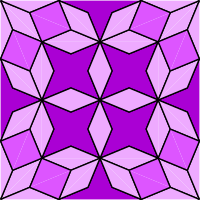
J. Millar discovered a set of tilings with patches of dihedral symmetry $D_2n$ and inflation multiplier $\sqrt{2 + 2 \cos(\frac{\pi}{n})}$, which is the same inflation multiplier as of the Generalized Godreche-Lancon-Billard Binary.
All interior angles of all prototiles are integer multiples of …
Finite Rotations Polytopal Tiles Finite Local Complexity
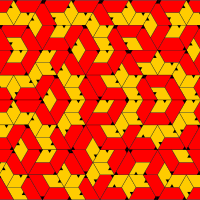
The Monnier Trapezium and Diamond tiling uses two prototiles,
a trapezium and a rhomb. The inflation multiplier is $2$.
By changing the chiralities of the prototiles within the first level
supertiles several further variants can be derived.
Finite Local Complexity Polytopal Tiles Self Similar Substitution With Decoration Limitperiodic
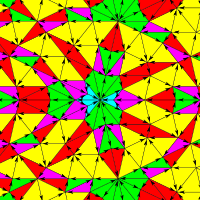
The Nischke-Danzer-Deltoid 7-fold-2-2 was discussed and derived in [ND96] but not shown. A figure with the tiling can be found in [Pau2017] .
Polytopal Tiles Self Similar Substitution Finite Local Complexity Finite Rotations Nischke Danzer Deltoid
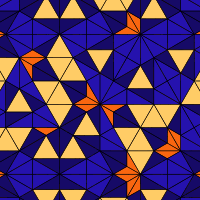
The Nischke-Danzer-Deltoid 6-fold-2-2 was discussed and derived in [ND96] .
Polytopal Tiles Self Similar Substitution Finite Local Complexity Finite Rotations Nischke Danzer Deltoid Limitperiodic
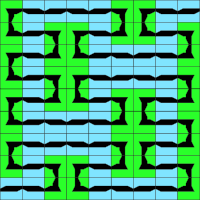
The Peano Curve is one the earliest known FASS-curves. The original algorithm in [pea1890] bases on one substitution rule and an additional rule which describes how the substitutes have to be connected. As briefly mentioned in [pau2021] it is also possible to create the Peano Curve by a …
Finite Local Complexity Polytopal Tiles Self Similar Substitution With Decoration Limitperiodic FASS_curve
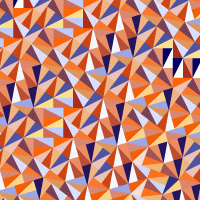
This substitution tiling is the example of substitution tilings with infinite rotations. Its statistical and dynamical properties were studied in several papers by C. Radin, see for instance [Rad92] , [Rad97] . In particular, it was shown that the orientations of triangles in the pinwheel tiling are …
With Decoration Finite Local Complexity Saduns Generalised Pinwheels Polytopal Tiles Self Similar Substitution Mld Class Pinwheel Infinite Rotations
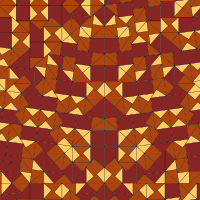
A simple example of an infinite series of substitutions with tilings of statistical circular symmetry. It is shown in [Frettloeh:STWCS not found], that all tilings in this series posses statistical circular symmetry. The substitution factors are $s2m$, where s is the largest root of $xm-xk-1$. Each …
Finite Local Complexity Polytopal Tiles Self Similar Substitution
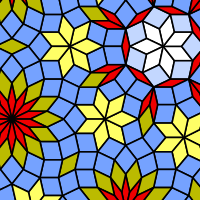
Schaad’s 7-fold is a variation of Madison’s 7-Fold, hence it shares many properties with it. It allows for tilings with global 7-fold symmetry and a lot of locally 7-fold symmetric patches. There are three tile shapes, but only seven instead of nine different prototiles. The inflation factor is a PV …
Polytopal Tiles Self Similar Substitution Finite Local Complexity Rhomb Tiles Finite Rotations
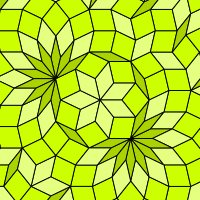
J. Kari and M. Rissanen derived a set of rhomb substitution tilings in [KR2016] with n-fold dihedral symmetry.
- All substitution rules have dihedral
$D_{2}$symmetry. - All edges of the substitution rules are equal and also have dihedral
$D_{2}$symmetry. - All interior angles of all prototiles are …
Polytopal Tiles Self Similar Substitution Finite Local Complexity Finite Rotations Rhomb Tiles
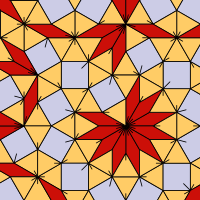
The source of the tiling can be found in [WSI95] Fig. 2 (iii) and Fig. 3.
Its inflation factor is $2+\sqrt{3}$ and it has finite local complexity with respect to rigid motions.
Unfortunately the corresponding substitution rules given in Fig. 2 (iii) of the paper are not unique. For some time the …
Finite Rotations Polytopal Tiles Self Similar Substitution Finite Local Complexity
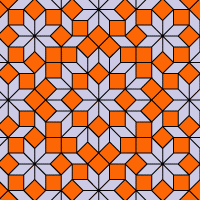
This tiling was originally introduced in [WSI87]
, however the description given there admits several substitution rules. This is the version given explicitly in [WSI95]
.
This is an example of a cut and project with a mixed internal space, a product of Euclidean and $p$-adic spaces, namely $\mathbb{R}^2 \times \mathbb{Q}_2$.
Finite Rotations Model Set Rhomb Tiles Polytopal Tiles Self Similar Substitution Finite Local Complexity