Matching Rules
Many interesting substitution tilings can alternatively be generated by a matching rule. Examples are (again) the Penrose Rhomb tilings: Note the red arcs on each tile. The matching rule is given by the condition that tiles have to meet in a way such that the arcs of each tile are connected with arcs on the neighboured tiles. The set of all tilings fulfilling this local condition is exactly the set of all tilings generated by the Penrose Rhomb substitution. In particular, the condition forces nonperiodic tilings. (Of course there are periodic tilings made of the Penrose rhomb tiles, but these do not obey the matching rule.) If one reads ’this substitution tilings can be generated by a matching rule’ or so, two cases has to be distincted: Usually a matching rule is formulated by using a decoration of the prototiles (like the red arcs on the Penrose Rhomb). Either the original tilings are mld to the decorated ones, or they are just locally derivable from the decorated ones (but not vice versa). In the latter case, there is no way to derive the decorated tiling from the undecorated in a unique way locally. In the former case, the matching rule can be given by an ‘atlas’ of undecorated clusters. For instance, Danzer’s 7-fold tilings can be defined by the atlas of its vertex stars. Those tilings are classified here under ‘known matching rules without decoration’, in contrast to ‘… with decoration’. Goodman-Strauss showed in [Goo98] that every ’nice’ family of substitution tilings can be generated by a matching rule with decoration.
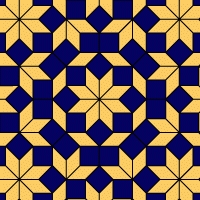
In 1977 R. Ammann found several sets of aperiodic tiles. This one (his set A5) is certainly the best-known of those. It allows tilings with perfect 8fold symmetry. The substitution factor is $1+\sqrt{2}$ - sometimes called the ‘silver mean’ - which was the first irrational inflation factor known …
With Decoration Finite Rotations Polytopal Windowed Tiling Canonical Substitution Tiling Rhomb Tiles Mld Class Ammann Matching Rules
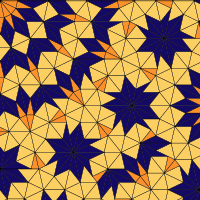
A substitution tiling with three triangles as prototiles,
based on 7-fold symmetry.
The four different edge lengths occurring are $\sin(\frac{\pi}{7})$, $\sin(\frac{2\pi}{7})$,
$\sin(\frac{3\pi}{7})$, $\sin(\frac{2\pi}{7}) + \sin(\frac{3\pi}{7})$,
The inflation factor is …
Without Decoration Finite Rotations Polytopal Tiles Self Similar Substitution Matching Rules
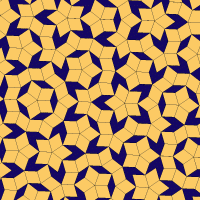
Certainly the most popular substitution tilings. Discovered in 1973 and 1974 by R. Penrose in - at least - three versions (Rhomb, Penrose kite-dart and Penrose Pentagon boat star), all of them forcing nonperiodic tilings by matching rules. It turns out that the three versions are strongly related: …
Without Decoration Finite Rotations Polytopal Windowed Tiling Canonical Substitution Tiling Rhomb Tiles Mld Class Penrose Matching Rules
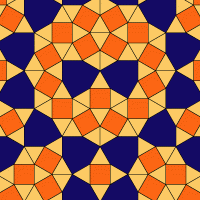
In connection with physical quasicrystals, the most interesting 2dim tilings are based on 5-, 8-, 10- and 12-fold rotational symmetry. This 12-fold tiling was studied by F. Gähler, in particular its cut and project scheme, the local matching rules and diffraction properties [Gah88]. The window of …
With Decoration Finite Rotations Euclidean Windowed Tiling Polytopal Windowed Tiling Polytopal Tiles Mld Class Shield and Socolar Matching Rules
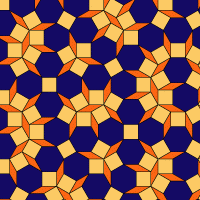
In connection with physical quasicrystals, the most interesting 2dim tilings are based on 5-, 8-, 10- and 12-fold rotational symmetry. This 12-fold tiling was studied thoroughly in [Soc89], where J. Socolar described the generating substitution as well as the local matching rules and the cut and …
Euclidean Windowed Tiling Polytopal Windowed Tiling Polytopal Tiles Parallelogram Tiles Canonical Substitution Tiling Mld Class Shield and Socolar Matching Rules
References
[Goo98]
Goodman-Strauss, Chaim
Matching rules and substitution tilings
Ann. of Math. (2)
1998,
147, 1,
pp. 181--223,
MR1609510