One Dimensional
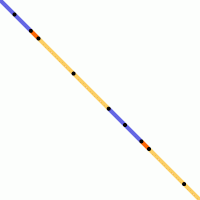
A one dimensional substitution rule with a two component Rauzy Fractal. For a second example and more details see infinite component Rauzy fractal.
One Dimensional Euclidean Windowed Tiling Self Similar Substitution

A classic simple substitution rule with Rauzy Fractal:
One Dimensional Euclidean Windowed Tiling Self Similar Substitution Polytopal Tiles
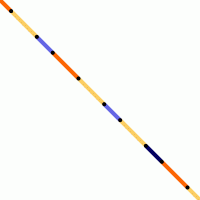
The substitution rule a1->a1 b1, a2->b2 a2, b1->a2, b2->a1. The tilings generated become Fibonacci tilings under the projection a1,a2->a and b1,b2->b. Alternatively one can simply remove the colour labels on the tiles. The name comes from the projection structure of the tiling. The expansion …
Euclidean Windowed Tiling Polytopal Windowed Tiling Canonical Substitution Tiling One Dimensional Polytopal Tiles Parallelogram Tiles Self Similar Substitution Mld Class Fibonacci
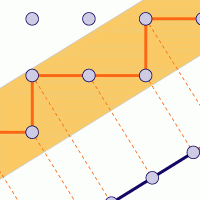
The classical example to explain the cut and project
method (see figure, lower part): In the standard square lattice $\mathbb{Z}^2$, choose a stripe with slope
$\frac{1}{\tau}$ (where tau is the golden ratio $\frac{1+\sqrt{5}}{2}$ ) of a certain width $\cos(\arctan(\frac{1}{\tau})) + …
Finite Rotations Polytopal Windowed Tiling Canonical Substitution Tiling One Dimensional Parallelogram Tiles Self Similar Substitution Mld Class Fibonacci

An invertible substitution rule with a disconnected Rauzy Fractal. For two letter substitution rules the Rauzy fractal is connected if and only if the substitution is invertible. In fact as the window is one dimensional for these tilings it is an interval. It was hoped that the connectedness …
One Dimensional Euclidean Windowed Tiling Self Similar Substitution Polytopal Tiles

An one-dimensional substitution rule that uses an infinite number of prototiles.
The inflation factor is $2.5$.
The substitution rules are given by:
$T_{0}\rightarrow T_{0},T_{1}$
$T_{1}\rightarrow T_{0},T_{0},T_{2}$
$T_{2}\rightarrow T_{0},T_{1},T_{3}$
$T_{k}\rightarrow T_{0},T_{k-1},T_{k+1}$ …
One Dimensional Self Similar Substitution

The substitution $a \rightarrow ab, b \rightarrow cb, c \rightarrow a$ is the composition of the one with the smallest PV scaling factor, $a \rightarrow bc, b \rightarrow a, c \rightarrow b$, and its mirror image, $a \rightarrow cb, b \rightarrow a, c \rightarrow b$. As such, it is MLD to its own …
Euclidean Windowed Tiling One Dimensional Self Similar Substitution
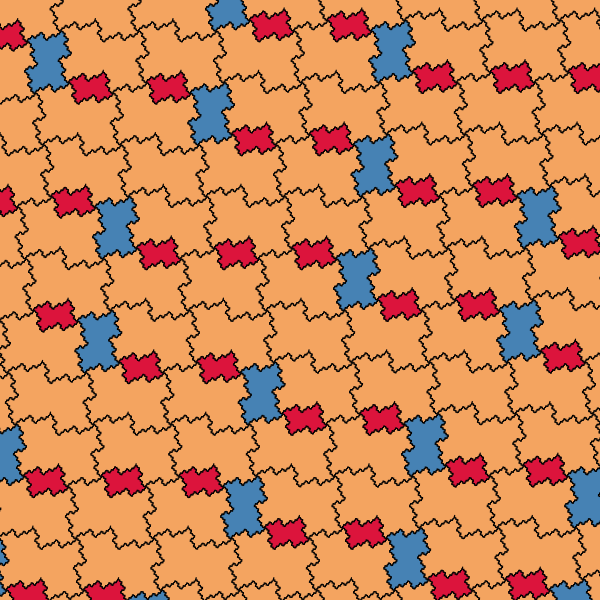
The substitution $a \rightarrow aca, b \rightarrow a, c \rightarrow b$ has palindromic and thus mirror symmetric variant of the Kolakoski-(3,1) substitution, which is in the same MLD class, along with the further variants A (mirror symmetric) and B (with its mirror image). The scaling factor …
Euclidean Windowed Tiling One Dimensional Self Similar Substitution
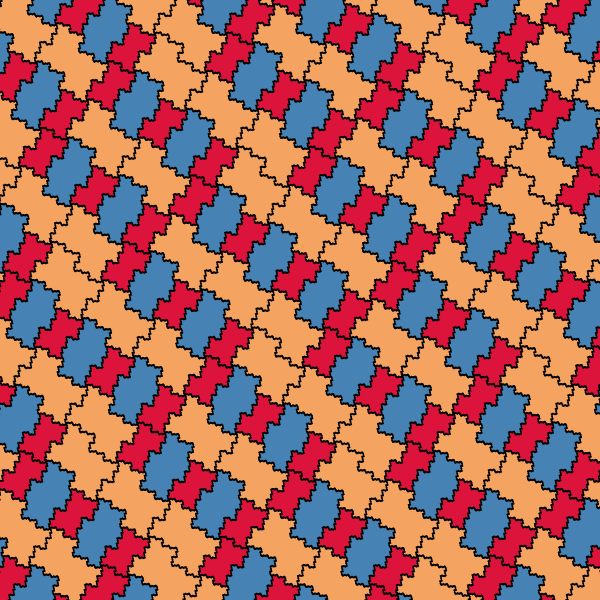
The substitution $a \rightarrow bcc, b \rightarrow ba, c \rightarrow bc$ is a member of the MLD class of the [Kolakoski-(3,1) sequence] (/substitution/kolakoski-3-1/). As the reversed substitution generates the same hull, it is mirror symmetric. The scaling factor $\lambda \approx $ 2.20557 is the …
Euclidean Windowed Tiling One Dimensional Self Similar Substitution
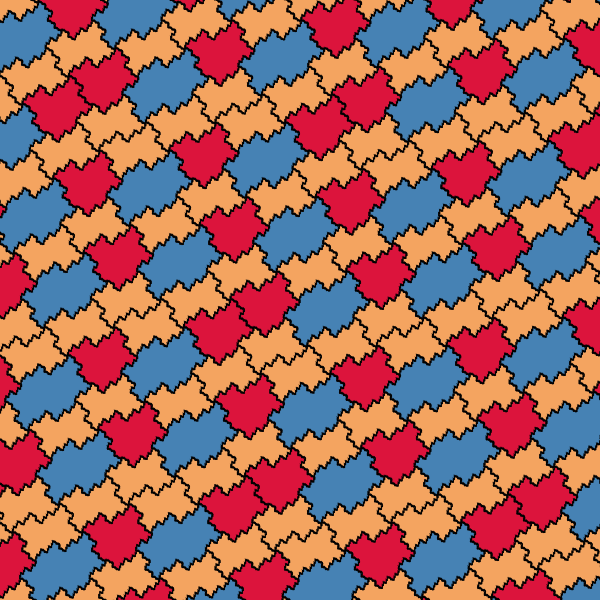
The substitution $a \rightarrow abcc, b \rightarrow a, c \rightarrow bc$ is a member of the MLD class of the [Kolakoski-(3,1) sequence] (/substitution/kolakoski-3-1/). The scaling factor $\lambda \approx $ 2.20557 is the largest root of $x^3-2x^2-1=0$.
This substitution has a simple dual, with three …
Euclidean Windowed Tiling One Dimensional Self Similar Substitution
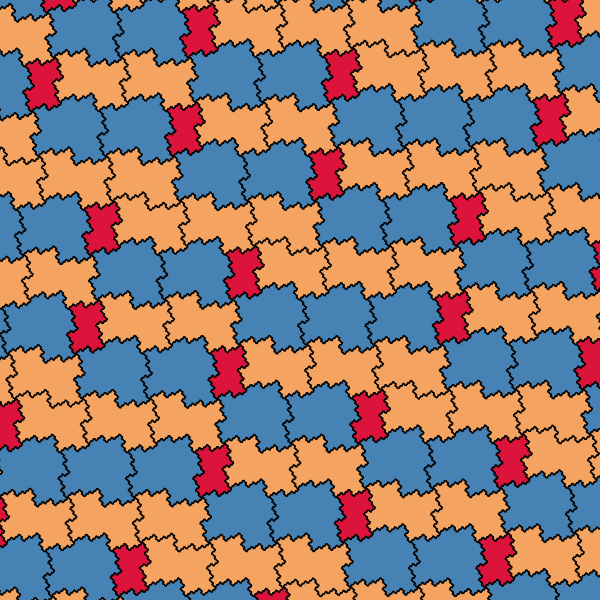
The substitution $a \rightarrow abc, b \rightarrow ab, c \rightarrow b$ is closely related to the Kolakoski-(3,1) sequence, and is one of the examples whose windows (dual tiles, Rauzy fractals) have been analysed in detail [BaS04] . It is MLD to the mirror symmetric variant given by the palindromic …
Euclidean Windowed Tiling One Dimensional Self Similar Substitution
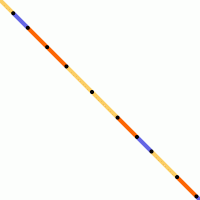
A companion to infinite component Rauzy fractal. As mentioned for that rule, it was hoped that the result for two symbol substitution rules that the window is connected if and only if the rule is invertible. This substitution rules is not invertible and yet the Rauzy fractal is connected:
Euclidean Windowed Tiling One Dimensional Polytopal Tiles Self Simmilar Substitution
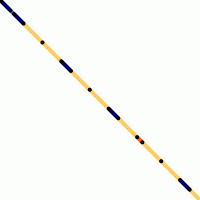

In some sense, the simplest cut and project tiling. It arises from the symbolic substitution a -> ab, b -> aa. Its internal space are the 2-adic integers.
P Adic Windowed Tiling One Dimensional Rep Tiles Self Similar Substitution
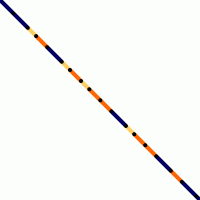
The three letter substitution rule whose scaling is the smallest PV number, the Plastic Number which is a root of the polynomial $x^3 - x - 1 = 0$.
Though it might not look it at first glance, the Rauzy fractal is connected.
This can be shown using the method of A. Siegel described in [Sie04].
The Rauzy fractal:
One Dimensional Euclidean Windowed Tiling Self Similar Substitution Polytopal Tiles Plastic Number

A classic. A lot of detail can be found in [JS99].
One Dimensional Self Similar Substitution
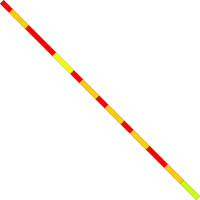
An one-dimensional substitution rule that uses an infinite number of proto tiles and yields a transcendental inflation multiplier.
The inflation factor is approximately $2.7899$.
The substitution rules are given by:
$T_{0}\rightarrow T_{0},T_{1}$
$T_{1}\rightarrow 3T_{0},T_{2}$
$T_{2}\rightarrow …
One Dimensional Self Similar Substitution

The three letter substitution rule analysed by G. Rauzy in [Rau82] . The Rauzy fractal for this tiling is the Rauzy fractal.
Euclidean Windowed Tiling One Dimensional Polytopal Tiles Self Similar Substitution