Danzer's 7-fold original
Discovered by
Number of Prototiles:
Info
A tiling based on 7-fold (resp. 14-fold) symmetry [ND96].
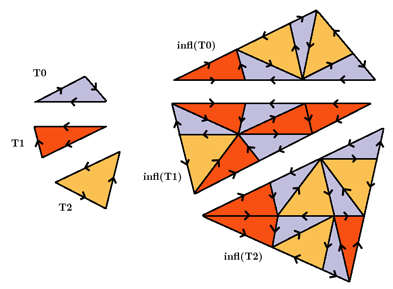
Note that in the original paper the diagram showing the
substitutionrule has one mistake:
the arrow on the shortest edge of tile $T_1$ is supposed to point up
(see here), not down (see paper).
The inflation factor is
$1+{\sin(\frac{2\pi}{7})}/{\sin(\frac{\pi}{7})}$, which is not a PV number.
The three different edge lengths are proportional to
$\sin(\frac{\pi}{7})$, $\sin(\frac{2\pi}{7})$,
$\sin(\frac{3\pi}{7})$.
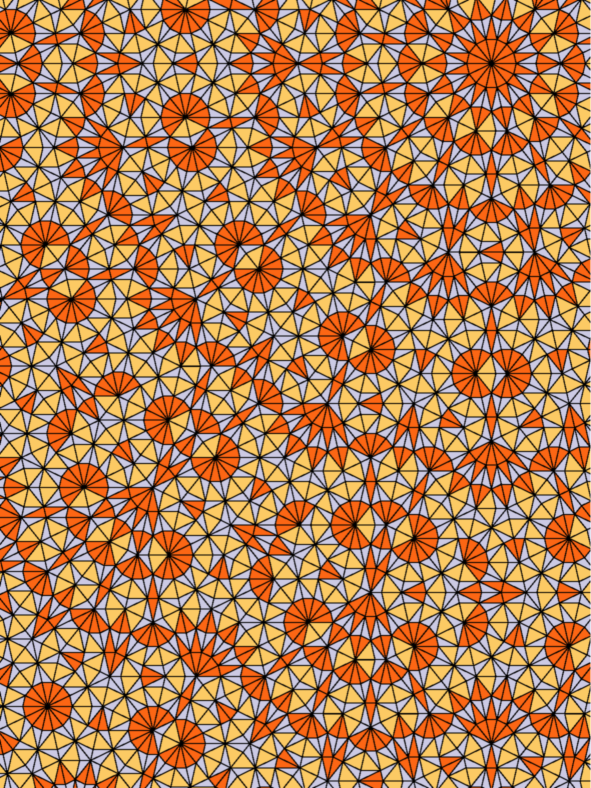
On a first glance, there seems to exist a centre of perfect 14-fold symmetry:
a 14-tipped star in the upper right corner.
But in fact it is only 2-fold symmetric.
The symmetry is broken by the right- and left-handedness of the tiles.
On rings around the 14-tipped star, this manifests in tiles pointing
clockwise or counterclockwise, thus breaking the symmetry.
This is one of the rare cases that a substitution has local matching rules without decoration. In fact, the list of all different vertex stars defines the matching rule. This was claimed by Danzer, and supposedly confirmed by a paper by Hayashi et al in 2011. Interestingly, this latter paper made still another mistake in their substitution rule: they kept the original mistake and switched still another arrow direction. So in fact they were studying another (very similar, but distinct) tiling. Finally, in 2026, LLM agents confirmed that Danzer’s claim is correct: the vertex stars of this one (in their arrowed version) force aperiodicity.
Substitution Rule
Patch
References
[ND96]
Nischke, K-P and Danzer, L
A construction of inflation rules based on $n$-fold symmetry
Discrete and Computational Geometry
1996,
15,2,
pp. 221-236,
96j:52035