Without Decoration
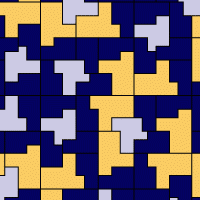
In 1977 Robert Ammann discovered a number of sets of aperiodic prototiles, i.e., prototiles with matching rules forcing nonperiodic tilings. These were published as late as 1987 in [GS87] , where they were named Ammann A2 (our Ammann Chair), Ammann A3, Ammann A4 and Ammann A5 (better known as Ammann …
Without Decoration Finite Rotations Euclidean Windowed Tiling Polytopal Tiles Self Similar Substitution
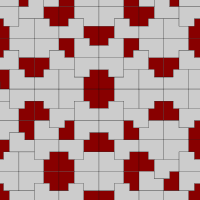
One of the tilings discovered by R. Ammann in 1977, published in [GS87] . The other ones (published there) are Ammann A3, Ammann A4, and Ammann A5 (better known as Ammann Beenker). The inflation factor of this substitution is quite small. It is the square root of the golden ratio, approx 1.272. …
Without Decoration Finite Rotations Polytopal Windowed Tiling Polytopal Tiles Self Similar Substitution
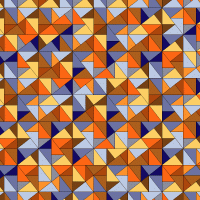
In order to generate the golden triangle tilings by matching rules, L. Danzer and G. van Ophuysen found this substitution for coloured prototiles. The list of its vertex stars serves as matching rules. For more details, see golden triangle and the references there.
Without Decoration Finite Rotations Euclidean Windowed Tiling Polytopal Tiles Self Similar Substitution
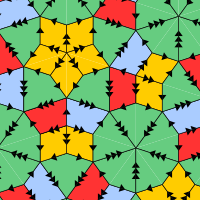
The tiling shares a mld-class with the Penrose Tilings, e.g. Penrose Rhomb, Penrose kite-dart and Penrose Pentagon boat star).
The inflation factor is the square of the golden mean $(\frac{\sqrt{5}}{2} + \frac{1}{2})^{2} = \frac{\sqrt{5}}{2} + \frac{3}{2} = 2.618033988\ldots$.
In contrast to the …
Without Decoration Finite Rotations Polytopal Windowed Tiling Canonical Substitution Tiling Mld Class Penrose
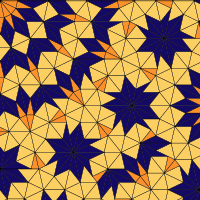
A substitution tiling with three triangles as prototiles,
based on 7-fold symmetry.
The four different edge lengths occurring are $\sin(\frac{\pi}{7})$, $\sin(\frac{2\pi}{7})$,
$\sin(\frac{3\pi}{7})$, $\sin(\frac{2\pi}{7}) + \sin(\frac{3\pi}{7})$,
The inflation factor is …
Without Decoration Finite Rotations Polytopal Tiles Self Similar Substitution Matching Rules
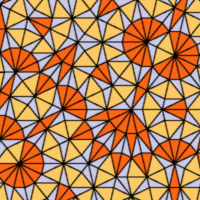
A tiling based on 7-fold (resp. 14-fold) symmetry [ND96].
The inflation factor is $1+{\sin(\frac{2\pi}{7})}/{\sin(\frac{\pi}{7})}$.
The three different edge lengths are proportional to
$\sin(\frac{\pi}{7})$, $\sin(\frac{2\pi}{7})$,
$\sin(\frac{3\pi}{7})$.
On a first glance, there seems to exist a …
Without Decoration Finite Rotations Polytopal Tiles Self Similar Substitution
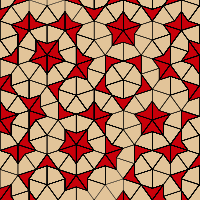
A classic, using a kite (blue) and a dart (orange) as prototiles. See Penrose Rhomb for more details.
Without Decoration Finite Rotations Polytopal Windowed Tiling Polytopal Tiles Mld Class Penrose
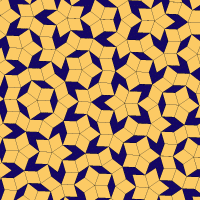
Certainly the most popular substitution tilings. Discovered in 1973 and 1974 by R. Penrose in - at least - three versions (Rhomb, Penrose kite-dart and Penrose Pentagon boat star), all of them forcing nonperiodic tilings by matching rules. It turns out that the three versions are strongly related: …
Without Decoration Finite Rotations Polytopal Windowed Tiling Canonical Substitution Tiling Rhomb Tiles Mld Class Penrose Matching Rules
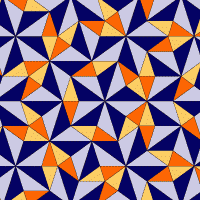
A variation of the Penrose rhomb tilings, suggested by R. M. Robinson. The rhombs are cut into triangles, thus making the substitution volume hierarchic. Thus, this one is obviously mld with the other Penrose tilings. For more details, see Penrose rhomb tilings. Each triangle comes either left- or …
Without Decoration Finite Rotations Polytopal Windowed Tiling Polytopal Tiles Self Similar Substitution Mld Class Penrose Generalized Robinson Triangles