Tilings with Factor: $3$
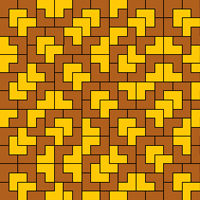
A more or less obvious variant of the chair substitution.
Finite Rotations Polytopal Tiles Self Similar Substitution
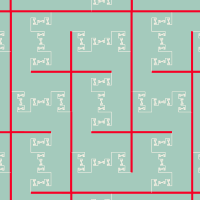
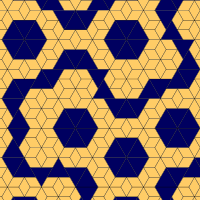
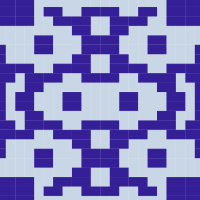
A generalization of the domino substitution. There are several possibilities to play with 1x2 rectangles (dominos) in order to generate non-periodic tilings.
The decorative lining shows here how the prototile gets turned and mirrored for this example. The two rules are actually exactly the same. For decoration the horizontal tile was colored purple.
Finite Rotations Polytopal Tiles Polyomio Tiling Rep Tiles Self Similar Substitution
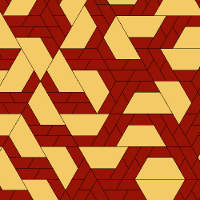
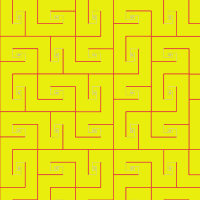
A relative of the Squiral tiling. The boundary of the prototile has infinitely many line segments, but it has still finite length. A relative of this tiling is Dampflok, where the boundary of the prototile has infinite length, even though it consists of line segments (and accumulation points) only.
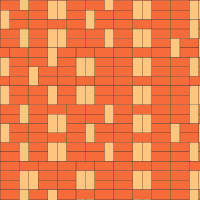
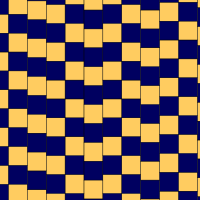
A simple substitution, yielding a tiling which is not of finite local complexity (flc). The substitution maps the single prototile, a unit square, to three columns of three squares each, where the third column is shifted by an irrational amount t. In higher iterates of the substitution, there are …
Polytopal Tiles Parallelogram Tiles Rhomb Tiles
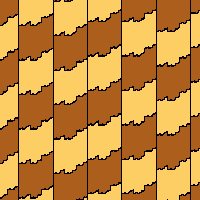
A simple substitution rule, generating tilings which don’t possess flc. The fractally shaped tiles make it a selfsimilar-substitution. Despite the fractal apperance, the dimension of the boundary of the prototile is one almost everywhere: the boundary of the tile consists of lines almost everywhere …
Rep Tiles Self Similar Substitution
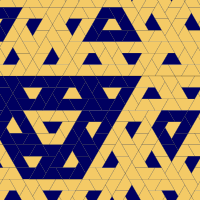
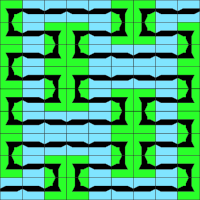
The Peano Curve is one the earliest known FASS-curves. The original algorithm in [pea1890] bases on one substitution rule and an additional rule which describes how the substitutes have to be connected. As briefly mentioned in [pau2021] it is also possible to create the Peano Curve by a …
Finite Local Complexity Polytopal Tiles Self Similar Substitution With Decoration Limitperiodic FASS_curve
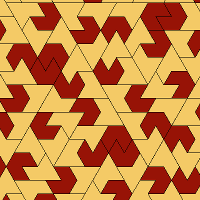
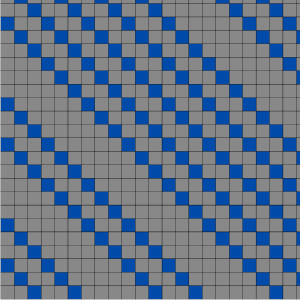
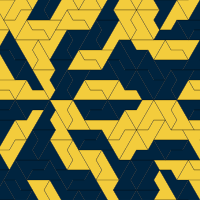
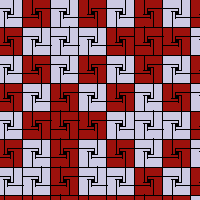
This substitution arises from a reptile with infinitely many straight edges, cf. [GS87]. It answers the question ‘Are there selfsimilar substitution tilings where the prototiles have infinitely many straight edges?’ positively. The colours of the tiles indicate their chirality. The substitution rule …
Finite Rotations Rep Tiles
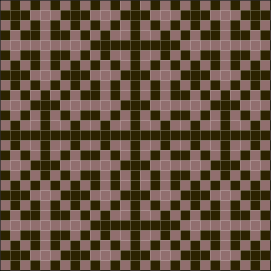
This is the block version of the Squiral tiling. The graphic was created by Leif Borgstedt.
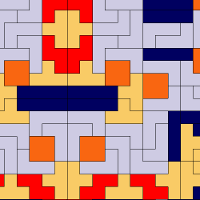
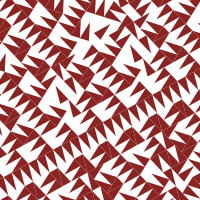
A simple rule with just one prototile that generates tilings with statistical circular symmetry. The image use two colours for the aesthetic effect only. The substitution do not even use reflections, so the tilings consist of ‘right-handed’ tiles only.
Infinite Rotations Polytopal Tiles Rep Tiles Self Similar Substitution