p-adic Windowed Tiling
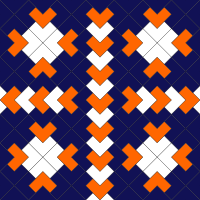
The chair tiling, as most tilings presented here, is nonperiodic. But there is a strong resemblance to periodic tiling. For instance, the set of vertex points in the tiling obviously spans a square lattice. Moreover, it is possible to detect large subsets in the tiling which are fully periodic. For …
Finite Rotations P Adic Windowed Tiling Polytopal Tiles Rep Tiles Self Similar Substitution Mld Class Chair
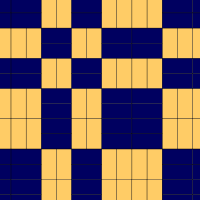
A simple variant of the domino tilings (aka table tilings).
C. Goodman-Strauss pointed out in [Goo98] the following. B. Solomyak
proved in Sol98,
that for each nonperiodic substitution tiling the substitution rule is invertible:
One can tell from $\sigma(T)$ its predecessor $T$ uniquely. But this is …
Finite Rotations P Adic Windowed Tiling Polytopal Tiles Parallelogram Tiles Polyomio Tiling Rep Tiles Self Similar Substitution
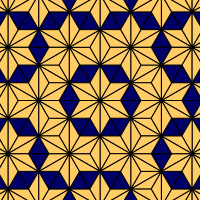
A substitution tiling found by Bill Kalahurka, Texas, in 2009 (?). It is mld to T2000 by L. Danzer in 2000.
Finite Rotations P Adic Windowed Tiling Polytopal Tiles Rep Tiles Self Similar Substitution Two Dimensional
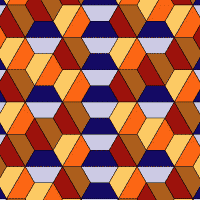
This one is easily seen to be limitperiodic: A large portion of the tiling is periodic. Thus it is a cut and project tiling. A detailed description of the corresponding cut and project scheme is contained in [Fre02].
The substitution occurs already in [GS87], see Exercise 10.1.3.
Finite Rotations P Adic Windowed Tiling Polytopal Tiles Rep Tiles Self Similar Substitution
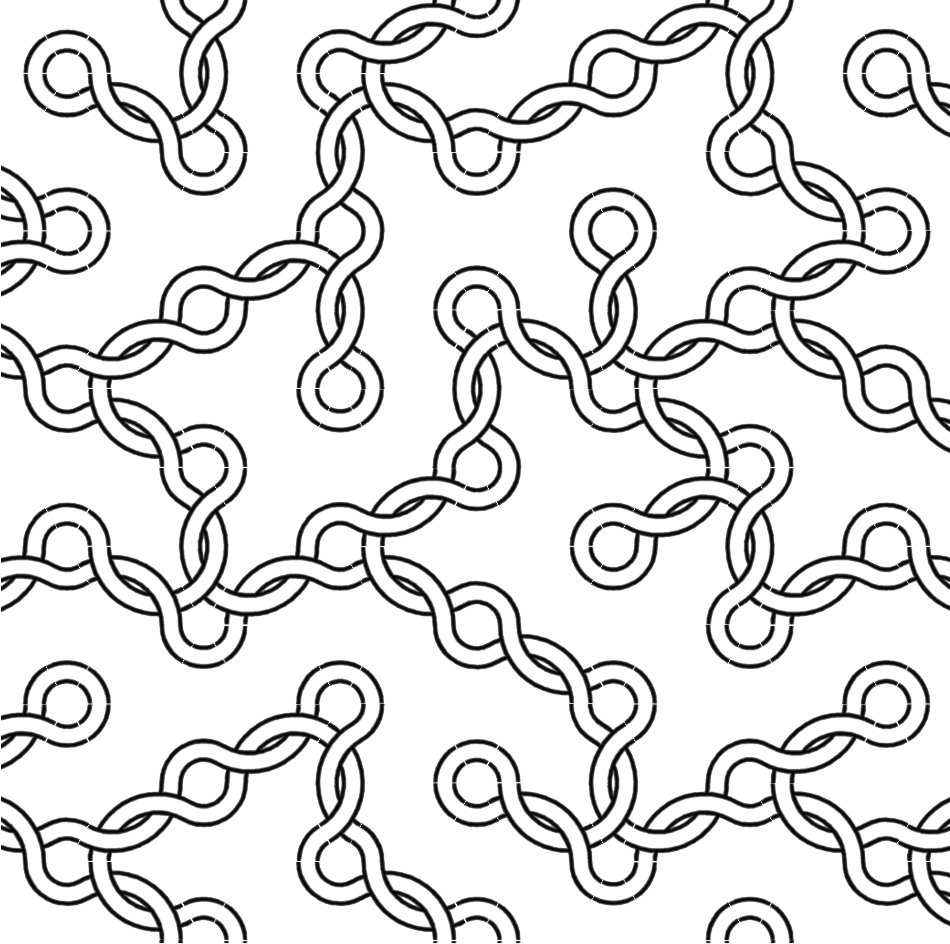
An artistic version of the 3-fold version of the 4-fold Hofstetter 4fold tilings. For details see there.
P Adic Windowed Tiling Polytopal Tiles
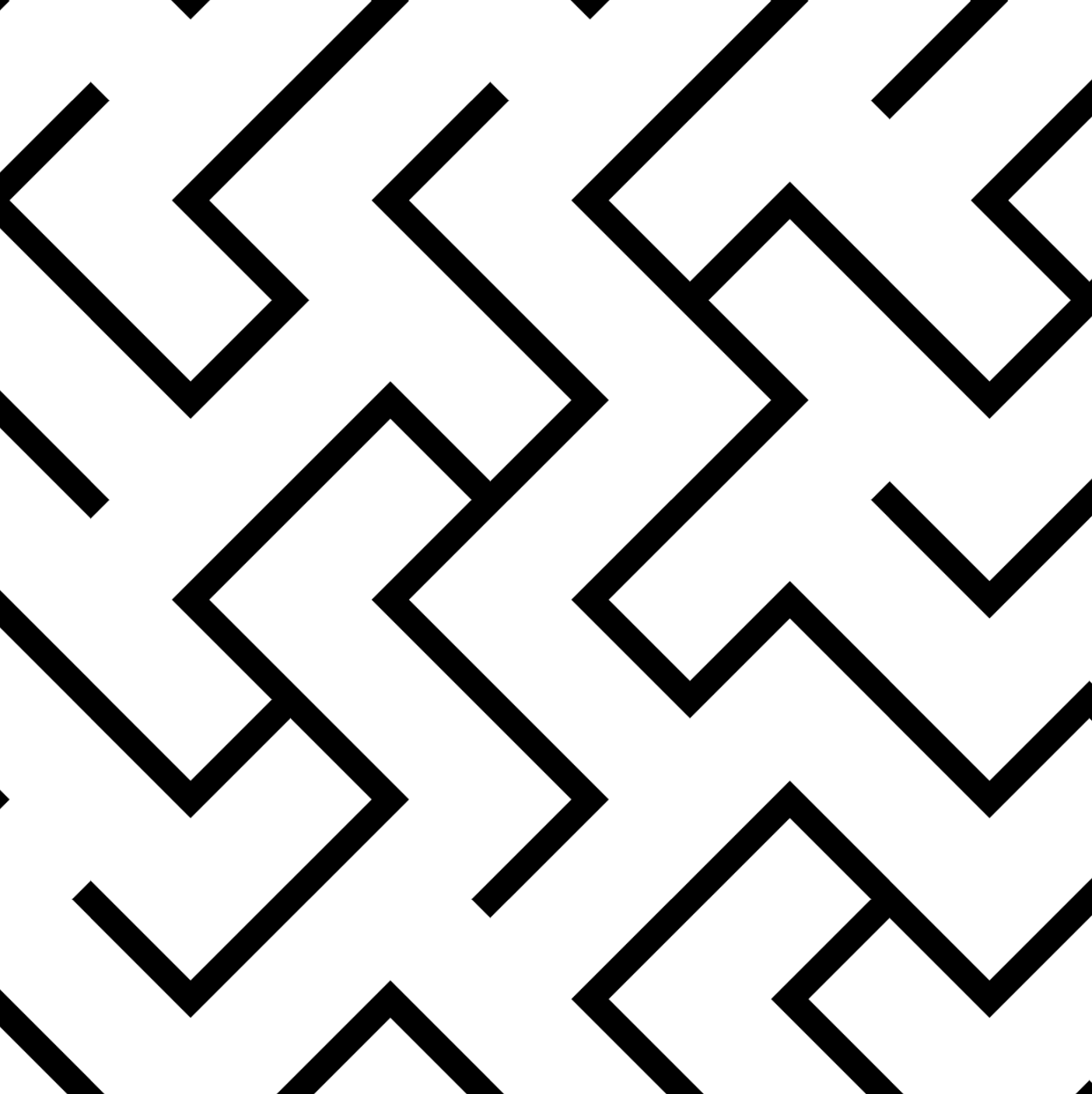
An artistic version of the Hofstetter 4fold tilings. For details see there.
P Adic Windowed Tiling Polytopal Tiles
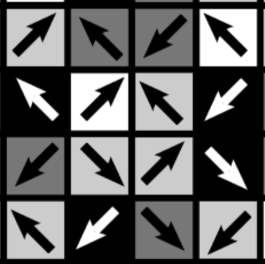
A decorated version of the Hofstetter 4fold tilings. This version can be generated by a proper substitution rule. It was shown in [FH15] that this version is aperiodic, as well as limitperiodic. For more details see Hofstetters 4-fold.
P Adic Windowed Tiling Polytopal Tiles
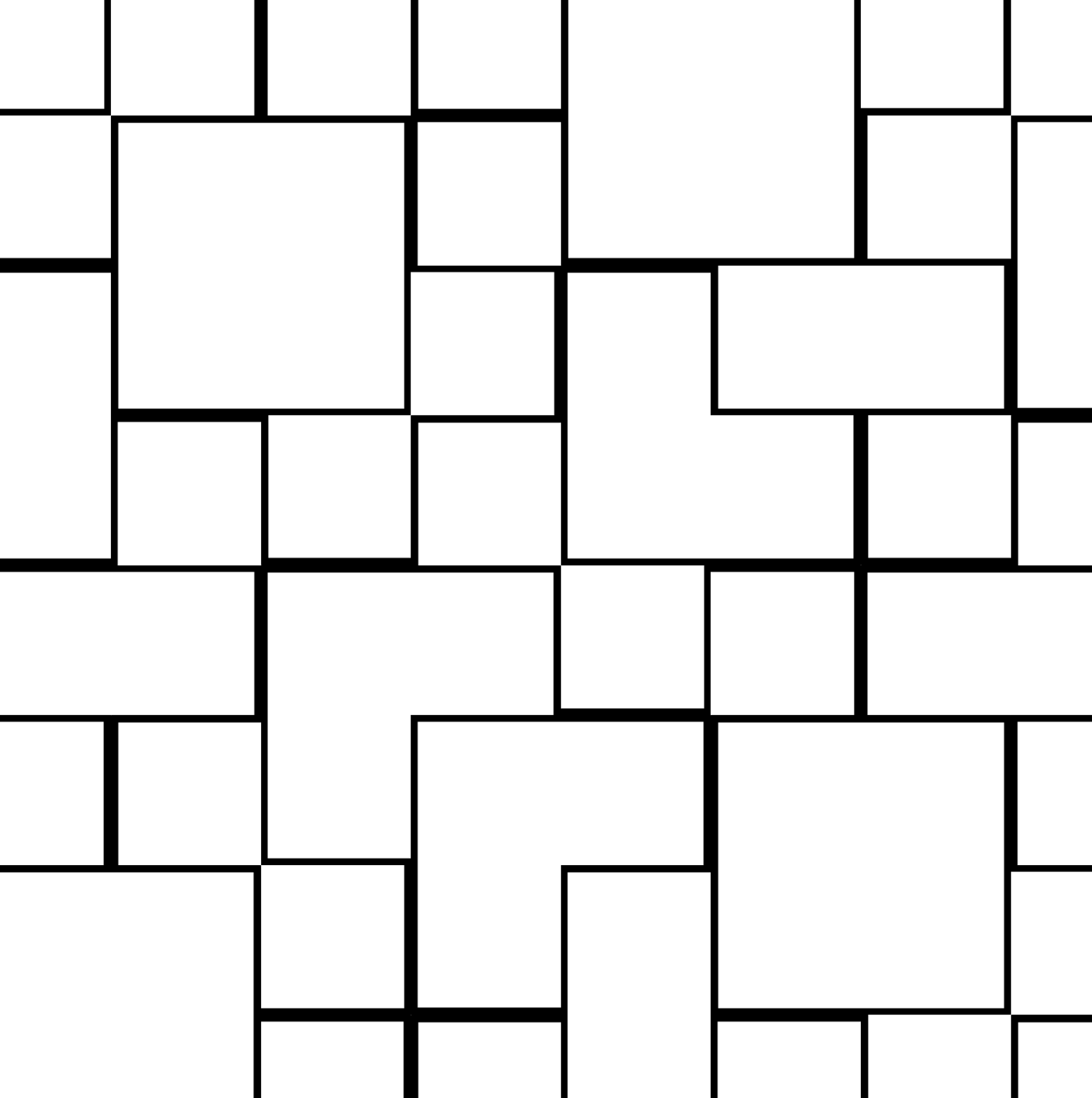
The Viennese Artist Hofstetter Kurt found a new iteration method that produces aperiodic tilings. The idea is illustrated in the figure below: one starts with a single square tile of edge length one. A second square tile of the same size is put below the first one, such that its SW corner is …
P Adic Windowed Tiling Polytopal Tiles

An artistic version of the 6-fold version of the 4-fold Hofstetter 4fold tilings, inspired by islamic patterns. For details see there.
P Adic Windowed Tiling Polytopal Tiles
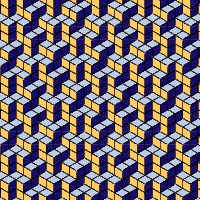
A substitution tiling with inflation factor sqrt(3), using a single prototile, namely a 60º rhomb. The substitution sends one rhomb to seven rhombs (instead of three, as one would expect from the inflation factor), thus the tiles in higher iterations do overlap. But the substitution is chosen in a …
Finite Rotations P Adic Windowed Tiling Polytopal Tiles Parallelogram Tiles Rhomb Tiles
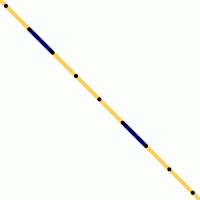
In some sense, the simplest cut and project tiling. It arises from the symbolic substitution a -> ab, b -> aa. Its internal space are the 2-adic integers.
P Adic Windowed Tiling One Dimensional Rep Tiles Self Similar Substitution
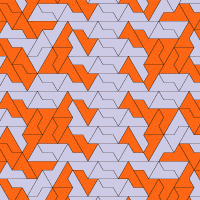
A classical example of a substitution with inflation factor 2. It arises from the well-known related rep-tile. It is not easy to see that this one is limitperiodic. This was shown in [LM01] , thus this one is a cut and project tiling, and therefore pure point diffractive. The prototile is not mirror …
With Decoration Finite Rotations P Adic Windowed Tiling Polytopal Tiles Rep Tiles Self Similar Substitution
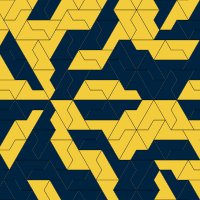
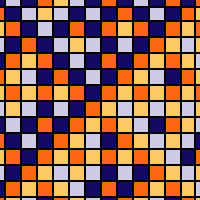
MLD to the more popular chair tiling, this version allows a simple translation into a coloured lattice: Replace each square of type i (1,2,3, or 4) with its midpoint, and assign to it colour i. Then each set of all points of colour i is a model set with internal p-adic space with p=2. This was first shown in [BMS98], a general framework is given in [LMS03].
With Decoration Finite Rotations P Adic Windowed Tiling Polytopal Tiles Self Similar Substitution Parallelogram Tiles Rhomb Tiles Mld Class Chair