Tilings with 7 Prototiles
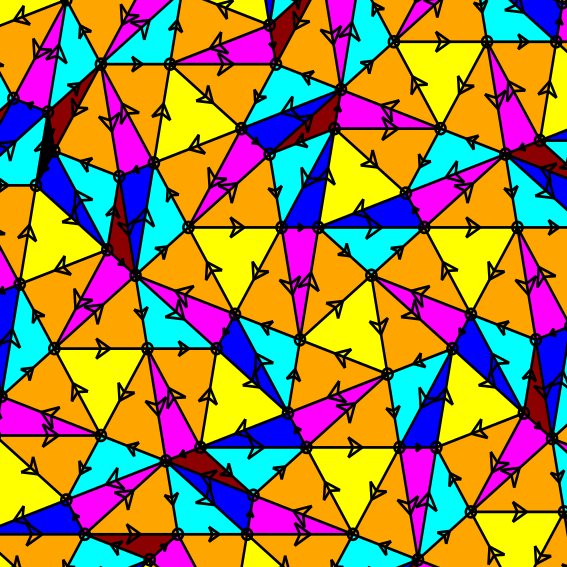
The 9-fold Needle Deltoid tiling was derived by K.P. Nischke using methods similar to the tilings in [ND96] . However, this tiling lacks full 9-fold symmetry.
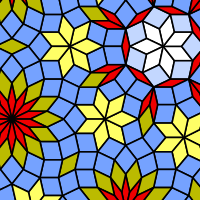
Schaad’s 7-fold is a variation of Madison’s 7-Fold, hence it shares many properties with it. It allows for tilings with global 7-fold symmetry and a lot of locally 7-fold symmetric patches. There are three tile shapes, but only seven instead of nine different prototiles. The inflation factor is a PV …
Polytopal Tiles Self Similar Substitution Finite Local Complexity Rhomb Tiles Finite Rotations
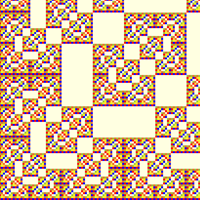
Denote the elements of the field $F_4$ by $\{0, 1, w, w + 1\}$, where $w$ satisfies the following equation with coefficients in $F_2: w2 + w + 1 = 0$.
Open Peano is a recurrent double sequence defined by $a(i, 0) = a(0, j) = w + 1$ and $a(i, j) = f(a(i, j-1), a(i-1, j-1), a(i-1, j))$, where $f(x, y, …
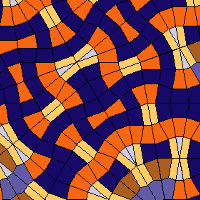
In order to generalize Danzer’s 7-fold tiling to n-fold symmetry,
where n>5 is odd, L. Danzer and D. Frettlöh introduced trapezoidal tiles,
each one the union of two triangles with edge lengths of the form $\sin(k \frac{\pi}{n})$.
It needs some further effort, including the introduction of three …
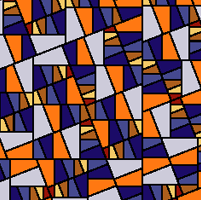
One of several substitution tilings found by L. Andritz using similar right-angled quadrilaterals.
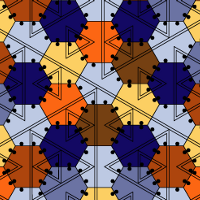
In 2009 Joan Taylor (Burnie, Tasmania) found a decoration of the hexagon, which - together with few local matching rules - allows only aperiodic tilings of the plane. This was probably the best example of an aperiodic monotile before the discovery of the Hat tiling. This decorated hexagonal tile, …
Aperiodic Monotile Self Similar Substitution