Polytopal Windowed Tiling
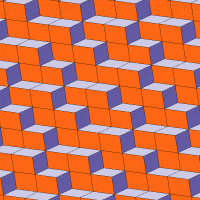
The dual tiling of the 1D tiling a->ab, b->c, c->a, resp. the version with polygonal tiles.
Finite Rotations Euclidean Windowed Tiling Polytopal Windowed Tiling Canonical Substitution Tiling Polytopal Tiles Parallelogramm Tiles
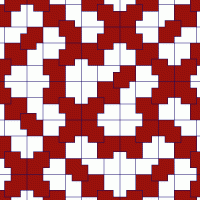
One of the tilings discovered R. Ammann in 1977, when he found several sets of aperiodic prototiles, i.e., prototiles with matching rules forcing nonperiodic tilings. These were published much later, in 1987, in [GS87] , where they were named Ammann A2 (our Ammann Chair), Ammann A3, Ammann A4, and …
With Decoration Finite Rotations Polytopal Windowed Tiling Canonical Substitution Tiling Parallelogram Tiles Self Similar Substitution Mld Class Ammann
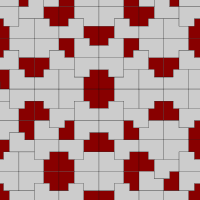
One of the tilings discovered by R. Ammann in 1977, published in [GS87] . The other ones (published there) are Ammann A3, Ammann A4, and Ammann A5 (better known as Ammann Beenker). The inflation factor of this substitution is quite small. It is the square root of the golden ratio, approx 1.272. …
Without Decoration Finite Rotations Polytopal Windowed Tiling Polytopal Tiles Self Similar Substitution
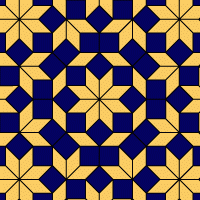
In 1977 R. Ammann found several sets of aperiodic tiles. This one (his set A5) is certainly the best-known of those. It allows tilings with perfect 8fold symmetry. The substitution factor is $1+\sqrt{2}$ - sometimes called the ‘silver mean’ - which was the first irrational inflation factor known …
With Decoration Finite Rotations Polytopal Windowed Tiling Canonical Substitution Tiling Rhomb Tiles Mld Class Ammann Matching Rules
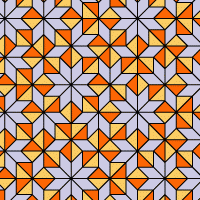
A self-similar version of the Ammann-Benker tiling. The colours of the triangles in the rule image indicate the orientation of the triangles: the orange triangle is just the ochre triangle reflected. Hence the rhomb supertile has two axes of mirror symmetry.
With Decoration Finite Rotations Euclidean Windowed Tiling Polytopal Windowed Tiling Canonical Substitution Tiling Polytopal Tiles Parallelogramm Tiles Self Similar Substitution
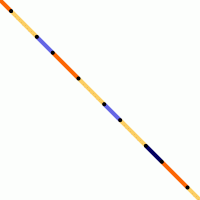
The substitution rule a1->a1 b1, a2->b2 a2, b1->a2, b2->a1. The tilings generated become Fibonacci tilings under the projection a1,a2->a and b1,b2->b. Alternatively one can simply remove the colour labels on the tiles. The name comes from the projection structure of the tiling. The expansion …
Euclidean Windowed Tiling Polytopal Windowed Tiling Canonical Substitution Tiling One Dimensional Polytopal Tiles Parallelogram Tiles Self Similar Substitution Mld Class Fibonacci
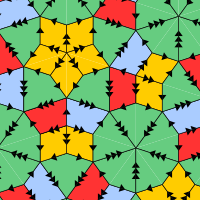
The tiling shares a mld-class with the Penrose Tilings, e.g. Penrose Rhomb, Penrose kite-dart and Penrose Pentagon boat star).
The inflation factor is the square of the golden mean $(\frac{\sqrt{5}}{2} + \frac{1}{2})^{2} = \frac{\sqrt{5}}{2} + \frac{3}{2} = 2.618033988\ldots$.
In contrast to the …
Without Decoration Finite Rotations Polytopal Windowed Tiling Canonical Substitution Tiling Mld Class Penrose
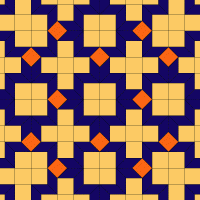
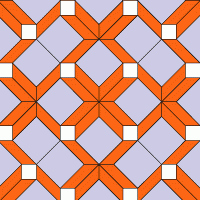
In his PhD thesis, E. Harriss classified all substitution tilings which are canonical projection tilings.
Here one example is shown, derived from the cut and project scheme of the Ammann-Beenker tilings.
Finite Rotations Euclidean Windowed Tiling Polytopal Windowed Tiling Canonical Substitution Tiling Polytopal Tiles Parallelogram Tiles
In his PhD thesis, E. Harriss classified all substitution tilings which are canonical projection tilings.
Here one example is shown, derived from the cut and project scheme of the Ammann-Beenker tilings.
Finite Rotations Euclidean Windowed Tiling Polytopal Windowed Tiling Canonical Substitution Tiling Polytopal Tiles Parallelogram Tiles
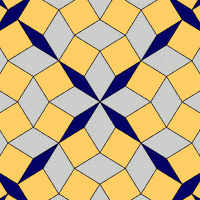
In his PhD thesis, E. Harriss classified all substitution tilings which are canonical projection tilings.
Here one example is shown, derived from the cut and project scheme of the Ammann-Beenker tilings.
Finite Rotations Euclidean Windowed Tiling Polytopal Windowed Tiling Canonical Substitution Tiling Polytopal Tiles Parallelogram Tiles Rhomb Tiles
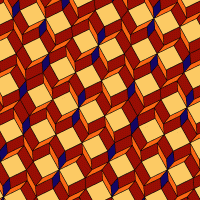
In his PhD thesis, E. Harriss classified all substitution tilings which are canonical projection tilings.
Here one example is shown, derived from the cut and project scheme of the Ammann-Beenker tilings.
Finite Rotations Euclidean Windowed Tiling Polytopal Windowed Tiling Canonical Substitution Tiling Polytopal Tiles Parallelogram Tiles
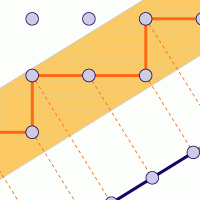
The classical example to explain the cut and project
method (see figure, lower part): In the standard square lattice $\mathbb{Z}^2$, choose a stripe with slope
$\frac{1}{\tau}$ (where tau is the golden ratio $\frac{1+\sqrt{5}}{2}$ ) of a certain width $\cos(\arctan(\frac{1}{\tau})) + …
Finite Rotations Polytopal Windowed Tiling Canonical Substitution Tiling One Dimensional Parallelogram Tiles Self Similar Substitution Mld Class Fibonacci
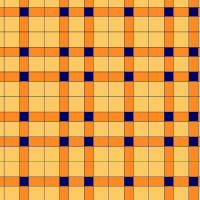
The 2dim analogue of the famous Fibonacci tiling in one dimension.
It is just the Cartesian product of two Fibonacci tilings $F_{1}$, $ F_{2} : \{ T_{1} \times T_{2}\ |\ T_{i}\ in\ F_{i}\}$.
Obviously, it can be generated by a substitution with three prototiles.
It shares a lot of nice features with …
Finite Rotations Euclidean Windowed Tiling Polytopal Windowed Tiling Polytopal Tiles Parallelogram Tiles Rhomb Tiles Self Similar Substitution
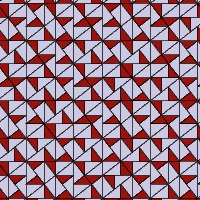
The substitution can be expressed by using the real inflation factor $\sqrt{\tau} = 1.272\ldots$, where $\tau=\frac{\sqrt{5}+1}{2}$ is the golden mean. This factor is not a PV number. Nevertheless, the tiling is pure point diffractive, and it is a cut and project tiling, see [Gel97]
, [Dv00]
. Thus …
With Decoration Finite Rotations Polytopal Windowed Tiling Polytopal Tiles Self Similar Substitution
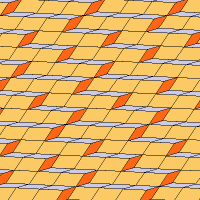
Finite Rotations Euclidean Windowed Tiling Polytopal Windowed Tiling Canonical Substitution Tiling Polytopal Tiles Parallelogram Tiles
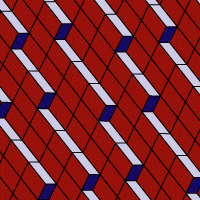
A polygonal version of Kenyon (1,2,1). The boundary is generated by the morphism $a \to b, b \to c, c \to c a' b' b'$ (where $x'$ is the inverse of $x$).
Finite Rotations Polytopal Windowed Tiling Canonical Substitution Tiling Parallelogram Tiles Kenyons Construction
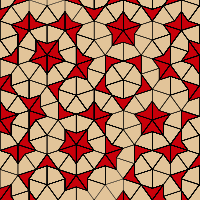
A classic, using a kite (blue) and a dart (orange) as prototiles. See Penrose Rhomb for more details.
Without Decoration Finite Rotations Polytopal Windowed Tiling Polytopal Tiles Mld Class Penrose
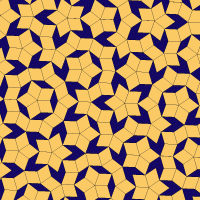
Certainly the most popular substitution tilings. Discovered in 1973 and 1974 by R. Penrose in - at least - three versions (Rhomb, Penrose kite-dart and Penrose Pentagon boat star), all of them forcing nonperiodic tilings by matching rules. It turns out that the three versions are strongly related: …
Without Decoration Finite Rotations Polytopal Windowed Tiling Canonical Substitution Tiling Rhomb Tiles Mld Class Penrose Matching Rules
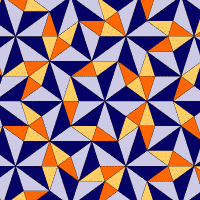
A variation of the Penrose rhomb tilings, suggested by R. M. Robinson. The rhombs are cut into triangles, thus making the substitution volume hierarchic. Thus, this one is obviously mld with the other Penrose tilings. For more details, see Penrose rhomb tilings. Each triangle comes either left- or …
Without Decoration Finite Rotations Polytopal Windowed Tiling Polytopal Tiles Self Similar Substitution Mld Class Penrose Generalized Robinson Triangles
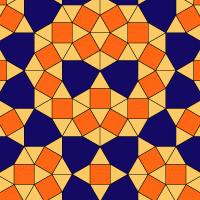
In connection with physical quasicrystals, the most interesting 2dim tilings are based on 5-, 8-, 10- and 12-fold rotational symmetry. This 12-fold tiling was studied by F. Gähler, in particular its cut and project scheme, the local matching rules and diffraction properties [Gah88]. The window of …
With Decoration Finite Rotations Euclidean Windowed Tiling Polytopal Windowed Tiling Polytopal Tiles Mld Class Shield and Socolar Matching Rules
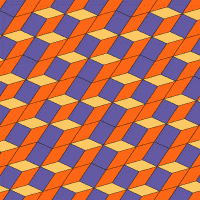
Finite Rotations Euclidean Windowed Tiling Polytopal Tiles Polytopal Windowed Tiling Canonical Substitution Tiling Parallelogram Tiles Plastic Number
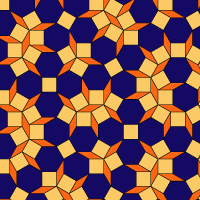
In connection with physical quasicrystals, the most interesting 2dim tilings are based on 5-, 8-, 10- and 12-fold rotational symmetry. This 12-fold tiling was studied thoroughly in [Soc89], where J. Socolar described the generating substitution as well as the local matching rules and the cut and …
Euclidean Windowed Tiling Polytopal Windowed Tiling Polytopal Tiles Parallelogram Tiles Canonical Substitution Tiling Mld Class Shield and Socolar Matching Rules
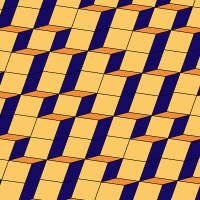
Finite Rotations Euclidean Windowed Tiling Polytopal Windowed Tiling Canonical Substitution Tiling Polytopal Tiles Parallelogram Tiles Self Similar Substitution
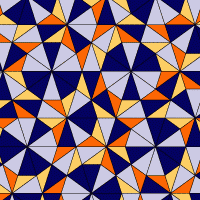
Beside the Penrose rhomb tilings (and its variations), this is a classical candidate to model 5-fold (resp. 10-fold) quasicrystals. The inflation factor is - as in the Penrose case - the golden mean, $\frac{\sqrt{5}}{2} + \frac{1}{2}$. The prototiles are Robinson triangles, but these tilings are not …
Finite Rotations Polytopal Windowed Tiling Polytopal Tiles Self Similar Substitution
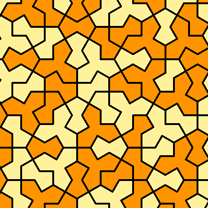
There is a very simple rule to transform the wheel tiling into the shield tiling: Replace each edge in the tiling by an edge orthogonal to it, of equal length, such that the old and new edge intersect in their midpoints. Applying this rule to the wheel tiling yields the shield tiling and vice versa. This is a very simple example of tilings which are mld.
With Decoration Finite Rotations Euclidean Windowed Tiling Polytopal Windowed Tiling Polytopal Tiles Mld Class Shield and Socolar