Rhomb Tiles
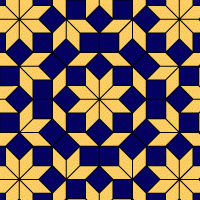
In 1977 R. Ammann found several sets of aperiodic tiles. This one (his set A5) is certainly the best-known of those. It allows tilings with perfect 8fold symmetry. The substitution factor is $1+\sqrt{2}$ - sometimes called the ‘silver mean’ - which was the first irrational inflation factor known …
With Decoration Finite Rotations Polytopal Windowed Tiling Canonical Substitution Tiling Rhomb Tiles Mld Class Ammann Matching Rules
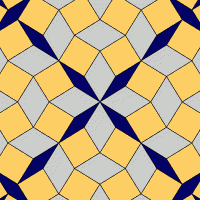
In his PhD thesis, E. Harriss classified all substitution tilings which are canonical projection tilings.
Here one example is shown, derived from the cut and project scheme of the Ammann-Beenker tilings.
Finite Rotations Euclidean Windowed Tiling Polytopal Windowed Tiling Canonical Substitution Tiling Polytopal Tiles Parallelogram Tiles Rhomb Tiles
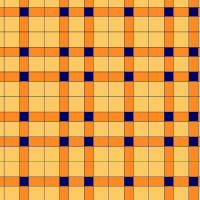
The 2dim analogue of the famous Fibonacci tiling in one dimension.
It is just the Cartesian product of two Fibonacci tilings $F_{1}$, $ F_{2} : \{ T_{1} \times T_{2}\ |\ T_{i}\ in\ F_{i}\}$.
Obviously, it can be generated by a substitution with three prototiles.
It shares a lot of nice features with …
Finite Rotations Euclidean Windowed Tiling Polytopal Windowed Tiling Polytopal Tiles Parallelogram Tiles Rhomb Tiles Self Similar Substitution
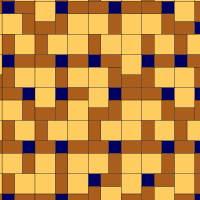
A simple variant of Fibonacci times Fibonacci, the latter arising from the one-dimensional Fibonacci tiling.
Finite Rotations Polytopal Tiles Parallelogram Tiles Rhomb Tiles Self Similar Substitution
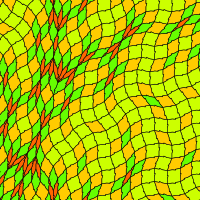
This tiling is a generalization of the Godreche-Lancon-Billard Binary first derived by T. Hibma and later worked out in detail by S. Pautze.
All interior angles are integer multiples of $\frac{\pi}{n}$.
For $n=5$ it is identical to the Godreche-Lancon-Billard Binary tiling with 2 prototiles.
For odd …
Finite Rotations Polytopal Tiles Parallelogramm Tiles Rhomb Tiles Finite Local Complexity
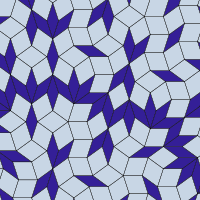
In [Lan88], energetic properties of certain decorations of Penrose Rhomb tilings were studied.
A $\frac{\pi}{5}$, $3\frac{\pi}{5}$}, or in {$2\frac{\pi}{5}$, $4\frac{\pi}{5}$}.
(‘Binary’ because …
Finite Rotations Polytopal Tiles Parallelogramm Tiles Rhomb Tiles Finite Local Complexity
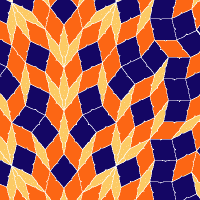
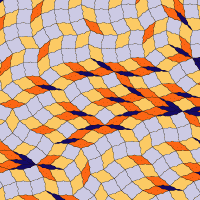
Whereas it is simple to generate rhomb tilings with n-fold symmetry by the cut and project method, it can be hard to find a substitution rule for such tilings. Here we see a rule for n=7. This one was later generalized by E. Harriss to arbitrary n.
Finite Rotations Canonical Substitution Tiling Polytopal Tiles Parallelogram Tiles Rhomb Tiles Harrisss Rhomb
Finite Rotations Polytopal Tiles Parallelogram Tiles Rhomb Tiles Harrisss Rhomb
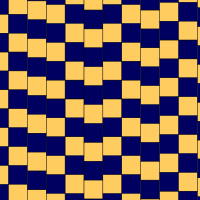
A simple substitution, yielding a tiling which is not of finite local complexity (flc). The substitution maps the single prototile, a unit square, to three columns of three squares each, where the third column is shifted by an irrational amount t. In higher iterates of the substitution, there are …
Polytopal Tiles Parallelogram Tiles Rhomb Tiles
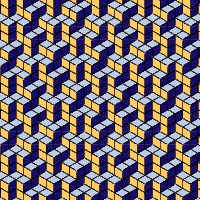
A substitution tiling with inflation factor sqrt(3), using a single prototile, namely a 60º rhomb. The substitution sends one rhomb to seven rhombs (instead of three, as one would expect from the inflation factor), thus the tiles in higher iterations do overlap. But the substitution is chosen in a …
Finite Rotations P Adic Windowed Tiling Polytopal Tiles Parallelogram Tiles Rhomb Tiles
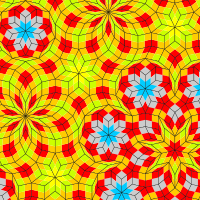
A tiling with 7-fold symmetry and a lot of locally 7-fold symmetric
patches. There are only three tile shapes, but nine different
prototiles. The inflation factor
is a PV number:
$2+2\cos\left(\frac{\pi}{7}\right)+2\cos\left(\frac{2\pi}{7}\right) = 5.04891733952231\ldots$
which is the largest root of $x^{3}-6x^{2}+5x-1$.
Polytopal Tiles Self Similar Substitution Finite Local Complexity Rhomb Tiles Finite Rotations
Finite Rotations Polytopal Tiles Self Similar Substitution Rhomb Tiles Finite Local Complexity
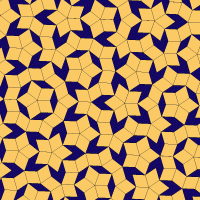
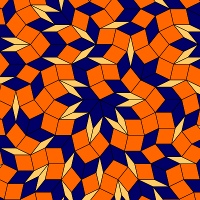
Certainly the most popular substitution tilings. Discovered in 1973 and 1974 by R. Penrose in - at least - three versions (Rhomb, Penrose kite-dart and Penrose Pentagon boat star), all of them forcing nonperiodic tilings by matching rules. It turns out that the three versions are strongly related: …
Without Decoration Finite Rotations Polytopal Windowed Tiling Canonical Substitution Tiling Rhomb Tiles Mld Class Penrose Matching Rules
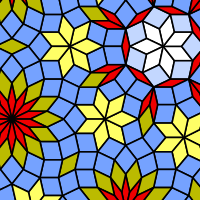
Schaad’s 7-fold is a variation of Madison’s 7-Fold, hence it shares many properties with it. It allows for tilings with global 7-fold symmetry and a lot of locally 7-fold symmetric patches. There are three tile shapes, but only seven instead of nine different prototiles. The inflation factor is a PV …
Polytopal Tiles Self Similar Substitution Finite Local Complexity Rhomb Tiles Finite Rotations
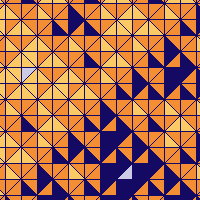
This one is mld to the semi-detached house tiling. A view at the latter (hopefully) explains the name. This version was realized in order to prove (or disprove) that the semi detached house tiling is a cut and project tiling with p-adic internal space. This is not the case, as was shown in [FS].
Finite Rotations Polytopal Tiles Parallelogram Tiles Rhomb Tiles Self Similar Substitution
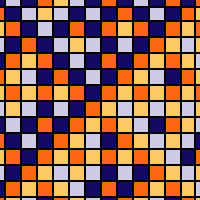
MLD to the more popular chair tiling, this version allows a simple translation into a coloured lattice: Replace each square of type i (1,2,3, or 4) with its midpoint, and assign to it colour i. Then each set of all points of colour i is a model set with internal p-adic space with p=2. This was first shown in [BMS98], a general framework is given in [LMS03].
With Decoration Finite Rotations P Adic Windowed Tiling Polytopal Tiles Self Similar Substitution Parallelogram Tiles Rhomb Tiles Mld Class Chair
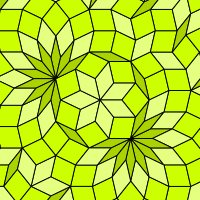
J. Kari and M. Rissanen derived a set of rhomb substitution tilings in [KR2016] with n-fold dihedral symmetry.
- All substitution rules have dihedral
$D_{2}$symmetry. - All edges of the substitution rules are equal and also have dihedral
$D_{2}$symmetry. - All interior angles of all prototiles are …
Polytopal Tiles Self Similar Substitution Finite Local Complexity Finite Rotations Rhomb Tiles
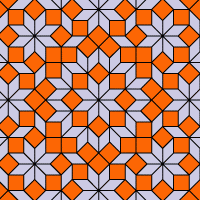
This tiling was originally introduced in [WSI87]
, however the description given there admits several substitution rules. This is the version given explicitly in [WSI95]
.
This is an example of a cut and project with a mixed internal space, a product of Euclidean and $p$-adic spaces, namely $\mathbb{R}^2 \times \mathbb{Q}_2$.
Finite Rotations Model Set Rhomb Tiles Polytopal Tiles Self Similar Substitution Finite Local Complexity