Tilings with Factor: $\frac{1 + \sqrt{5}}{2}$
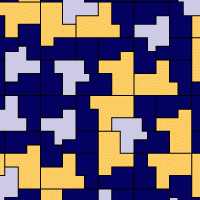
In 1977 Robert Ammann discovered a number of sets of aperiodic prototiles, i.e., prototiles with matching rules forcing nonperiodic tilings. These were published as late as 1987 in [GS87] , where they were named Ammann A2 (our Ammann Chair), Ammann A3, Ammann A4 and Ammann A5 (better known as Ammann …
Without Decoration Finite Rotations Euclidean Windowed Tiling Polytopal Tiles Self Similar Substitution
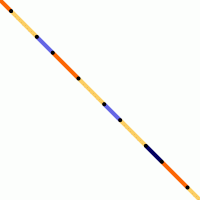
The substitution rule a1->a1 b1, a2->b2 a2, b1->a2, b2->a1. The tilings generated become Fibonacci tilings under the projection a1,a2->a and b1,b2->b. Alternatively one can simply remove the colour labels on the tiles. The name comes from the projection structure of the tiling. The expansion …
Euclidean Windowed Tiling Polytopal Windowed Tiling Canonical Substitution Tiling One Dimensional Polytopal Tiles Parallelogram Tiles Self Similar Substitution Mld Class Fibonacci
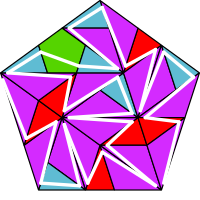
The FASS-curve of the pentagon bases on an aperiodic substitution tiling with four substitution rules and appropriate decorations.
The substitution tiling was derived from the Robinson Triangle Tiling.
Its inflation factor is the golden mean $\frac{\sqrt{5}}{2} + \frac{1}{2} = 1.618033988\ldots$.
Polytopal Tiles Self Similar Substitution With Decoration FASS_curve
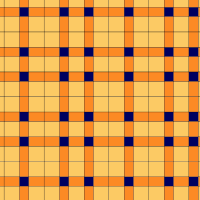
The 2dim analogue of the famous Fibonacci tiling in one dimension.
It is just the Cartesian product of two Fibonacci tilings $F_{1}$, $ F_{2} : \{ T_{1} \times T_{2}\ |\ T_{i}\ in\ F_{i}\}$.
Obviously, it can be generated by a substitution with three prototiles.
It shares a lot of nice features with …
Finite Rotations Euclidean Windowed Tiling Polytopal Windowed Tiling Polytopal Tiles Parallelogram Tiles Rhomb Tiles Self Similar Substitution
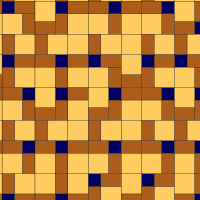
A simple variant of Fibonacci times Fibonacci, the latter arising from the one-dimensional Fibonacci tiling.
Finite Rotations Polytopal Tiles Parallelogram Tiles Rhomb Tiles Self Similar Substitution
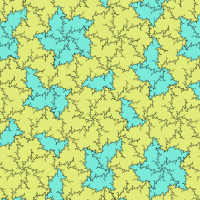
A fractalized version of the Penrose Kite and Dart tilings. Unlike Kite and Dart, this version is a selfsimilar substitution.
Self Similar Substitution
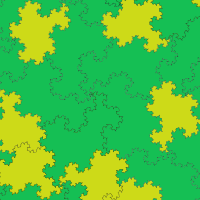
A selfsimilar version of a substitution with Penrose rhombs, but without reflections. These tilings are mld to the Penrose Rhomb tilings, even though they lack their mirror symmetry.
Self Similar Substitution
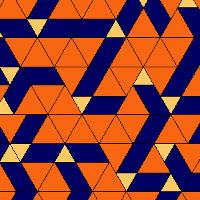
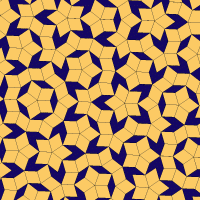
Certainly the most popular substitution tilings. Discovered in 1973 and 1974 by R. Penrose in - at least - three versions (Rhomb, Penrose kite-dart and Penrose Pentagon boat star), all of them forcing nonperiodic tilings by matching rules. It turns out that the three versions are strongly related: …
Without Decoration Finite Rotations Polytopal Windowed Tiling Canonical Substitution Tiling Rhomb Tiles Mld Class Penrose Matching Rules
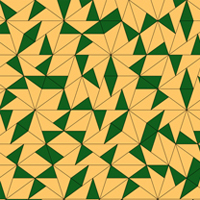
A simple variant of the Robinson triangle substitution. This substitution uses no reflections. The resulting tilings are not longer vertex-to-vertex, but still flc.
Finite Rotations Polytopal Tiles Self Similar Substitution
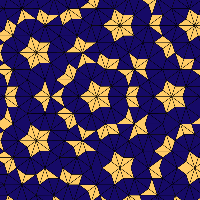
The Robinson Triangle substitution is just one out of several possibilities to play with the triangle versions of the Penrose tilings. Another one is the Tübingen Triangle substitution. Here is an example where the obtuse triangle is the smaller prototile, and the acute triangle is the larger one. …
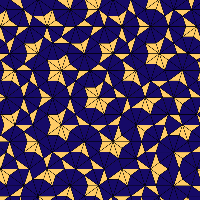
The Robinson Triangle substitution is just one out of several possibilities to play with the triangle versions of the Penrose tilings. Another one is the Tübingen Triangle substitution. Here is an example where the obtuse triangle is the smaller prototile, and the acute triangle is the larger one. …
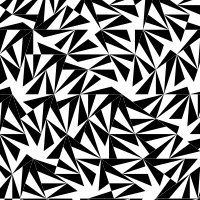
A variation of the Robinson Triangle substitution where the tiles are decorated in order to produce striking visual effects. The idea came from the design of Aperiodic 2012 in Cairns, Australia. Other variants can be found in psychedelic-penrose-variant-2, psychedelic-penrose-variant-3, …
Finite Rotations Polytopal Tiles Self Similar Substitution
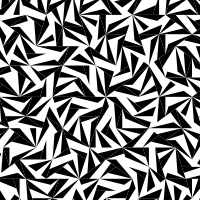
A variation of the Robinson Triangle substitution where the tiles are decorated in order to produce striking visual effects. The idea came from the design of Aperiodic 2012 in Cairns, Australia. Other variants can be found in psychedelic-penrose-variant-1, psychedelic-penrose-variant-3, …
Finite Rotations Polytopal Tiles Self Similar Substitution
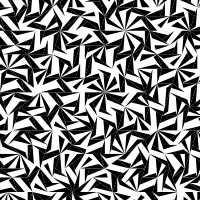
A variation of the Robinson Triangle substitution where the tiles are decorated in order to produce striking visual effects. The idea came from the design of Aperiodic 2012 in Cairns, Australia. Other variants can be found in psychedelic-penrose-variant-1, psychedelic-penrose-variant-2, …
Finite Rotations Polytopal Tiles Self Similar Substitution
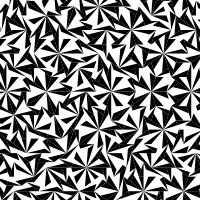
A variation of the Robinson Triangle substitution where the tiles are decorated in order to produce striking visual effects. The idea came from the design of Aperiodic 2012 in Cairns, Australia. Other variants can be found in psychedelic-penrose-variant-1, psychedelic-penrose-variant-2, …
Finite Rotations Polytopal Tiles Self Similar Substitution
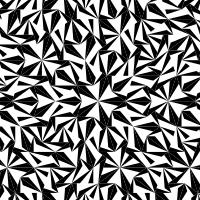
A variation of the Robinson Triangle substitution where the tiles are decorated in order to produce striking visual effects. The idea came from the design of Aperiodic 2012 in Cairns, Australia. Other variants can be found in psychedelic-penrose-variant-1, psychedelic-penrose-variant-2, …
Finite Rotations Polytopal Tiles Self Similar Substitution
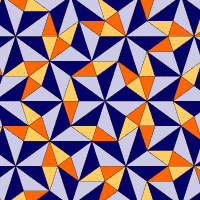
A variation of the Penrose rhomb tilings, suggested by R. M. Robinson. The rhombs are cut into triangles, thus making the substitution volume hierarchic. Thus, this one is obviously mld with the other Penrose tilings. For more details, see Penrose rhomb tilings. Each triangle comes either left- or …
Without Decoration Finite Rotations Polytopal Windowed Tiling Polytopal Tiles Self Similar Substitution Mld Class Penrose Generalized Robinson Triangles
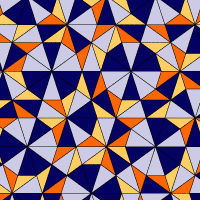
Beside the Penrose rhomb tilings (and its variations), this is a classical candidate to model 5-fold (resp. 10-fold) quasicrystals. The inflation factor is - as in the Penrose case - the golden mean, $\frac{\sqrt{5}}{2} + \frac{1}{2}$. The prototiles are Robinson triangles, but these tilings are not …
Finite Rotations Polytopal Windowed Tiling Polytopal Tiles Self Similar Substitution