Tilings with Factor: $2$
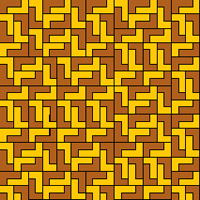
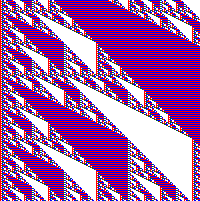
Denote the elements of the field $F_{4}$ by ${0, 1, w, w + 1}$, where w satisfies the following equation with coefficients in $F2: w^{2} + w + 1 = 0$.
Bumerang is a recurrent double sequence defined by $a(i, 0) = a(0, j) = 1$ and $a(i, j) = f(a(i, j-1), a(i-1, j-1), a(i-1, j) )$,
where $f(x, y, z ) …
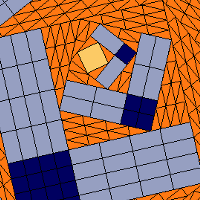
The substitution system uses 4 letters. With:
$x = \frac{\pi}{7}$, $c = \cos(x)$ and $s = \sin(x)$
They are: two squares of side lengths $1$ and $2-c-s$; a rectangle with sides $c+s$ and $2-c-s$: and a right triangle with legs $c$ and $s$.
The substitution is indicated in the figure. Up to our …
Self Similar Substitution Infinite Rotations
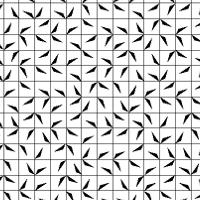
A simple non-periodic substitution tiling with just one decorated prototile mentioned in the extended version of [Goo98] .

The chair tiling, as most tilings presented here, is nonperiodic. But there is a strong resemblance to periodic tiling. For instance, the set of vertex points in the tiling obviously spans a square lattice. Moreover, it is possible to detect large subsets in the tiling which are fully periodic. For …
Finite Rotations P Adic Windowed Tiling Polytopal Tiles Rep Tiles Self Similar Substitution Mld Class Chair
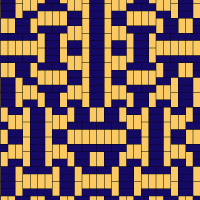
Also known as ’table tiling’. In [Sol97] was shown that its dynamical spectrum has a continuous component. Thus it cannot be a cut and project tiling. The same was shown in [Rob99] , where a topological model of the dynamical system of the domino tilings is obtained.
Polyomio Tiling Finite Rotations Polyomio Tilings Rep Tiles Self Similar Substitution
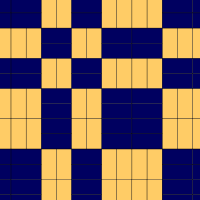
A simple variant of the domino tilings (aka table tilings).
C. Goodman-Strauss pointed out in [Goo98] the following. B. Solomyak
proved in Sol98,
that for each nonperiodic substitution tiling the substitution rule is invertible:
One can tell from $\sigma(T)$ its predecessor $T$ uniquely. But this is …
Finite Rotations P Adic Windowed Tiling Polytopal Tiles Parallelogram Tiles Polyomio Tiling Rep Tiles Self Similar Substitution
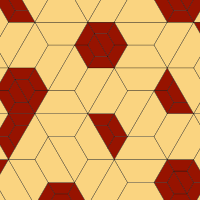
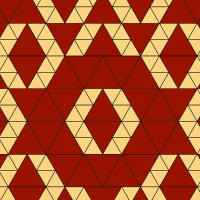
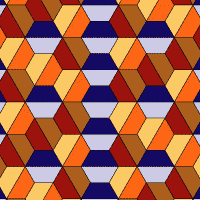
This one is easily seen to be limitperiodic: A large portion of the tiling is periodic. Thus it is a cut and project tiling. A detailed description of the corresponding cut and project scheme is contained in [Fre02].
The substitution occurs already in [GS87], see Exercise 10.1.3.
Finite Rotations P Adic Windowed Tiling Polytopal Tiles Rep Tiles Self Similar Substitution
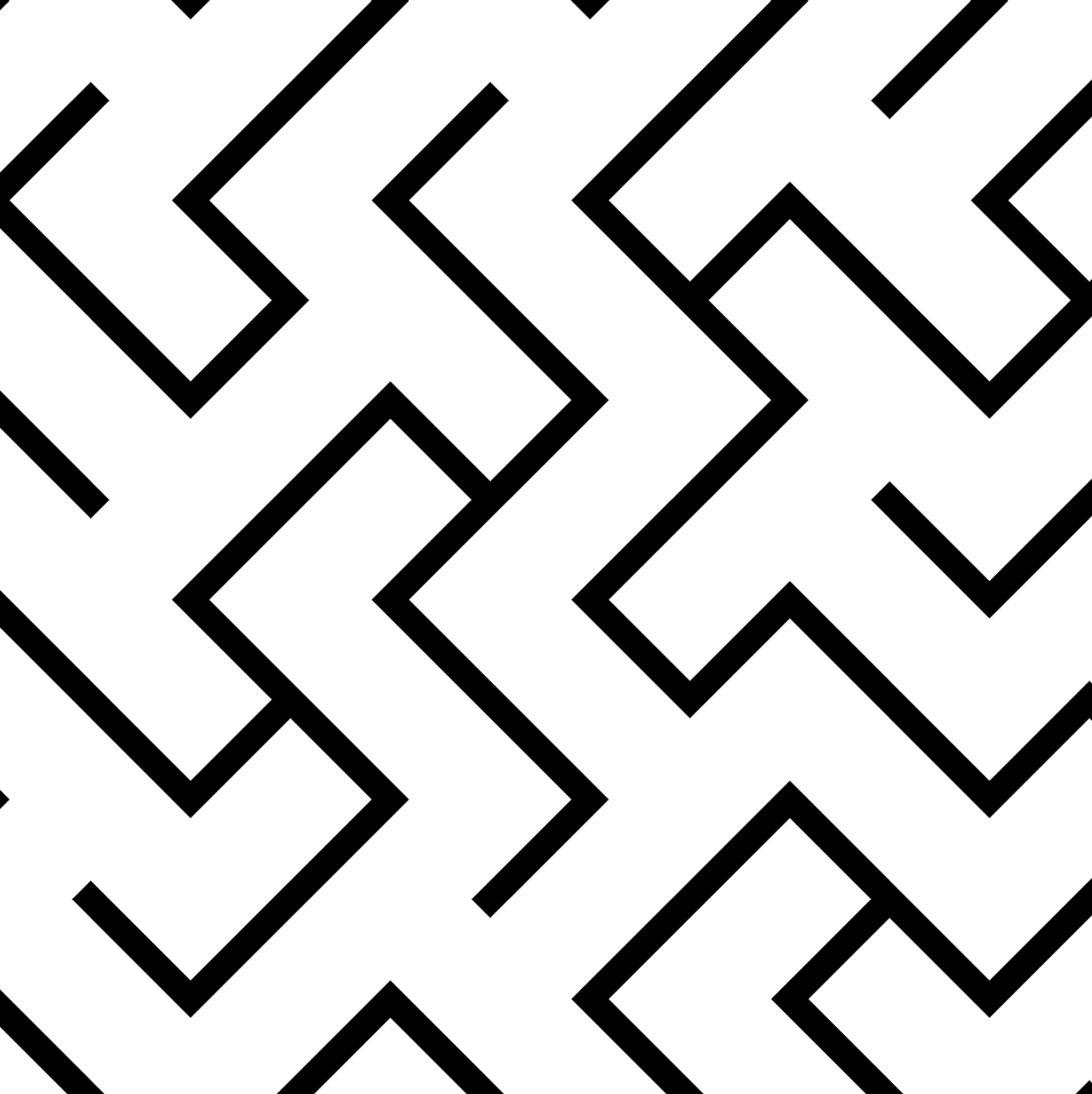
An artistic version of the Hofstetter 4fold tilings. For details see there.
P Adic Windowed Tiling Polytopal Tiles
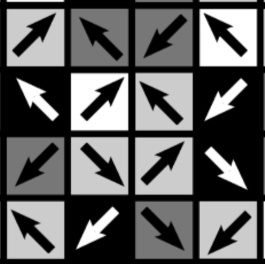
A decorated version of the Hofstetter 4fold tilings. This version can be generated by a proper substitution rule. It was shown in [FH15] that this version is aperiodic, as well as limitperiodic. For more details see Hofstetters 4-fold.
P Adic Windowed Tiling Polytopal Tiles
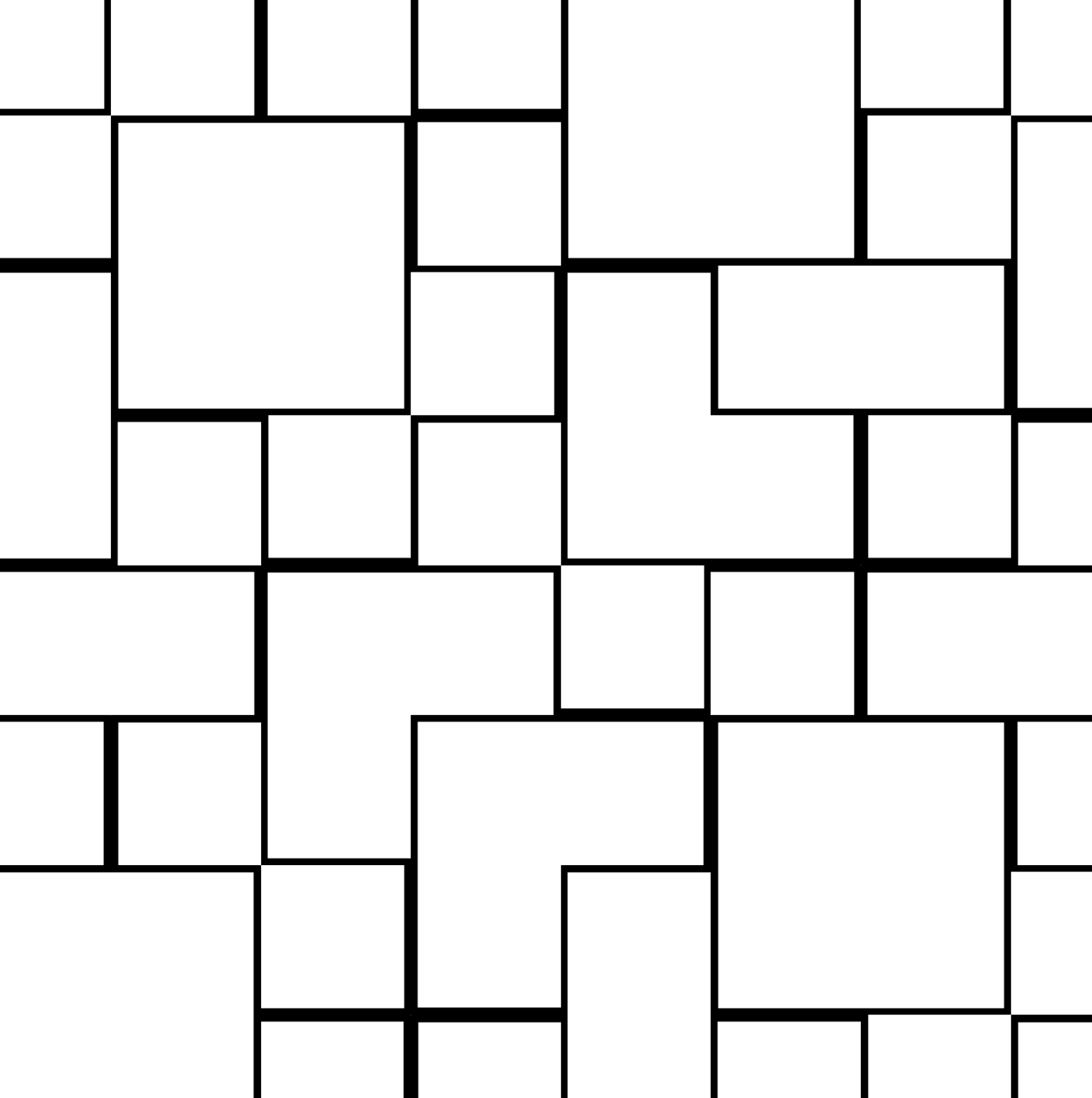
The Viennese Artist Hofstetter Kurt found a new iteration method that produces aperiodic tilings. The idea is illustrated in the figure below: one starts with a single square tile of edge length one. A second square tile of the same size is put below the first one, such that its SW corner is …
P Adic Windowed Tiling Polytopal Tiles
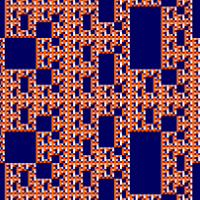
Denote the elements of the field $F_{4}$ by $\{0, 1, w, w + 1\}$, where $w$ satisfies the following equation with coefficients in $F_{2}: w^{2} + w + 1 = 0$.
Infinity is a recurrent double sequence defined by $a(i, 0) = a(0, j) = 1$ and $a(i, j) = f(a(i, j-1), a(i-1, j-1), a(i-1, j))$,
where $f(x, …
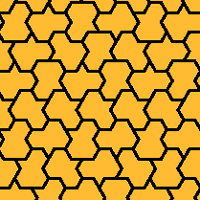
A substitution yielding tilings with statistical 6-fold symmetry, with inflation factor 2. It is not known whether this one is a cut and project tiling or not. If it is, it has necessarily a p-adic internal space.
Finite Rotations Polytopal Tiles
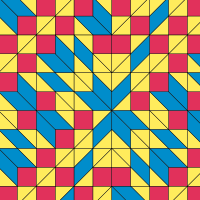
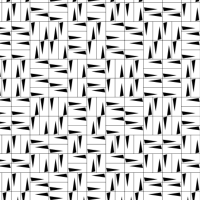
A simple substitution rule, using three Tangram pieces as prototiles.
Finite Rotations Polytopal Tiles Self Similar Substitution
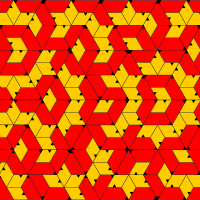
The Monnier Trapezium and Diamond tiling uses two prototiles,
a trapezium and a rhomb. The inflation factor is $2$.
By changing the chiralities of the prototiles within the first level
supertiles several further variants can be derived.
Finite Local Complexity Polytopal Tiles Self Similar Substitution With Decoration Limitperiodic
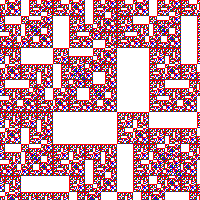
Denote the elements of the field $F_{4}$ by $\{0, 1, w, w + 1\}$, where $w$ satisfies the following equation with coefficients in $F_{2}: w^{2} + w + 1 = 0$.
Mothman is a recurrent double sequence defined by $a(i, 0) = a(0, j) = 1$ and
$a(i, j) = f(a(i, j-1), a(i-1, j-1), a(i-1, j))$,
where $f(x, y, …
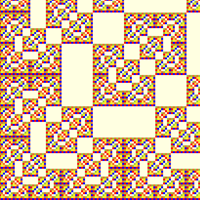
Denote the elements of the field $F_4$ by $\{0, 1, w, w + 1\}$, where $w$ satisfies the following equation with coefficients in $F_2: w2 + w + 1 = 0$.
Open Peano is a recurrent double sequence defined by $a(i, 0) = a(0, j) = w + 1$ and $a(i, j) = f(a(i, j-1), a(i-1, j-1), a(i-1, j))$, where $f(x, y, …
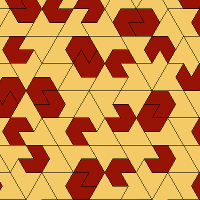
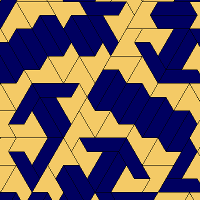
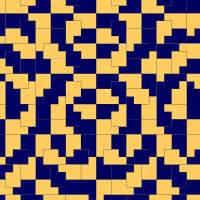
A substitution arising from a polyomio rep-tile. This one is made of five unit squares, thus the name. The tiles are coloured blue or ochre, according to their chirality (left-handed vs right-handed).
Finite Rotations Polytopal Tiles Polyomio Tilings Rep Tiles Self Similar Substitution
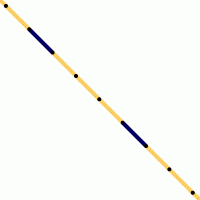
In some sense, the simplest cut and project tiling. It arises from the symbolic substitution a -> ab, b -> aa. Its internal space are the 2-adic integers.
P Adic Windowed Tiling One Dimensional Rep Tiles Self Similar Substitution
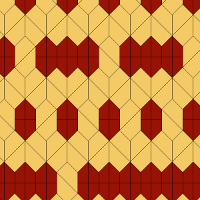
A variant of semi-detached house. In contrast to the latter, this one is a model set with p-adic internal space.
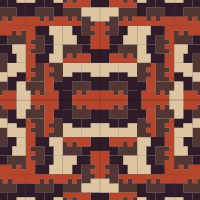
A substitution tiling using four different prototiles, as described by [LS12].
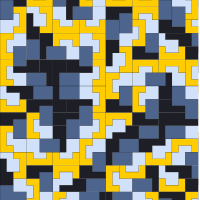
A substitution tiling using four different prototiles, as described by [LS12].
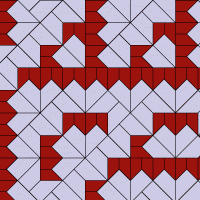
A simple substitution rule with inflation factor 2, using two prototiles only. A glimpse on the image hopefully explains the name. The translation module is a square lattice, which is a hint that the semi-detached house tilings may be a model set with p-adic internal space. This question (model set or not) was raised in [Fre02] and was answered in [FS] .
Finite Rotations Polytopal Tiles Self Similar Substitution
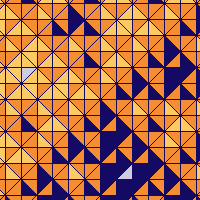
This one is mld to the semi-detached house tiling. A view at the latter (hopefully) explains the name. This version was realized in order to prove (or disprove) that the semi detached house tiling is a cut and project tiling with p-adic internal space. This is not the case, as was shown in [FS].
Finite Rotations Polytopal Tiles Parallelogram Tiles Rhomb Tiles Self Similar Substitution
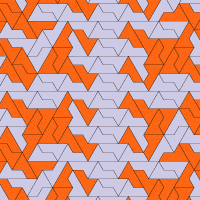
A classical example of a substitution with inflation factor 2. It arises from the well-known related rep-tile. It is not easy to see that this one is limitperiodic. This was shown in [LM01] , thus this one is a cut and project tiling, and therefore pure point diffractive. The prototile is not mirror …
With Decoration Finite Rotations P Adic Windowed Tiling Polytopal Tiles Rep Tiles Self Similar Substitution
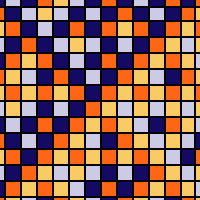
MLD to the more popular chair tiling, this version allows a simple translation into a coloured lattice: Replace each square of type i (1,2,3, or 4) with its midpoint, and assign to it colour i. Then each set of all points of colour i is a model set with internal p-adic space with p=2. This was first shown in [BMS98], a general framework is given in [LMS03].
With Decoration Finite Rotations P Adic Windowed Tiling Polytopal Tiles Self Similar Substitution Parallelogram Tiles Rhomb Tiles Mld Class Chair
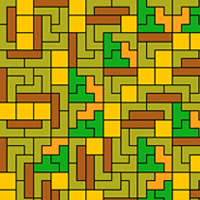
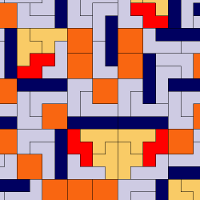
A classic. A lot of detail can be found in [JS99].
One Dimensional Self Similar Substitution
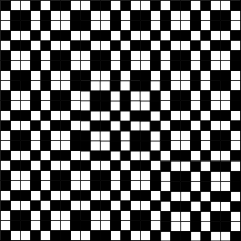
This is the 2D version of the one-dimensional Thue Morse tiling due to Shelomo Ben-Abraham et.al. The graphic was created by Leif Borgstedt.
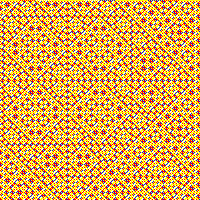
Denote the elements of the field $F_4$ by $\{0, 1, w, w + 1\}$, where $w$ satisfies the following equation with coefficients in $F_2: w^2 + w + 1 = 0$.
Treasure is a recurrent double sequence defined by $a(i, 0) = a(0, j) = 1$ and $a(i, j) = f(a(i, j-1), a(i-1, j-1), a(i-1, j))$,
where $f(x, y, z) = …
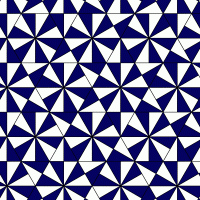
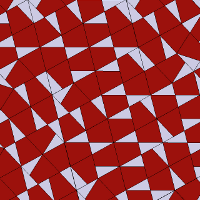
A simple rule to generate nonperiodic tilings with one prototile, a triangle with angles 30°, 60°, 90°. It looks pretty much periodic: the hexagonal patches cover 75% of the plane, and this part is clearly periodic. The triangles in between the hexagons destroy the periodicity. But, by the …
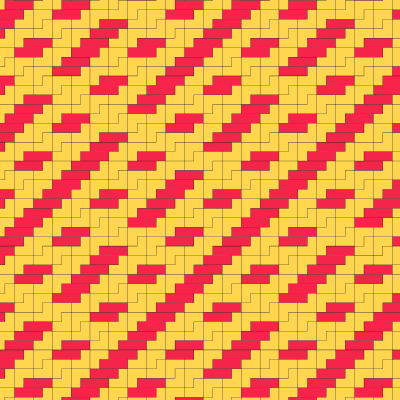
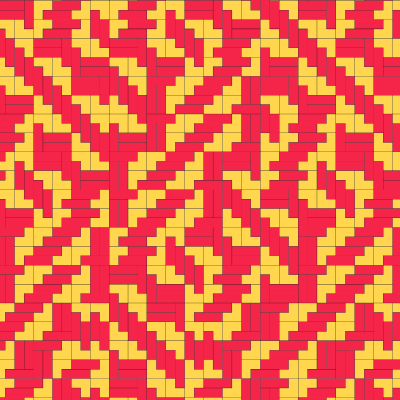
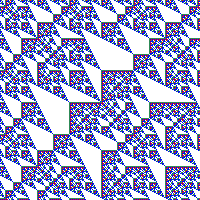
Denote the elements of the field $F_4$ by $\{0, 1, w, w + 1\}$, where $w$ satisfies the following equation with coefficients in $F_2: w^2 + w + 1 = 0$.
Vampire is a recurrent double sequence defined by $a(i, 0) = a(0, j) = 1$ and $a(i, j) = f(a(i, j-1), a(i-1, j-1), a(i-1, j))$,
where $f(x, y, z) = …

This Wanderer tiling is the first of an infinite series of substitution tilings by Joan Taylor based on paper-folding sequences. It uses a single square tile with four distinct rotations and two distinct reflections. Here we use colours to distinguish left-handed (brown) from right-handed (white) …
Limitperiodic Polytopal Tiles Rep Tiles Self Similar Substitution
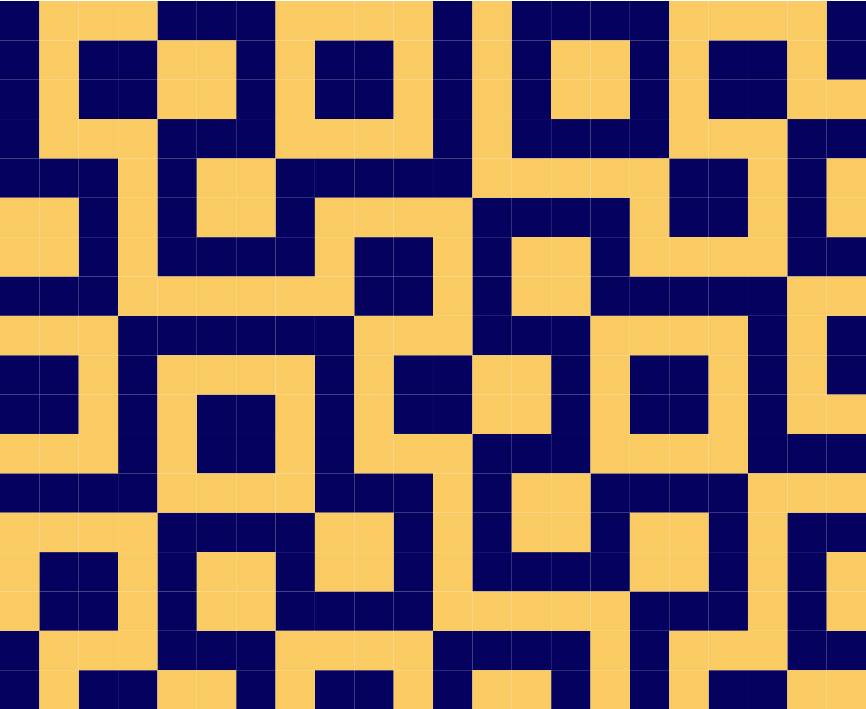
This Wanderer tiling is one in an infinite series of substitution tilings by Joan Taylor based on paper-folding sequences. It uses a single square tile with four distinct rotations and two distinct reflections. Here we use colours to distinguish vertical (blue) from horizontal (ochre) tiles. In the …
Limitperiodic Polytopal Tiles Rep Tiles Self Similar Substitution