Rep-Tiles
Substitution rules with just a single tile.
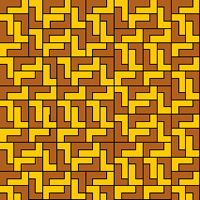
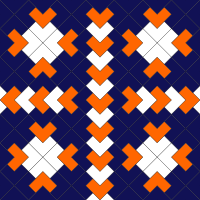
The chair tiling, as most tilings presented here, is nonperiodic. But there is a strong resemblance to periodic tiling. For instance, the set of vertex points in the tiling obviously spans a square lattice. Moreover, it is possible to detect large subsets in the tiling which are fully periodic. For …
Finite Rotations P Adic Windowed Tiling Polytopal Tiles Rep Tiles Self Similar Substitution Mld Class Chair
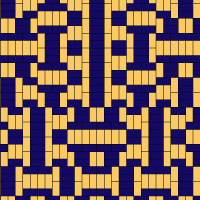
Also known as ’table tiling’. In [Sol97] was shown that its dynamical spectrum has a continuous component. Thus it cannot be a cut and project tiling. The same was shown in [Rob99] , where a topological model of the dynamical system of the domino tilings is obtained.
Polyomio Tiling Finite Rotations Polyomio Tilings Rep Tiles Self Similar Substitution
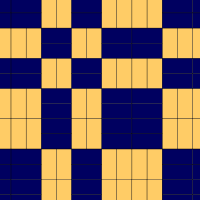
A simple variant of the domino tilings (aka table tilings).
C. Goodman-Strauss pointed out in [Goo98] the following. B. Solomyak
proved in Sol98,
that for each nonperiodic substitution tiling the substitution rule is invertible:
One can tell from $\sigma(T)$ its predecessor $T$ uniquely. But this is …
Finite Rotations P Adic Windowed Tiling Polytopal Tiles Parallelogram Tiles Polyomio Tiling Rep Tiles Self Similar Substitution

A generalization of the domino substitution. There are several possibilities to play with 1x2 rectangles (dominos) in order to generate non-periodic tilings.
The decorative lining shows here how the prototile gets turned and mirrored for this example. The two rules are actually exactly the same. For decoration the horizontal tile was colored purple.
Finite Rotations Polytopal Tiles Polyomio Tiling Rep Tiles Self Similar Substitution
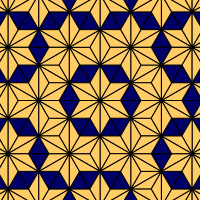
A substitution tiling found by Bill Kalahurka, Texas, in 2009 (?). It is mld to T2000 by L. Danzer in 2000.
Finite Rotations P Adic Windowed Tiling Polytopal Tiles Rep Tiles Self Similar Substitution Two Dimensional
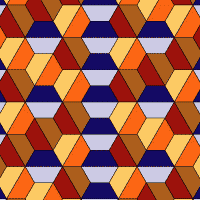
This one is easily seen to be limitperiodic: A large portion of the tiling is periodic. Thus it is a cut and project tiling. A detailed description of the corresponding cut and project scheme is contained in [Fre02].
The substitution occurs already in [GS87], see Exercise 10.1.3.
Finite Rotations P Adic Windowed Tiling Polytopal Tiles Rep Tiles Self Similar Substitution
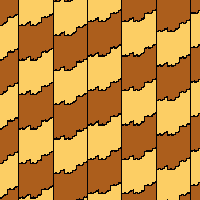
A simple substitution rule, generating tilings which don’t possess flc. The fractally shaped tiles make it a selfsimilar-substitution. Despite the fractal apperance, the dimension of the boundary of the prototile is one almost everywhere: the boundary of the tile consists of lines almost everywhere …
Rep Tiles Self Similar Substitution
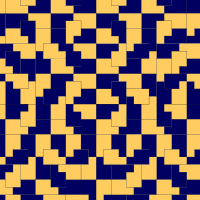
A substitution arising from a polyomio rep-tile. This one is made of five unit squares, thus the name. The tiles are coloured blue or ochre, according to their chirality (left-handed vs right-handed).
Finite Rotations Polytopal Tiles Polyomio Tilings Rep Tiles Self Similar Substitution
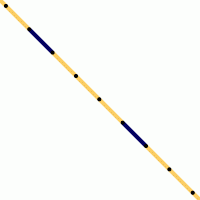
In some sense, the simplest cut and project tiling. It arises from the symbolic substitution a -> ab, b -> aa. Its internal space are the 2-adic integers.
P Adic Windowed Tiling One Dimensional Rep Tiles Self Similar Substitution
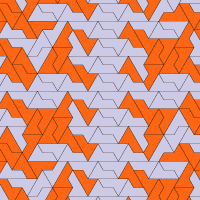
A classical example of a substitution with inflation factor 2. It arises from the well-known related rep-tile. It is not easy to see that this one is limitperiodic. This was shown in [LM01] , thus this one is a cut and project tiling, and therefore pure point diffractive. The prototile is not mirror …
With Decoration Finite Rotations P Adic Windowed Tiling Polytopal Tiles Rep Tiles Self Similar Substitution
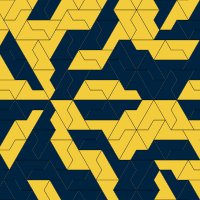
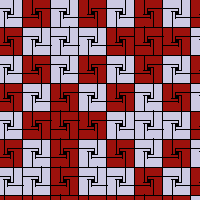
This substitution arises from a reptile with infinitely many straight edges, cf. [GS87]. It answers the question ‘Are there selfsimilar substitution tilings where the prototiles have infinitely many straight edges?’ positively. The colours of the tiles indicate their chirality. The substitution rule …
Finite Rotations Rep Tiles

A simple rule with just one prototile that generates tilings with statistical circular symmetry. The image use two colours for the aesthetic effect only. The substitution do not even use reflections, so the tilings consist of ‘right-handed’ tiles only.
Infinite Rotations Polytopal Tiles Rep Tiles Self Similar Substitution

This Wanderer tiling is the first of an infinite series of substitution tilings by Joan Taylor based on paper-folding sequences. It uses a single square tile with four distinct rotations and two distinct reflections. Here we use colours to distinguish left-handed (brown) from right-handed (white) …
Limitperiodic Polytopal Tiles Rep Tiles Self Similar Substitution
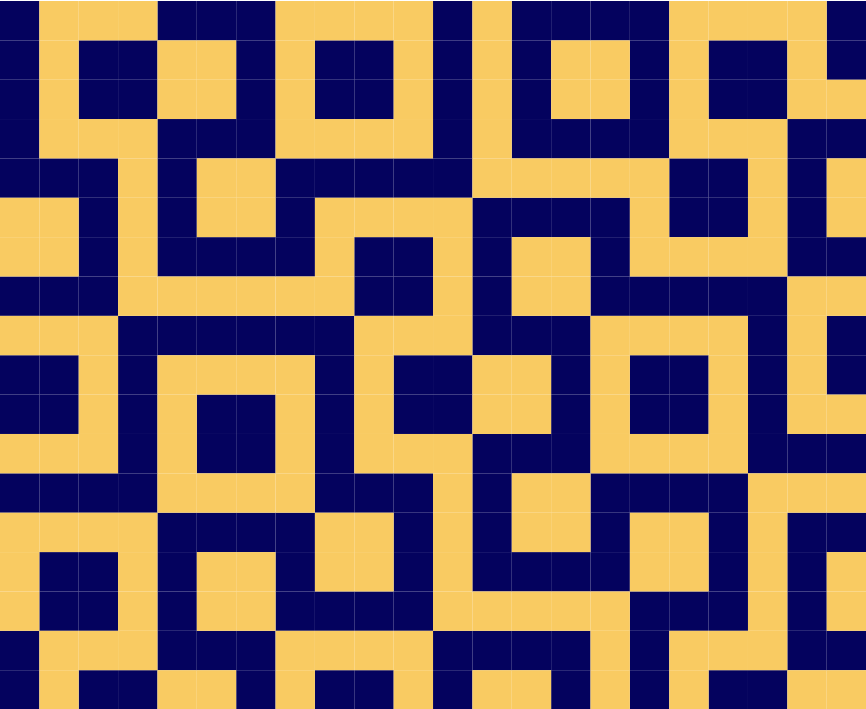
This Wanderer tiling is one in an infinite series of substitution tilings by Joan Taylor based on paper-folding sequences. It uses a single square tile with four distinct rotations and two distinct reflections. Here we use colours to distinguish vertical (blue) from horizontal (ochre) tiles. In the …
Limitperiodic Polytopal Tiles Rep Tiles Self Similar Substitution