Tilings with 1 Prototile
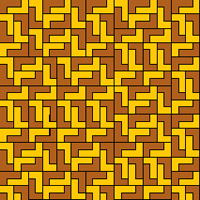
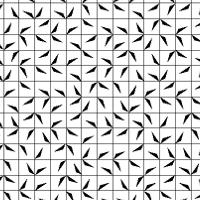
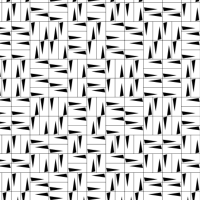
A simple non-periodic substitution tiling with just one decorated prototile mentioned in the extended version of [Goo98] .
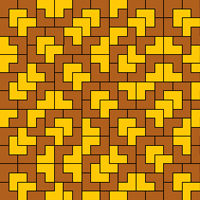
A more or less obvious variant of the chair substitution.
Finite Rotations Polytopal Tiles Self Similar Substitution
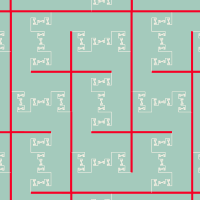
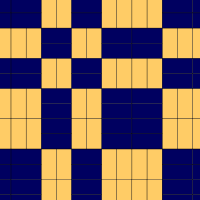
A simple variant of the domino tilings (aka table tilings).
C. Goodman-Strauss pointed out in [Goo98] the following. B. Solomyak
proved in Sol98,
that for each nonperiodic substitution tiling the substitution rule is invertible:
One can tell from $\sigma(T)$ its predecessor $T$ uniquely. But this is …
Finite Rotations P Adic Windowed Tiling Polytopal Tiles Parallelogram Tiles Polyomio Tiling Rep Tiles Self Similar Substitution
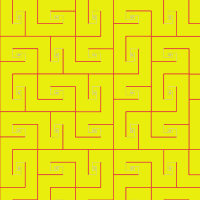
A relative of the Squiral tiling. The boundary of the prototile has infinitely many line segments, but it has still finite length. A relative of this tiling is Dampflok, where the boundary of the prototile has infinite length, even though it consists of line segments (and accumulation points) only.
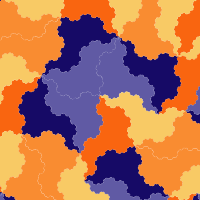
It is hard to find substitution tilings with dense tile orientations (like the pinwheel tiling) that uses a single prototile with fractal boundary. The fractal version of he pinwheel tiling by Frank and whittaker uses 13 different prototiles.
An extensive computer search revealed that there are only …
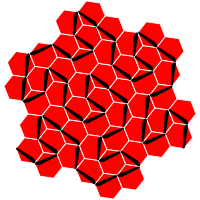
The Gosper Curve is a FASS-curve which can be derived by a substitution tiling with one substitution rule and appropriate decorations.
The inflation factor $q$ is $\sqrt{7}$.
Finite Local Complexity Polytopal Tiles Self Similar Substitution With Decoration Limitperiodic FASS_curve
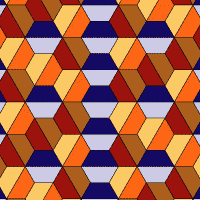
This one is easily seen to be limitperiodic: A large portion of the tiling is periodic. Thus it is a cut and project tiling. A detailed description of the corresponding cut and project scheme is contained in [Fre02].
The substitution occurs already in [GS87], see Exercise 10.1.3.
Finite Rotations P Adic Windowed Tiling Polytopal Tiles Rep Tiles Self Similar Substitution
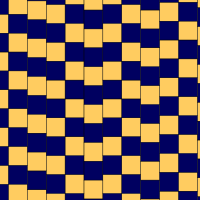
A simple substitution, yielding a tiling which is not of finite local complexity (flc). The substitution maps the single prototile, a unit square, to three columns of three squares each, where the third column is shifted by an irrational amount t. In higher iterates of the substitution, there are …
Polytopal Tiles Parallelogram Tiles Rhomb Tiles
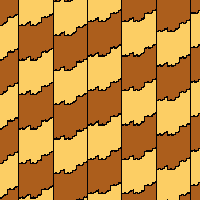
A simple substitution rule, generating tilings which don’t possess flc. The fractally shaped tiles make it a selfsimilar-substitution. Despite the fractal apperance, the dimension of the boundary of the prototile is one almost everywhere: the boundary of the tile consists of lines almost everywhere …
Rep Tiles Self Similar Substitution
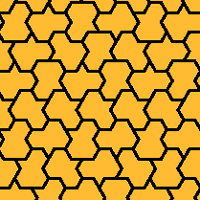
A substitution yielding tilings with statistical 6-fold symmetry, with inflation factor 2. It is not known whether this one is a cut and project tiling or not. If it is, it has necessarily a p-adic internal space.
Finite Rotations Polytopal Tiles
A substitution tiling with inflation factor $\sqrt{3}$, using a single prototile, namely a 60º rhomb. The substitution sends one rhomb to seven rhombs (instead of three, as one would expect from the inflation factor), thus the tiles in higher iterations do overlap. But the substitution is chosen in …
Finite Rotations P Adic Windowed Tiling Polytopal Tiles Parallelogram Tiles Rhomb Tiles
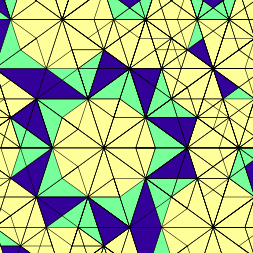
A substitution rule where the tiles are allowed to overlap. The image left indicates, that the yellow and the green tiles do overlap. It is unknown whether these tilings are mld to the Penrose Rhomb tilings.
Finite Rotations Euclidean Windowed Tiling Polytopal Tiles
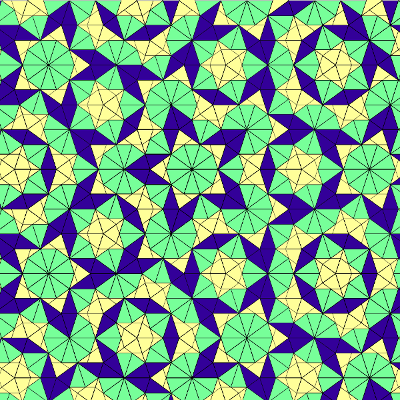
As Overlapping Robinson Triangles I, this is a variant of the Penrose Rhomb tiling, using only one prototile, and the tiles are allowed to overlap. Here, the overlap happens after applying the substitution rule twice on one tile.
Finite Rotations Polytopal Tiles
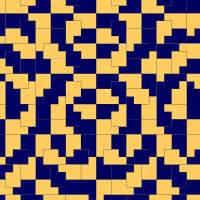
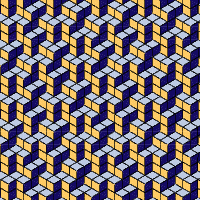
A substitution arising from a polyomio rep-tile. This one is made of five unit squares, thus the name. The tiles are coloured blue or ochre, according to their chirality (left-handed vs right-handed).
Finite Rotations Polytopal Tiles Polyomio Tilings Rep Tiles Self Similar Substitution
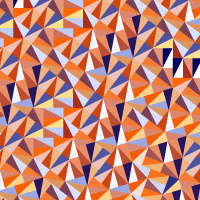
This substitution tiling is the example of substitution tilings with infinite rotations. Its statistical and dynamical properties were studied in several papers by C. Radin, see for instance [Rad92] , [Rad97] . In particular, it was shown that the orientations of triangles in the pinwheel tiling are …
With Decoration Finite Local Complexity Saduns Generalised Pinwheels Polytopal Tiles Self Similar Substitution Mld Class Pinwheel Infinite Rotations
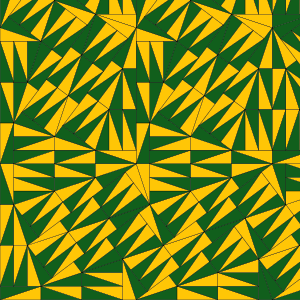
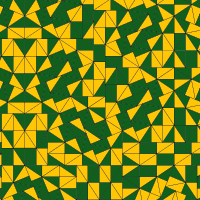
The pinwheel tiling has several straight forward variants. Here is one with 13 tiles.
Finite Rotations Polytopal Tiles Self Similar Substitution
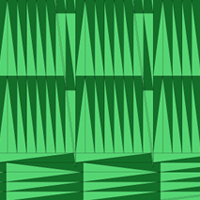
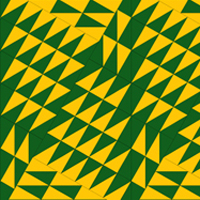
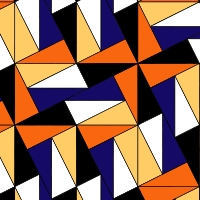
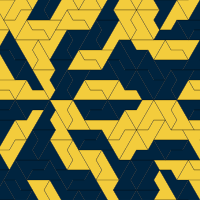
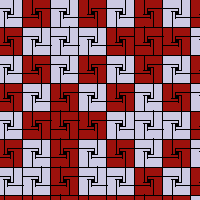
This substitution arises from a reptile with infinitely many straight edges, cf. [GS87]. It answers the question ‘Are there selfsimilar substitution tilings where the prototiles have infinitely many straight edges?’ positively. The colours of the tiles indicate their chirality. The substitution rule …
Finite Rotations Rep Tiles
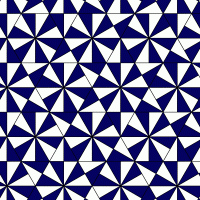
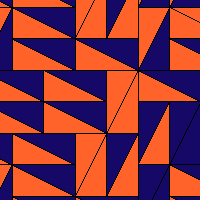
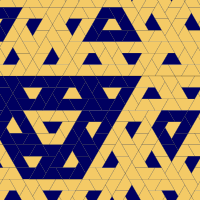
A simple rule to generate nonperiodic tilings with one prototile, a triangle with angles 30°, 60°, 90°. It looks pretty much periodic: the hexagonal patches cover 75% of the plane, and this part is clearly periodic. The triangles in between the hexagons destroy the periodicity. But, by the …
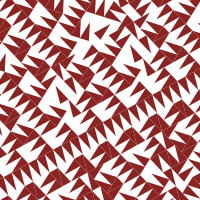
A simple rule with just one prototile that generates tilings with statistical circular symmetry. The image use two colours for the aesthetic effect only. The substitution do not even use reflections, so the tilings consist of ‘right-handed’ tiles only.
Infinite Rotations Polytopal Tiles Rep Tiles Self Similar Substitution