Tilings with 4 Prototiles
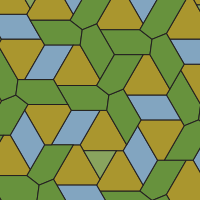
A substitution for the aperiodic hat monotile found in 2022 and published in [SMCG2024] , see also [BGS2023] . The “metatiles” in the first paper have some free parameter. Most of these parameters yield a substitution that is not selfsimilar. Here we show the selfsimilar version of the substitution …
Aperiodic Monotile Self Similar Substitution
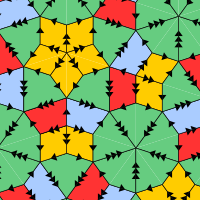
The tiling shares a mld-class with the Penrose Tilings, e.g. Penrose Rhomb, Penrose kite-dart and Penrose Pentagon boat star).
The inflation factor is the square of the golden mean $(\frac{\sqrt{5}}{2} + \frac{1}{2})^{2} = \frac{\sqrt{5}}{2} + \frac{3}{2} = 2.618033988\ldots$.
In contrast to the …
Without Decoration Finite Rotations Polytopal Windowed Tiling Canonical Substitution Tiling Mld Class Penrose
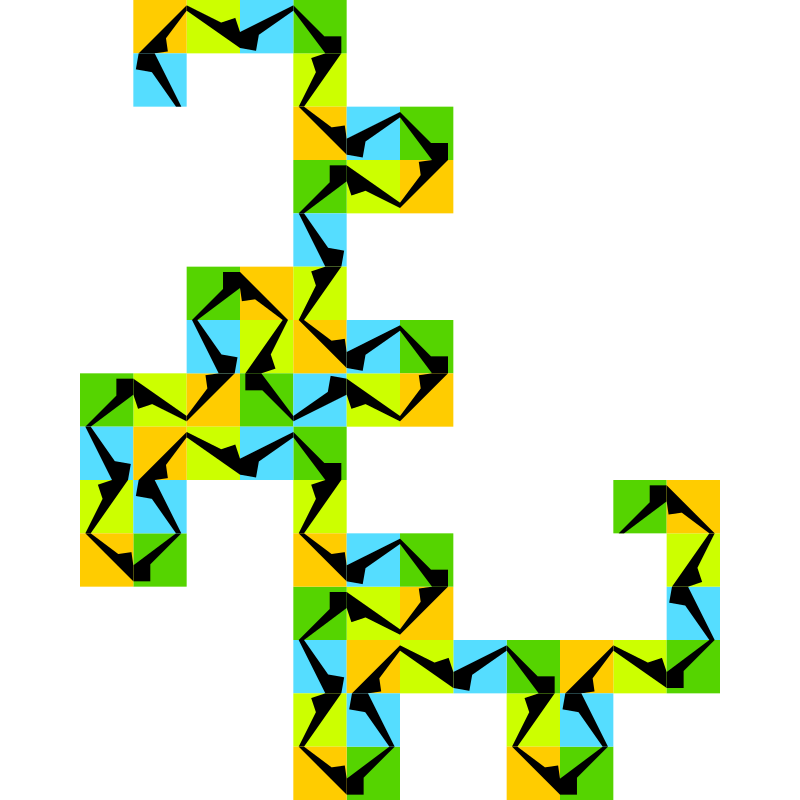
The original Heighway Dragon Curve as described in [gar1967] , can be derived by a substitution tiling with one substitution rule and appropriate decoration. However, it is not a FASS-curve because it is not self avoiding. With the results in [pau2021] it is possible to derive a substitution tiling …
Finite Local Complexity Polytopal Tiles Self Similar Substitution With Decoration Limitperiodic FASS_curve
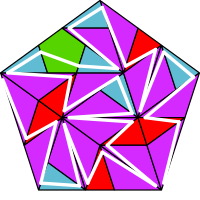
The FASS-curve of the pentagon bases on an aperiodic substitution tiling with four substitution rules and appropriate decorations.
The substitution tiling was derived from the Robinson Triangle Tiling.
Its inflation factor is the golden mean $\frac{\sqrt{5}}{2} + \frac{1}{2} = 1.618033988\ldots$.
Polytopal Tiles Self Similar Substitution With Decoration FASS_curve
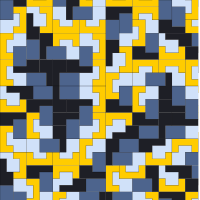
A substitution tiling using four different prototiles, as described by [LS12].
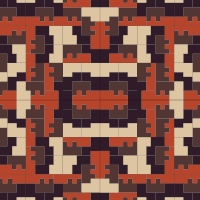
A substitution tiling using four different prototiles, as described by [LS12].
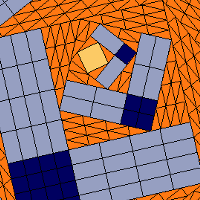
The substitution system uses 4 letters. With:
$x = \frac{\pi}{7}$, $c = \cos(x)$ and $s = \sin(x)$
They are: two squares of side lengths $1$ and $2-c-s$; a rectangle with sides $c+s$ and $2-c-s$: and a right triangle with legs $c$ and $s$.
The substitution is indicated in the figure. Up to our …
Self Similar Substitution Infinite Rotations
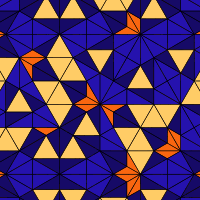
The Nischke-Danzer-Deltoid 6-fold-2-2 was discussed and derived in [ND96] .
Polytopal Tiles Self Similar Substitution Finite Local Complexity Finite Rotations Nischke Danzer Deltoid Limitperiodic
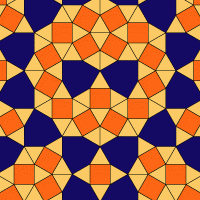
In connection with physical quasicrystals, the most interesting 2dim tilings are based on 5-, 8-, 10- and 12-fold rotational symmetry. This 12-fold tiling was studied by F. Gähler, in particular its cut and project scheme, the local matching rules and diffraction properties [Gah88]. The window of …
With Decoration Finite Rotations Euclidean Windowed Tiling Polytopal Windowed Tiling Polytopal Tiles Mld Class Shield and Socolar Matching Rules
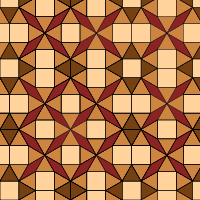
A substitution rule for a tiling with prototiles based on 12-fold dihedral symmetry. However, the tilings show only 4-fold dihedral symmetry. In contrast to the usual suspects related to 12-fold symmetry, like the shield tilings or the Socolar tilings, the inflation factor of this one is not an …
Finite Rotations Polytopal Tiles
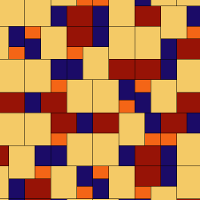
Imagine a rectangle which can be decomposed into three proportional rectangles. The three rectangles have different sizes. The smallest one has the same orientation as the primitive rectangle. The other two rectangles have a 90 degrees with respect to the large rectangle. Starting with the smallest …
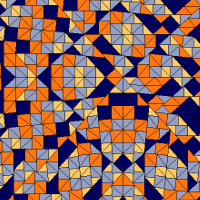
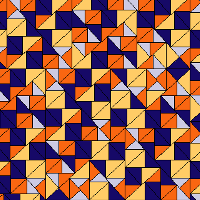

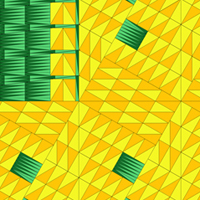
A variation of the Robinson Triangle substitution where the tiles are decorated in order to produce striking visual effects. The idea came from the design of Aperiodic 2012 in Cairns, Australia. Other variants can be found in psychedelic-penrose-variant-1, psychedelic-penrose-variant-2, …
Finite Rotations Polytopal Tiles Self Similar Substitution

A variation of the Robinson Triangle substitution where the tiles are decorated in order to produce striking visual effects. The idea came from the design of Aperiodic 2012 in Cairns, Australia. Other variants can be found in psychedelic-penrose-variant-1, psychedelic-penrose-variant-2, …
Finite Rotations Polytopal Tiles Self Similar Substitution

A variation of the Robinson Triangle substitution where the tiles are decorated in order to produce striking visual effects. The idea came from the design of Aperiodic 2012 in Cairns, Australia. Other variants can be found in psychedelic-penrose-variant-1, psychedelic-penrose-variant-2, …
Finite Rotations Polytopal Tiles Self Similar Substitution

A variation of the Robinson Triangle substitution where the tiles are decorated in order to produce striking visual effects. The idea came from the design of Aperiodic 2012 in Cairns, Australia. Other variants can be found in psychedelic-penrose-variant-1, psychedelic-penrose-variant-3, …
Finite Rotations Polytopal Tiles Self Similar Substitution

A variation of the Robinson Triangle substitution where the tiles are decorated in order to produce striking visual effects. The idea came from the design of Aperiodic 2012 in Cairns, Australia. Other variants can be found in psychedelic-penrose-variant-2, psychedelic-penrose-variant-3, …
Finite Rotations Polytopal Tiles Self Similar Substitution
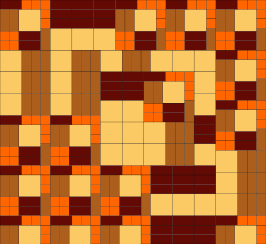
A plane substitution tiling which does not possess flc. It arises from the 1-dimensional substitution a -> abbb, b -> a, which inflation factor is not a PV-number. In the last sentence, ‘arises’ is to be understood as follows: Whenever one has a 1-dimensional substitution, it defines a d-dimensional …
Polytopal Tiles Parallelogram Tiles Self Similar Substitution
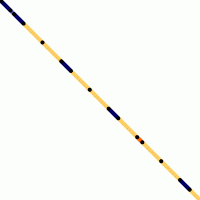
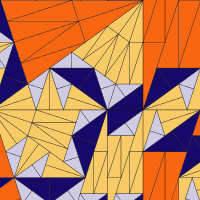
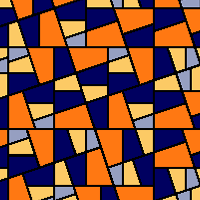
One of several substitution tilings found by L. Andritz using similar right-angled quadrilaterals.
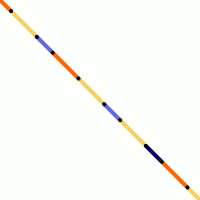
The substitution rule a1->a1 b1, a2->b2 a2, b1->a2, b2->a1. The tilings generated become Fibonacci tilings under the projection a1,a2->a and b1,b2->b. Alternatively one can simply remove the colour labels on the tiles. The name comes from the projection structure of the tiling. The expansion …
Euclidean Windowed Tiling Polytopal Windowed Tiling Canonical Substitution Tiling One Dimensional Polytopal Tiles Parallelogram Tiles Self Similar Substitution Mld Class Fibonacci
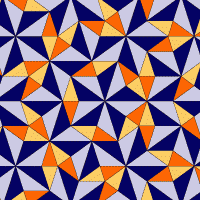
A variation of the Penrose rhomb tilings, suggested by R. M. Robinson. The rhombs are cut into triangles, thus making the substitution volume hierarchic. Thus, this one is obviously mld with the other Penrose tilings. For more details, see Penrose rhomb tilings. Each triangle comes either left- or …
Without Decoration Finite Rotations Polytopal Windowed Tiling Polytopal Tiles Self Similar Substitution Mld Class Penrose Generalized Robinson Triangles
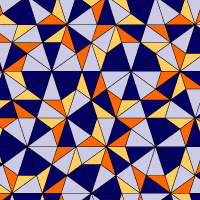
Beside the Penrose rhomb tilings (and its variations), this is a classical candidate to model 5-fold (resp. 10-fold) quasicrystals. The inflation factor is - as in the Penrose case - the golden mean, $\frac{\sqrt{5}}{2} + \frac{1}{2}$. The prototiles are Robinson triangles, but these tilings are not …
Finite Rotations Polytopal Windowed Tiling Polytopal Tiles Self Similar Substitution