Tilings with 2 Prototiles
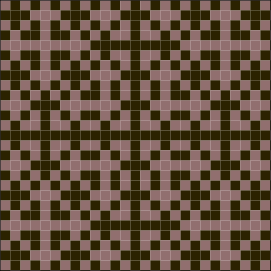
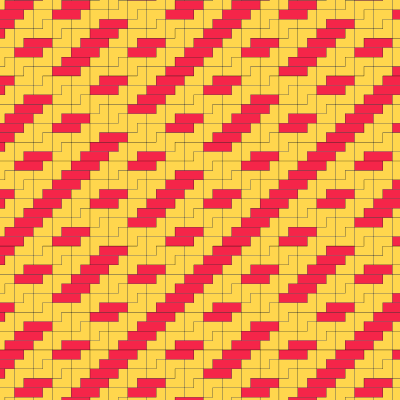
This is the block version of the Squiral tiling. The graphic was created by Leif Borgstedt.
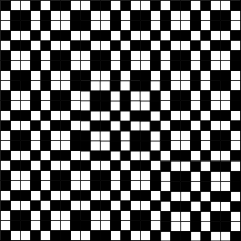
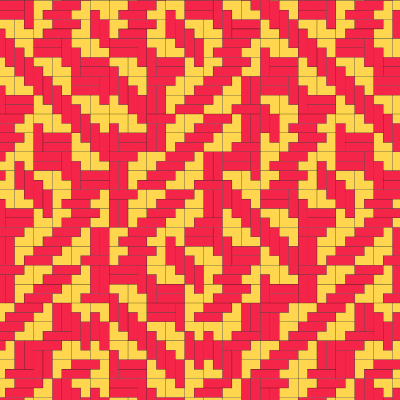
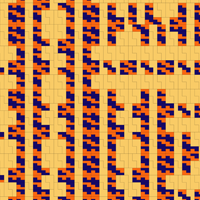
This is the 2D version of the one-dimensional Thue Morse tiling due to Shelomo Ben-Abraham et.al. The graphic was created by Leif Borgstedt.
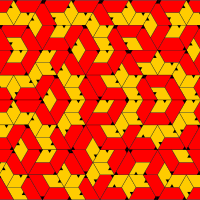
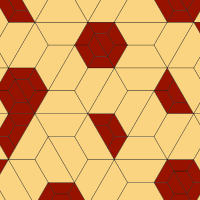
The Monnier Trapezium and Diamond tiling uses two prototiles,
a trapezium and a rhomb. The inflation multiplier is $2$.
By changing the chiralities of the prototiles within the first level
supertiles several further variants can be derived.
Finite Local Complexity Polytopal Tiles Self Similar Substitution With Decoration Limitperiodic
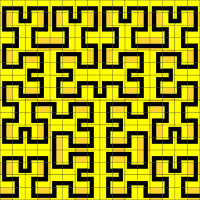
The Hilbert Curve is one of the earliest FASS-curves. The original algorithm in [hil1891] bases on one substitution rule and an additional rule which describes how the substitutes have to be connected. As briefly mentioned in [pau2021] it is also possible to create the Hilbert Curve by a …
Finite Local Complexity Polytopal Tiles Self Similar Substitution With Decoration Limitperiodic FASS_curve
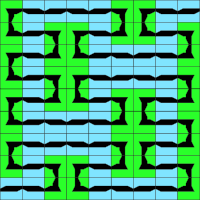
The Peano Curve is one the earliest known FASS-curves. The original algorithm in [pea1890] bases on one substitution rule and an additional rule which describes how the substitutes have to be connected. As briefly mentioned in [pau2021] it is also possible to create the Peano Curve by a …
Finite Local Complexity Polytopal Tiles Self Similar Substitution With Decoration Limitperiodic FASS_curve
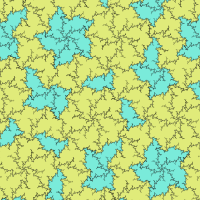
A fractalized version of the Penrose Kite and Dart tilings. Unlike Kite and Dart, this version is a selfsimilar substitution.
Self Similar Substitution
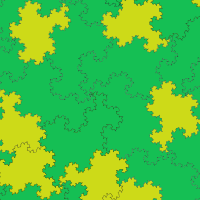
A selfsimilar version of a substitution with Penrose rhombs, but without reflections. These tilings are mld to the Penrose Rhomb tilings, even though they lack their mirror symmetry.
Self Similar Substitution

A generalization of the domino substitution. There are several possibilities to play with 1x2 rectangles (dominos) in order to generate non-periodic tilings.
The decorative lining shows here how the prototile gets turned and mirrored for this example. The two rules are actually exactly the same. For decoration the horizontal tile was colored purple.
Finite Rotations Polytopal Tiles Polyomio Tiling Rep Tiles Self Similar Substitution
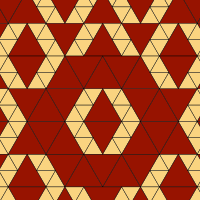
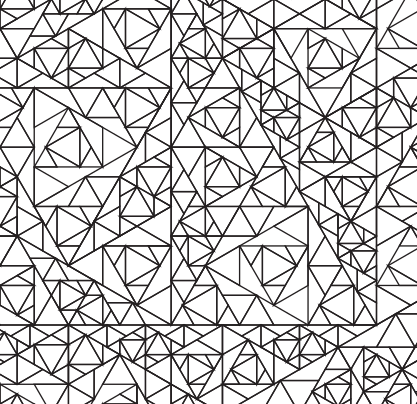
Nowadays (2019) there are several generalizations of a tile substitution. One was introduced already in Sad98 Even though his idea produces a welath of examples, most of these have not yet been well studied.
The idea is to give a rule how to substitute a prototile and apply this rule always to the …
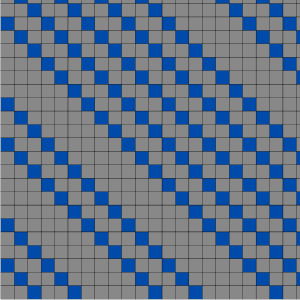
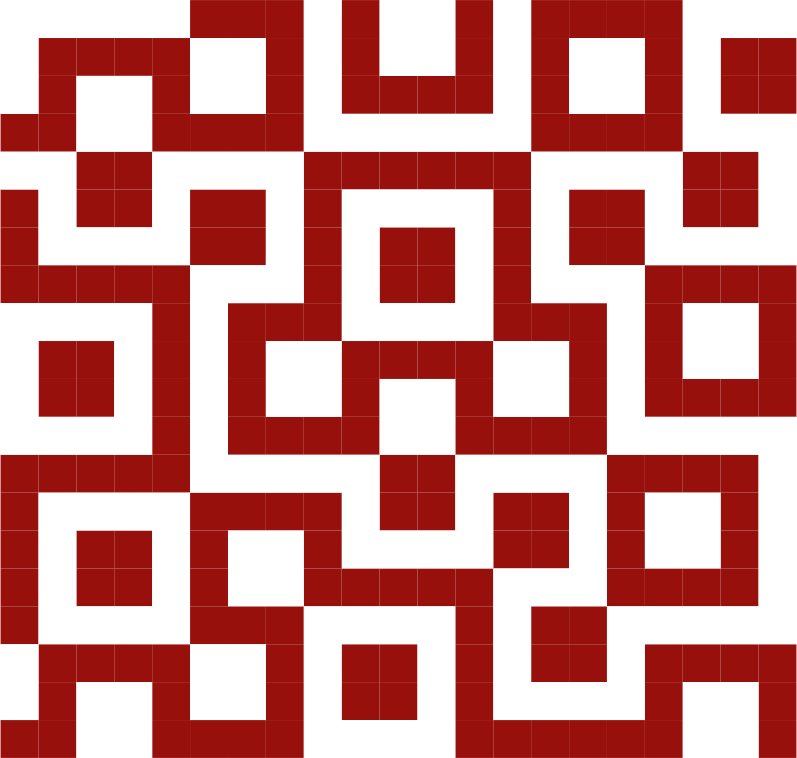
This Wanderer tiling is the first of an infinite series of substitution tilings by Joan Taylor based on paper-folding sequences. It uses a single square tile with four distinct rotations and two distinct reflections. Here we use colours to distinguish left-handed (brown) from right-handed (white) …
Limitperiodic Polytopal Tiles Rep Tiles Self Similar Substitution
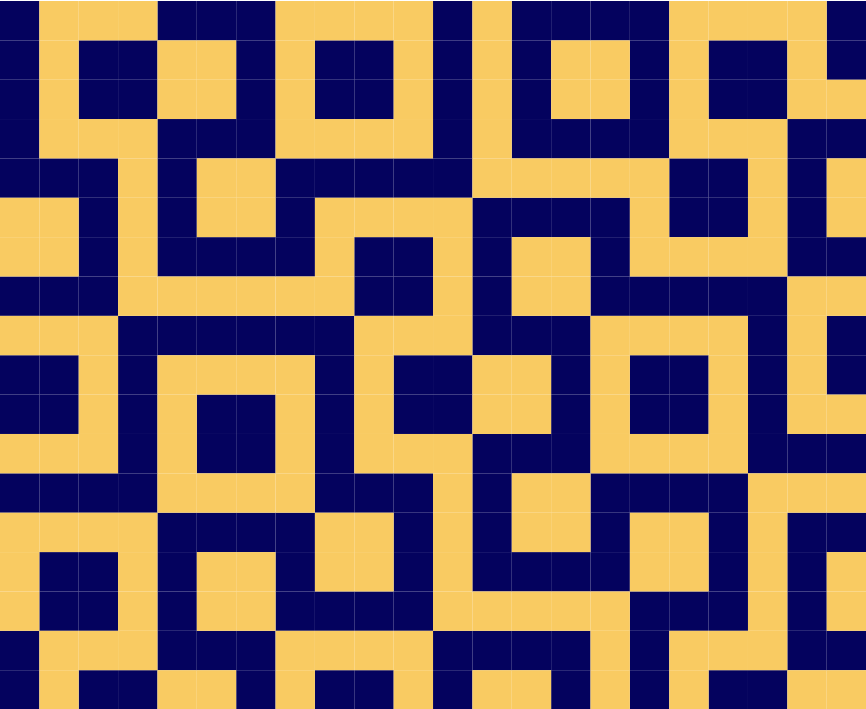
This Wanderer tiling is one in an infinite series of substitution tilings by Joan Taylor based on paper-folding sequences. It uses a single square tile with four distinct rotations and two distinct reflections. Here we use colours to distinguish vertical (blue) from horizontal (ochre) tiles. In the …
Limitperiodic Polytopal Tiles Rep Tiles Self Similar Substitution
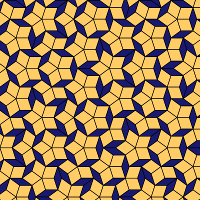
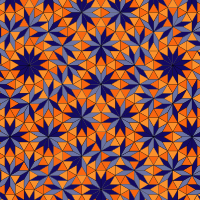
A 12-fold substitution tiling without squares (most other 12-fold tilings do use squares, search for “12-fold” to see them).
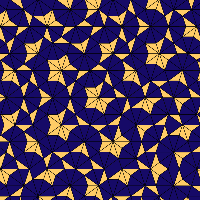
The Robinson Triangle substitution is just one out of several possibilities to play with the triangle versions of the Penrose tilings. Another one is the Tübingen Triangle substitution. Here is an example where the obtuse triangle is the smaller prototile, and the acute triangle is the larger one. …
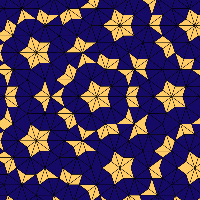
The Robinson Triangle substitution is just one out of several possibilities to play with the triangle versions of the Penrose tilings. Another one is the Tübingen Triangle substitution. Here is an example where the obtuse triangle is the smaller prototile, and the acute triangle is the larger one. …
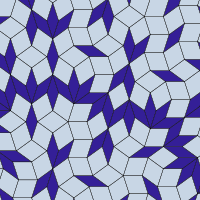
In [Lan88], energetic properties of certain decorations of Penrose Rhomb tilings were studied.
A $\frac{\pi}{5}$, $3\frac{\pi}{5}$}, or in {$2\frac{\pi}{5}$, $4\frac{\pi}{5}$}.
(‘Binary’ because …
Finite Rotations Polytopal Tiles Parallelogramm Tiles Rhomb Tiles Finite Local Complexity
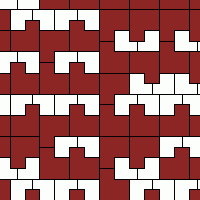
A substitution rule with inflation factor $\sqrt2$ and two prototiles.
This makes it a candidate for being a model set with p-adic internal space.
This has not been checked so far, but in principle it is possible by the methods in [LMS03] or [FS].
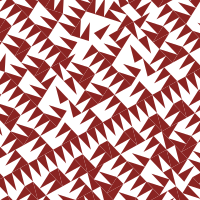
A simple rule with just one prototile that generates tilings with statistical circular symmetry. The image use two colours for the aesthetic effect only. The substitution do not even use reflections, so the tilings consist of ‘right-handed’ tiles only.
Infinite Rotations Polytopal Tiles Rep Tiles Self Similar Substitution
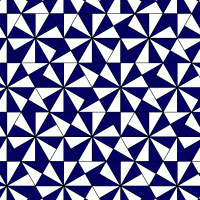
A simple rule to generate nonperiodic tilings with one prototile, a triangle with angles 30°, 60°, 90°. It looks pretty much periodic: the hexagonal patches cover 75% of the plane, and this part is clearly periodic. The triangles in between the hexagons destroy the periodicity. But, by the …
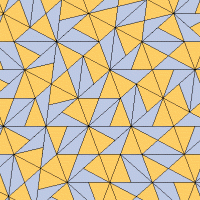
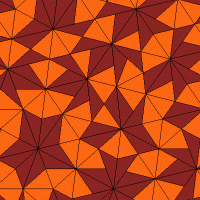
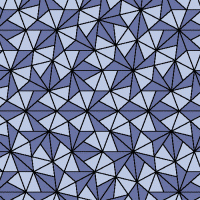
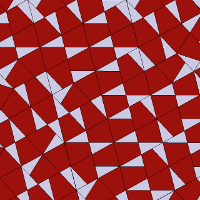
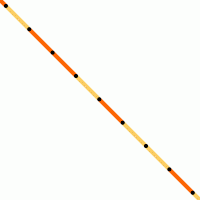
A classic. A lot of detail can be found in [JS99].
One Dimensional Self Similar Substitution
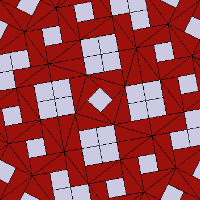
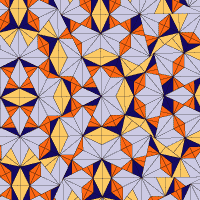
One of the rare examples of a tiling where the prototiles occur in infinitely many orientations. Apart from the pinwheel tiling and its generalizations [Sad98] there are only a few examples known which show infinite rotations.
The inflation factor of this one is a complex algebraic PV number of …
Infinite Rotations Infinite Local Complexity Polytopal Tiles Self Similar Substitution
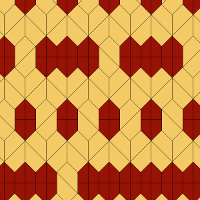
A variant of semi-detached house. In contrast to the latter, this one is a model set with p-adic internal space.
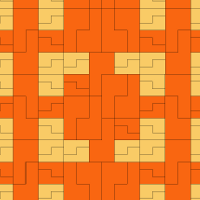
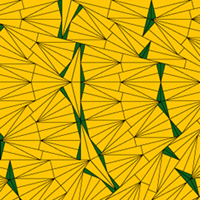
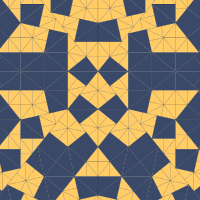
One member of an infinite series of tilings generated by a more general construction than a tile-substitution, [Sad98]. In particular, Sadun’s construction yields tilings with infinitely many prototiles, as well as with finitely many prototiles. Each tiling in this series is described by two …
Infinite Rotations Infinite Local Complexity Saduns Generalised Pinwheels Polytopal Tiles Self Similar Substitution
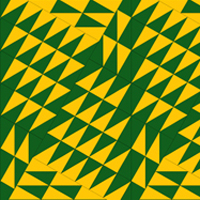
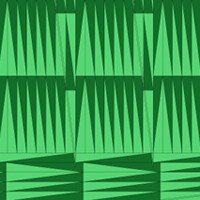
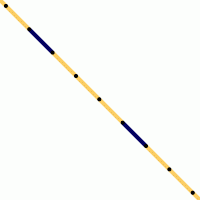
In some sense, the simplest cut and project tiling. It arises from the symbolic substitution a -> ab, b -> aa. Its internal space are the 2-adic integers.
P Adic Windowed Tiling One Dimensional Rep Tiles Self Similar Substitution
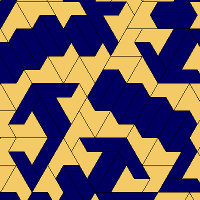
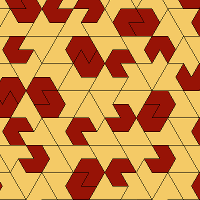
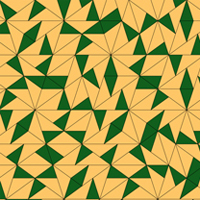
A simple variant of the Robinson triangle substitution. This substitution uses no reflections. The resulting tilings are not longer vertex-to-vertex, but still flc.
Finite Rotations Polytopal Tiles Self Similar Substitution
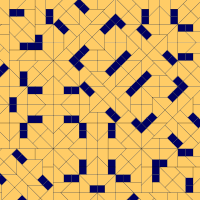
A substitution tiling with statistical eight-fold symmetry. This example answers a question of L. Danzer, whether there is a substitution tiling with substitution matrix with entries 1,2,2,5.
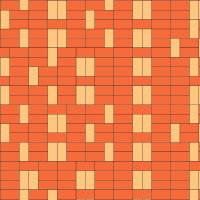
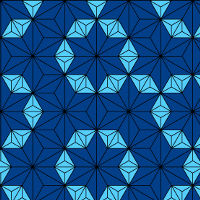
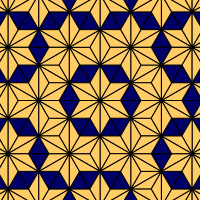
A substitution tiling found by Bill Kalahurka, Texas, in 2009 (?). It is mld to T2000 by L. Danzer in 2000.
Finite Rotations P Adic Windowed Tiling Polytopal Tiles Rep Tiles Self Similar Substitution Two Dimensional
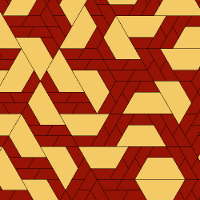
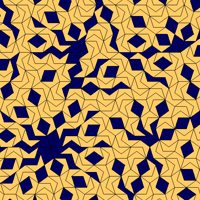
The ochre tile - the “crown” - is an amazingly versatile tile to play with. This substitution is one possible substitution using it.
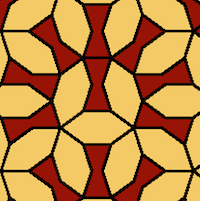
One of several substitution tilings found and submitted in February 2016 by L. Andritz with fivefold symmetry using tiles inspired by Islamic Girih patterns.
Despite the similarities the tiling is different to the “Tie and Navette” tiling as discussed in [Lue1990] and [LL1994] .
Finite Rotations Model Set Polytopal Tiles Self Similar Substitution Finite Local Complexity Girih
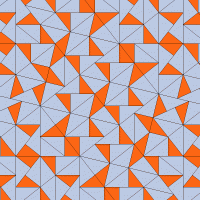
Using the prototiles of the golden triangle tiling, this substitution yields tilings where the tiles occur in infinitely many orientations. The inflation factor is $\tau + 1 = 2.618033988 \ldots $, the square of the golden mean. This is a PV number of algebraic degree 2. The expansion contains no …
Finite Local Complexity Polytopal Tiles Self Similar Substitution Infinite Rotations
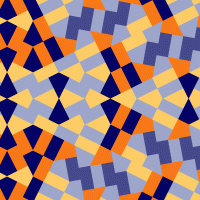
This is a variation of the pinwheel substitution. The kite-domino tilings are mld to the pinwheel tilings. The two prototiles are made of two pinwheel triangles, glued together at their long edge. There are two ways to do so, one gives a kite (a quadrilateral with edge lengths 1,1,2,2) and a domino …
With Decoration Finite Local Complexity Polytopal Tiles Self Similar Substitution Mld Class Pinwheel
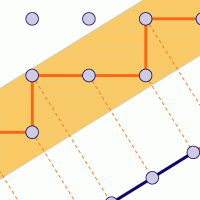
The classical example to explain the cut and project
method (see figure, lower part): In the standard square lattice $\mathbb{Z}^2$, choose a stripe with slope
$\frac{1}{\tau}$ (where tau is the golden ratio $\frac{1+\sqrt{5}}{2}$ ) of a certain width $\cos(\arctan(\frac{1}{\tau})) + …
Finite Rotations Polytopal Windowed Tiling Canonical Substitution Tiling One Dimensional Parallelogram Tiles Self Similar Substitution Mld Class Fibonacci
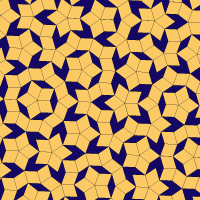
Certainly the most popular substitution tilings. Discovered in 1973 and 1974 by R. Penrose in - at least - three versions (Rhomb, Penrose kite-dart and Penrose Pentagon boat star), all of them forcing nonperiodic tilings by matching rules. It turns out that the three versions are strongly related: …
Without Decoration Finite Rotations Polytopal Windowed Tiling Canonical Substitution Tiling Rhomb Tiles Mld Class Penrose Matching Rules
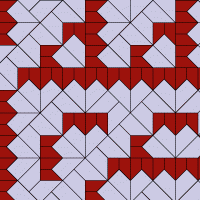
A simple substitution rule with inflation factor 2, using two prototiles only. A glimpse on the image hopefully explains the name. The translation module is a square lattice, which is a hint that the semi-detached house tilings may be a model set with p-adic internal space. This question (model set or not) was raised in [Fre02] and was answered in [FS] .
Finite Rotations Polytopal Tiles Self Similar Substitution
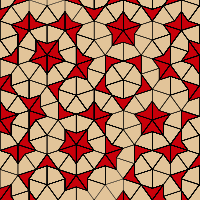
A classic, using a kite (blue) and a dart (orange) as prototiles. See Penrose Rhomb for more details.
Without Decoration Finite Rotations Polytopal Windowed Tiling Polytopal Tiles Mld Class Penrose
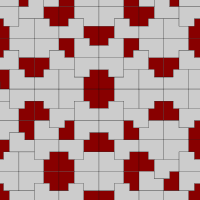
One of the tilings discovered by R. Ammann in 1977, published in [GS87] . The other ones (published there) are Ammann A3, Ammann A4, and Ammann A5 (better known as Ammann Beenker). The inflation factor of this substitution is quite small. It is the square root of the golden ratio, approx 1.272. …
Without Decoration Finite Rotations Polytopal Windowed Tiling Polytopal Tiles Self Similar Substitution
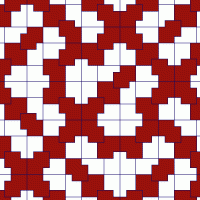
One of the tilings discovered R. Ammann in 1977, when he found several sets of aperiodic prototiles, i.e., prototiles with matching rules forcing nonperiodic tilings. These were published much later, in 1987, in [GS87] , where they were named Ammann A2 (our Ammann Chair), Ammann A3, Ammann A4, and …
With Decoration Finite Rotations Polytopal Windowed Tiling Canonical Substitution Tiling Parallelogram Tiles Self Similar Substitution Mld Class Ammann
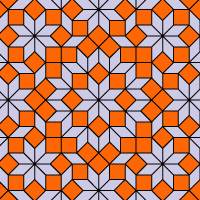
This tiling was originally introduced in [WSI87]
, however the description given there admits several substitution rules. This is the version given explicitly in [WSI95]
.
This is an example of a cut and project with a mixed internal space, a product of Euclidean and $p$-adic spaces, namely $\mathbb{R}^2 \times \mathbb{Q}_2$.
Finite Rotations Model Set Rhomb Tiles Polytopal Tiles Self Similar Substitution Finite Local Complexity
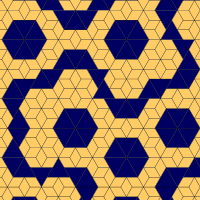
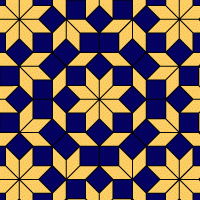
In 1977 R. Ammann found several sets of aperiodic tiles. This one (his set A5) is certainly the best-known of those. It allows tilings with perfect 8fold symmetry. The substitution factor is $1+\sqrt{2}$ - sometimes called the ‘silver mean’ - which was the first irrational inflation factor known …
With Decoration Finite Rotations Polytopal Windowed Tiling Canonical Substitution Tiling Rhomb Tiles Mld Class Ammann Matching Rules