Tilings with 3 Prototiles
- All substitution rules have dihedral
$D_{2}$symmetry. - All edges of the substitution rules are equal and also have dihedral
$D_{2}$symmetry. - All interior angles of all prototiles are …
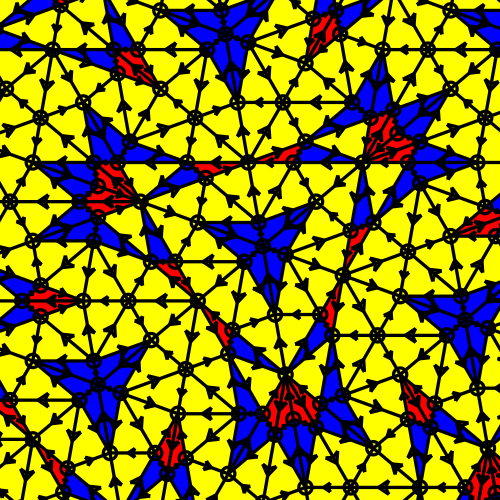
The 9-fold Vampire Deltoid tiling was derived by K.P. Nischke using methods similar to the tilings in [ND96] . However, this tiling lacks full 9-fold symmetry.
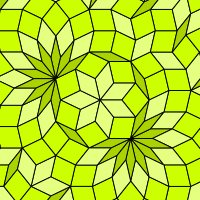
J. Kari and M. Rissanen derived a set of rhomb substitution tilings in [KR2016] with n-fold dihedral symmetry.
Polytopal Tiles Self Similar Substitution Finite Local Complexity Finite Rotations Rhomb Tiles
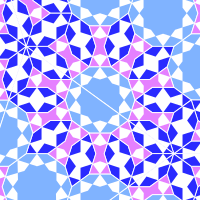
The substitution tiling was derived from a mosaic at the Darb-i Imam Shrine in Isfahan, Iran. While the shrine dates back from 1453, [Lau2018] argues that the mosaic was created much later between 1715 - 1717.
The tiling relies on the regular decagon and two hexagons and has individual dihedral …
Finite Local Complexity Finite Rotations Polytopal Tiles Self Similar Substitution Girih
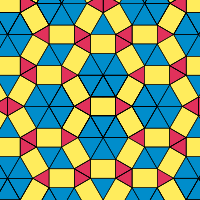
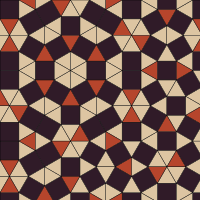
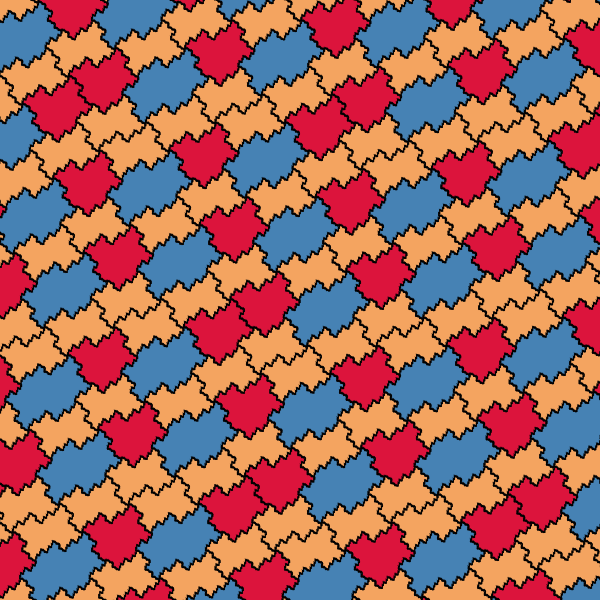
The substitution $a \rightarrow abcc, b \rightarrow a, c \rightarrow bc$ is a member of the MLD class of the [Kolakoski-(3,1) sequence] (/substitution/kolakoski-3-1/). The scaling factor $\lambda \approx $ 2.20557 is the largest root of $x^3-2x^2-1=0$.
This substitution has a simple dual, with three …
Euclidean Windowed Tiling One Dimensional Self Similar Substitution
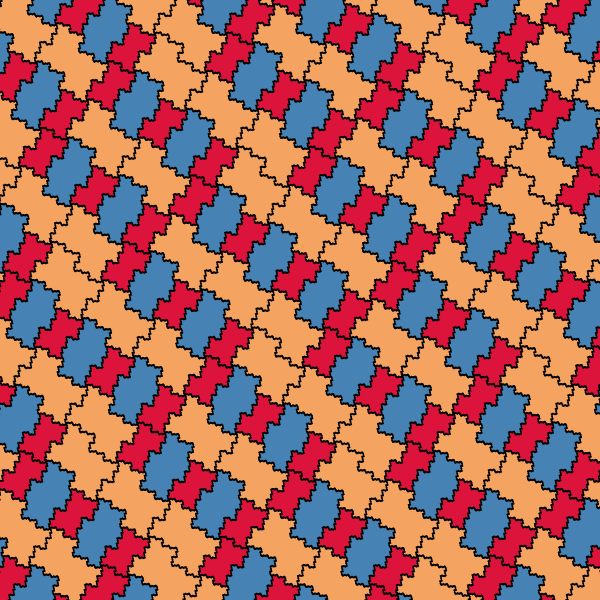
The substitution $a \rightarrow bcc, b \rightarrow ba, c \rightarrow bc$ is a member of the MLD class of the [Kolakoski-(3,1) sequence] (/substitution/kolakoski-3-1/). As the reversed substitution generates the same hull, it is mirror symmetric. The scaling factor $\lambda \approx $ 2.20557 is the …
Euclidean Windowed Tiling One Dimensional Self Similar Substitution
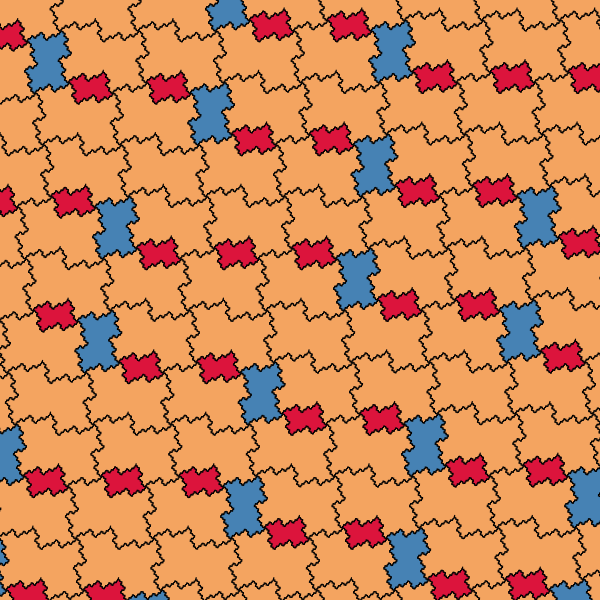
The substitution $a \rightarrow aca, b \rightarrow a, c \rightarrow b$ has palindromic and thus mirror symmetric variant of the Kolakoski-(3,1) substitution, which is in the same MLD class, along with the further variants A (mirror symmetric) and B (with its mirror image). The scaling factor …
Euclidean Windowed Tiling One Dimensional Self Similar Substitution
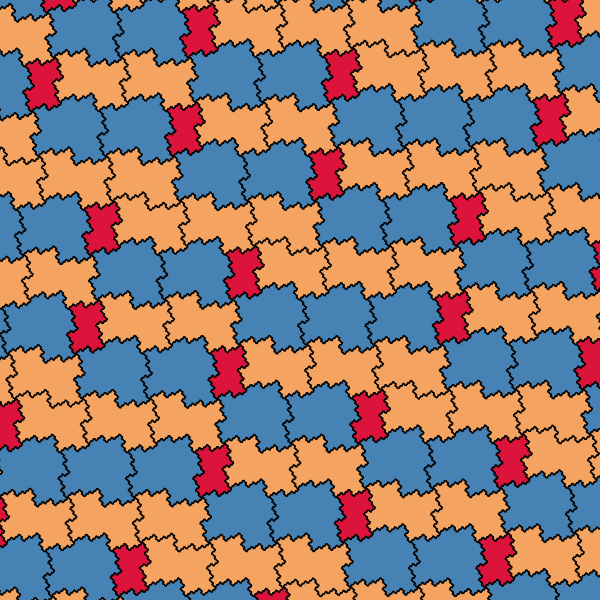
The substitution $a \rightarrow abc, b \rightarrow ab, c \rightarrow b$ is closely related to the Kolakoski-(3,1) sequence, and is one of the examples whose windows (dual tiles, Rauzy fractals) have been analysed in detail [BaS04] . It is MLD to the mirror symmetric variant given by the palindromic …
Euclidean Windowed Tiling One Dimensional Self Similar Substitution
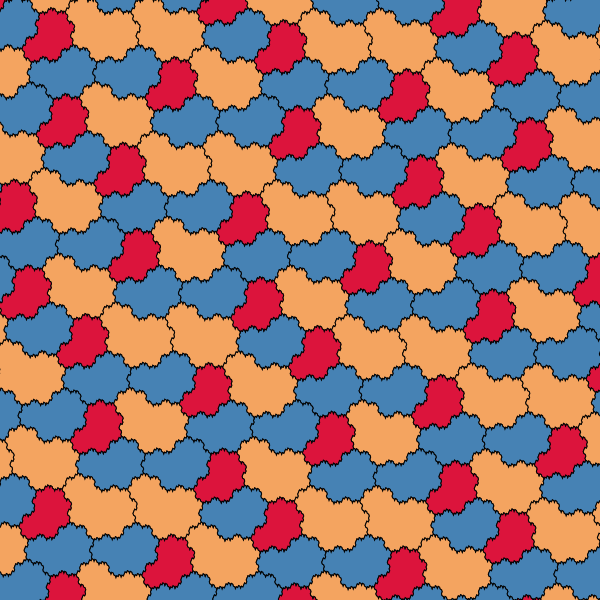
The substitution $a \rightarrow ab, b \rightarrow cb, c \rightarrow a$ is the composition of the one with the smallest PV scaling factor, $a \rightarrow bc, b \rightarrow a, c \rightarrow b$, and its mirror image, $a \rightarrow cb, b \rightarrow a, c \rightarrow b$. As such, it is MLD to its own …
Euclidean Windowed Tiling One Dimensional Self Similar Substitution
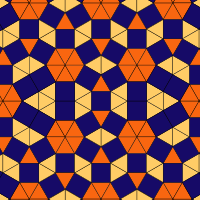
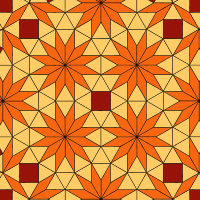
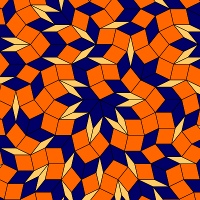
A substitution rule for a tiling with prototiles based on 12-fold dihedral symmetry. However, the tilings show only 6-fold dihedral symmetry, in contrast to the usual suspects related to 12-fold symmetry, like the shield tilings or the Socolar tilings.
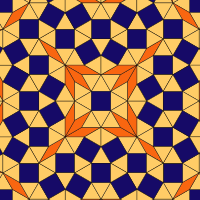
Finite Rotations Polytopal Tiles Self Similar Substitution Rhomb Tiles Finite Local Complexity
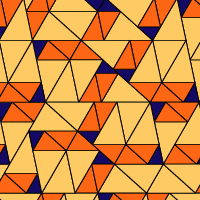
Part of an infinite series, where most tilings in this series are not flc, this one is the exception.
The reason is that the inflation factor is a - real - PV number.
By an argument in [PR] this forces flc.
Interestingly, the shape of the tiles can vary.
That is, there is one free parameter $l$ , …
Finite Rotations Euclidean Windowed Tiling Polytopal Tiles Self Similar Substitution
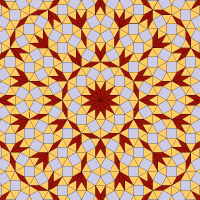
This is a variant of Watanabe Ito Soma 12-fold, with more symmetry.
Finite Rotations Polytopal Tiles
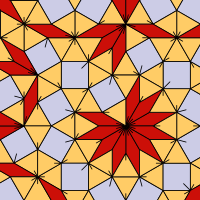
The source of the tiling can be found in [WSI95] Fig. 2 (iii) and Fig. 3.
Its inflation factor is $2+\sqrt{3}$ and it has finite local complexity with respect to rigid motions.
Unfortunately the corresponding substitution rules given in Fig. 2 (iii) of the paper are not unique. For some time the …
Finite Rotations Polytopal Tiles Self Similar Substitution Finite Local Complexity
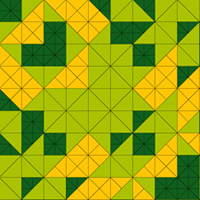
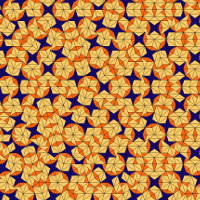
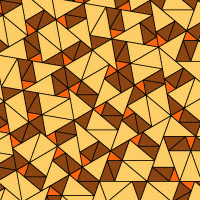
One example in a series of substitutions with inflation factor $\sqrt{s}$, where $s^m-s^k-1=0$.
The parameters m and k are arbitrary integers with m>k, m>2, k>0.
It seems that all these tilings show statistical circular symmetry. Click on ‘Infinite rotations’ above in order to see more examples of …
Infinite Rotations Finite Local Complexity Polytopal Tiles Self Similar Substitution
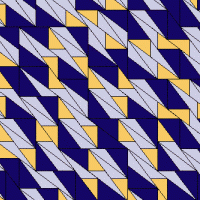
One possible version of a substitution rule with a free parameter: The upper tip of the three triangles can be shifted arbitrarily in horizontal direction, the result is always a self-similar substitution.
The inflation multiplier is the smallest PV number, the Plastic Number which is a root of the polynomial $x^3 - x - 1 = 0$.
Self Similar Substitution Polytopal Tiles Plastic Number
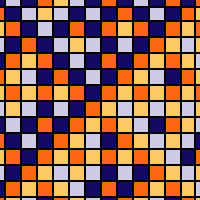
MLD to the more popular chair tiling, this version allows a simple translation into a coloured lattice: Replace each square of type i (1,2,3, or 4) with its midpoint, and assign to it colour i. Then each set of all points of colour i is a model set with internal p-adic space with p=2. This was first shown in [BMS98], a general framework is given in [LMS03].
With Decoration Finite Rotations P Adic Windowed Tiling Polytopal Tiles Self Similar Substitution Parallelogram Tiles Rhomb Tiles Mld Class Chair
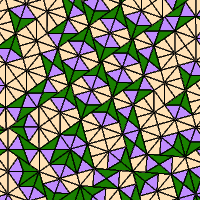
A substitution rule with inflation factor $\sqrt{6}$, using three triangles as prototiles.
Like the pinwheel tilings, one of the first examples showing statistical circular symmetry,
but being flc w.r.t. Euclidean motions.
Infinite Rotations Finite Local Complexity Polytopal Tiles Self Similar Substitution
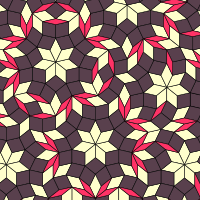
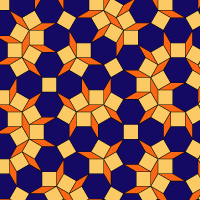
In connection with physical quasicrystals, the most interesting 2dim tilings are based on 5-, 8-, 10- and 12-fold rotational symmetry. This 12-fold tiling was studied thoroughly in [Soc89], where J. Socolar described the generating substitution as well as the local matching rules and the cut and …
Euclidean Windowed Tiling Polytopal Windowed Tiling Polytopal Tiles Parallelogram Tiles Canonical Substitution Tiling Mld Class Shield and Socolar Matching Rules
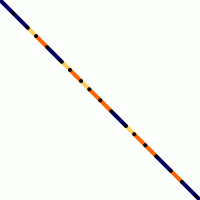
The three letter substitution rule whose scaling is the smallest PV number, the Plastic Number which is a root of the polynomial $x^3 - x - 1 = 0$.
Though it might not look it at first glance, the Rauzy fractal is connected.
This can be shown using the method of A. Siegel described in [Sie04].
The Rauzy fractal:
One Dimensional Euclidean Windowed Tiling Self Similar Substitution Polytopal Tiles Plastic Number
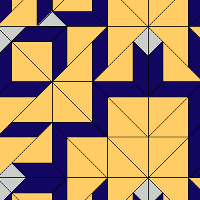
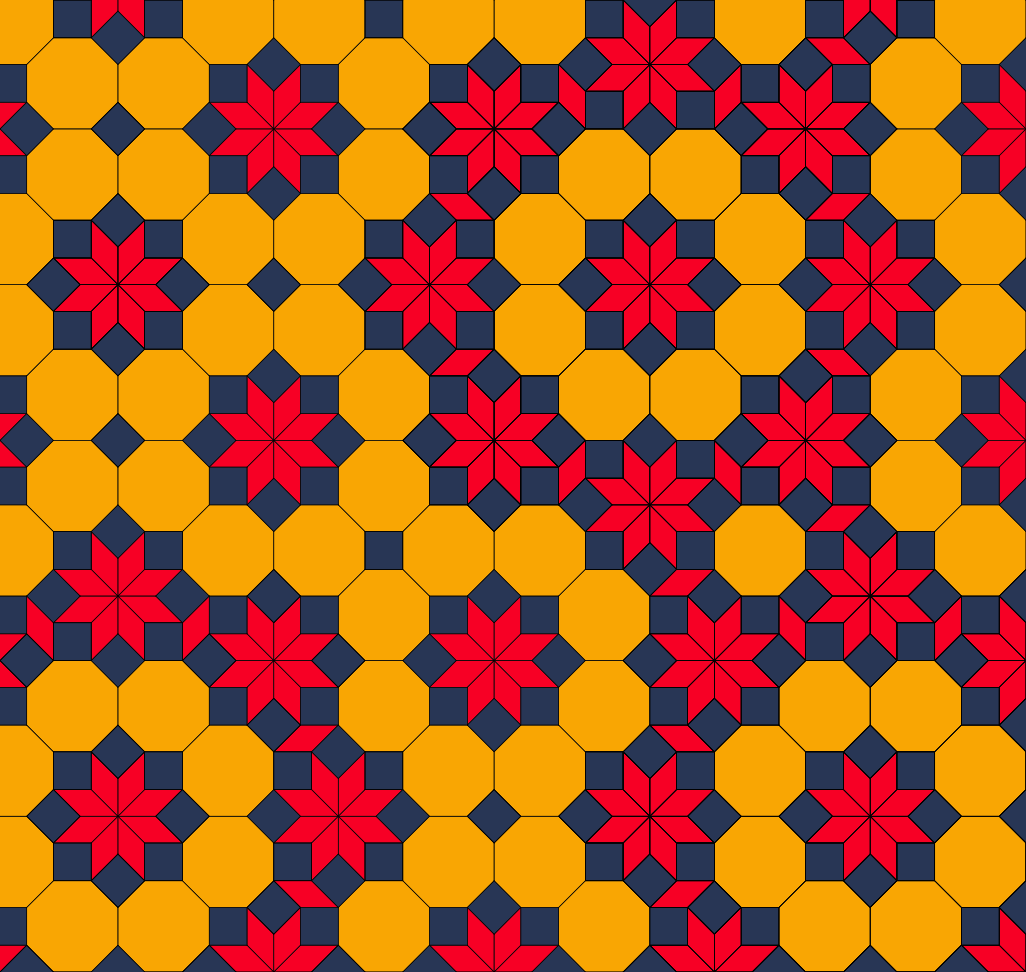
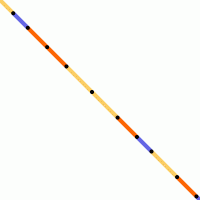
A companion to infinite component Rauzy fractal. As mentioned for that rule, it was hoped that the result for two symbol substitution rules that the window is connected if and only if the rule is invertible. This substitution rules is not invertible and yet the Rauzy fractal is connected:
Euclidean Windowed Tiling One Dimensional Polytopal Tiles Self Simmilar Substitution
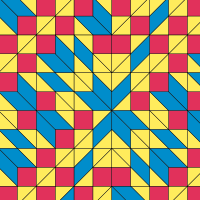
A simple substitution rule, using three Tangram pieces as prototiles.
Finite Rotations Polytopal Tiles Self Similar Substitution
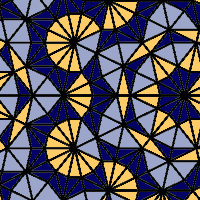
A substitution for three triangular prototiles, based on 7-fold symmetry.
The lengths of the edges of the tiles are $\sin(\frac{\pi}{7})$, $\sin(\frac{2\pi}{7})$, $\sin(\frac{3\pi}{7})$.
These tilings are essentially different from Danzer’s 7-fold examples, see for instance Danzer’s 7-fold.
Finite Rotations Polytopal Tiles Self Similar Substitution Finite Local Complexity
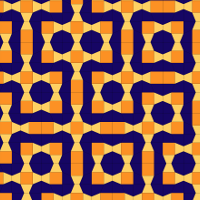
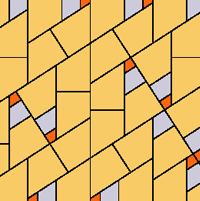
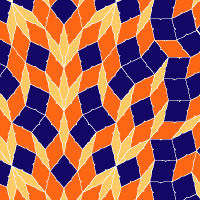
Whereas it is simple to generate rhomb tilings with n-fold symmetry by the cut and project method, it can be hard to find a substitution rule for such tilings. Here we see a rule for n=7. This one was later generalized by E. Harriss to arbitrary n.
Finite Rotations Canonical Substitution Tiling Polytopal Tiles Parallelogram Tiles Rhomb Tiles Harrisss Rhomb
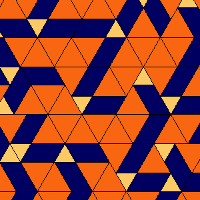
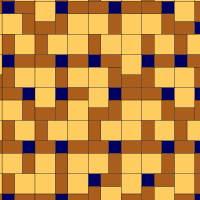
A simple variant of Fibonacci times Fibonacci, the latter arising from the one-dimensional Fibonacci tiling.
Finite Rotations Polytopal Tiles Parallelogram Tiles Rhomb Tiles Self Similar Substitution
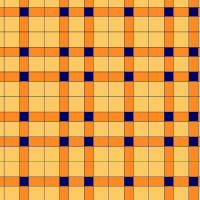
The 2dim analogue of the famous Fibonacci tiling in one dimension.
It is just the Cartesian product of two Fibonacci tilings $F_{1}$, $ F_{2} : \{ T_{1} \times T_{2}\ |\ T_{i}\ in\ F_{i}\}$.
Obviously, it can be generated by a substitution with three prototiles.
It shares a lot of nice features with …
Finite Rotations Euclidean Windowed Tiling Polytopal Windowed Tiling Polytopal Tiles Parallelogram Tiles Rhomb Tiles Self Similar Substitution
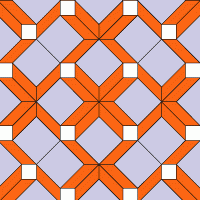
In his PhD thesis, E. Harriss classified all substitution tilings which are canonical projection tilings.
Here one example is shown, derived from the cut and project scheme of the Ammann-Beenker tilings.
Finite Rotations Euclidean Windowed Tiling Polytopal Windowed Tiling Canonical Substitution Tiling Polytopal Tiles Parallelogram Tiles
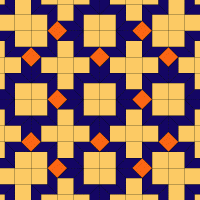
In his PhD thesis, E. Harriss classified all substitution tilings which are canonical projection tilings.
Here one example is shown, derived from the cut and project scheme of the Ammann-Beenker tilings.
Finite Rotations Euclidean Windowed Tiling Polytopal Windowed Tiling Canonical Substitution Tiling Polytopal Tiles Parallelogram Tiles
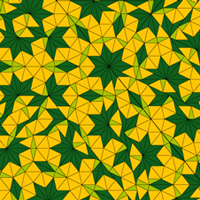
Substitution tiling with isosceles triangles as prototiles allow several variations: For each tile in the first order supertiles, one can choose whether it is a left-handed or a right-handed version. By playing around with these possibilities, one obtains this variant from Danzer’s 7-fold.
Finite Rotations Polytopal Tiles Self Similar Substitution Generalized Robinson Triangles
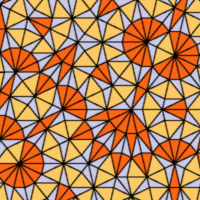
A tiling based on 7-fold (resp. 14-fold) symmetry [ND96].
The inflation factor is $1+{\sin(\frac{2\pi}{7})}/{\sin(\frac{\pi}{7})}$.
The three different edge lengths are proportional to
$\sin(\frac{\pi}{7})$, $\sin(\frac{2\pi}{7})$,
$\sin(\frac{3\pi}{7})$.
On a first glance, there seems to exist a …
Without Decoration Finite Rotations Polytopal Tiles Self Similar Substitution
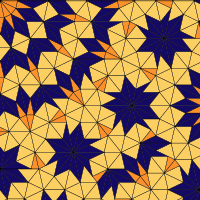
A substitution tiling with three triangles as prototiles,
based on 7-fold symmetry.
The four different edge lengths occurring are $\sin(\frac{\pi}{7})$, $\sin(\frac{2\pi}{7})$,
$\sin(\frac{3\pi}{7})$, $\sin(\frac{2\pi}{7}) + \sin(\frac{3\pi}{7})$,
The inflation factor is …
Without Decoration Finite Rotations Polytopal Tiles Self Similar Substitution Matching Rules
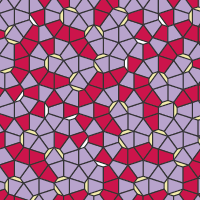
A substitution tiling with three prototiles.
The substitution rule is given for only two of the three tiles.
The third tile (yellow) is substituted by nothing.
The discoverer gives credits to Veit Elser for suggesting the shape of the tiles.
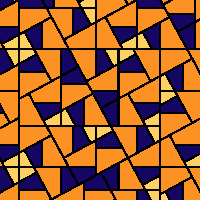
A member of an infinite family of substitution rules for similar quadrangles possessing two right interior angles at opposite vertices. A big copy of such a quadrangle can be divided into (smaller) similar quadrangles in several ways. Some of them are compatible with a substitution rule. This one is …
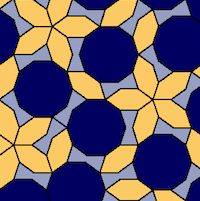
One of several substitution tilings found by L. Andritz with fivefold symmetry using tiles inspired by Islamic Girih patterns.
Finite Rotations Polytopal Tiles Self Similar Substitution Finite Local Complexity Girih
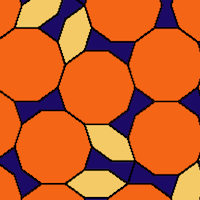
A tiling with fivefold symmetry using tiles inspired by Islamic Girih patterns.
Finite Rotations Polytopal Tiles Self Similar Substitution Finite Local Complexity Girih
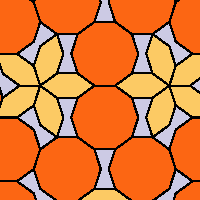
One of several substitution tilings found by L. Andritz with fivefold symmetry using tiles inspired by Islamic Girih patterns.
Finite Rotations Polytopal Tiles Self Similar Substitution Finite Local Complexity Girih
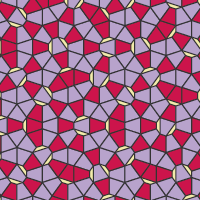
A substitution tiling with three prototiles. The substitution rule is given for only two of the three tiles. The third tile (yellow) is substituted by nothing.
The discoverer gives credits to Veit Elser for suggesting the shape of the tiles.
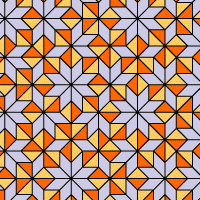
A self-similar version of the Ammann-Benker tiling. The colours of the triangles in the rule image indicate the orientation of the triangles: the orange triangle is just the ochre triangle reflected. Hence the rhomb supertile has two axes of mirror symmetry.
With Decoration Finite Rotations Euclidean Windowed Tiling Polytopal Windowed Tiling Canonical Substitution Tiling Polytopal Tiles Parallelogramm Tiles Self Similar Substitution
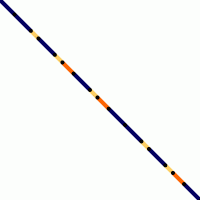
A classic simple substitution rule with Rauzy Fractal:
One Dimensional Euclidean Windowed Tiling Self Similar Substitution Polytopal Tiles
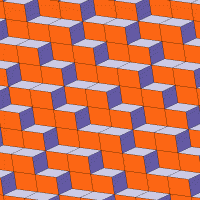
The dual tiling of the 1D tiling a->ab, b->c, c->a, resp. the version with polygonal tiles.
Finite Rotations Euclidean Windowed Tiling Polytopal Windowed Tiling Canonical Substitution Tiling Polytopal Tiles Parallelogramm Tiles
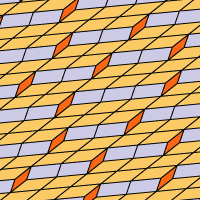
In the cut and project scheme for the 2-component Rauzy Fractal, just interchange the roles of direct space and internal space: The Rauzy fractal and its decomposition define a plane substitution for fractal tiles. Here we replace the fractal tiles with appropriate parallelograms. This plane tiling …
Border Forcing
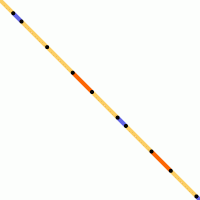
An invertible substitution rule with a disconnected Rauzy Fractal. For two letter substitution rules the Rauzy fractal is connected if and only if the substitution is invertible. In fact as the window is one dimensional for these tilings it is an interval. It was hoped that the connectedness …
One Dimensional Euclidean Windowed Tiling Self Similar Substitution Polytopal Tiles
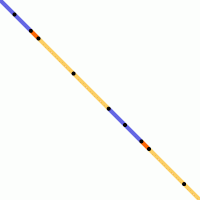
A one dimensional substitution rule with a two component Rauzy Fractal. For a second example and more details see infinite component Rauzy fractal.
One Dimensional Euclidean Windowed Tiling Self Similar Substitution
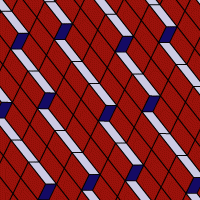
A polygonal version of Kenyon (1,2,1). The boundary is generated by the morphism $a \to b, b \to c, c \to c a' b' b'$ (where $x'$ is the inverse of $x$).
Finite Rotations Polytopal Windowed Tiling Canonical Substitution Tiling Parallelogram Tiles Kenyons Construction
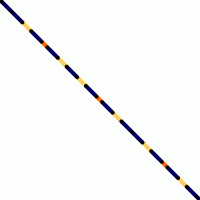
The three letter substitution rule analysed by G. Rauzy in [Rau82] . The Rauzy fractal for this tiling is the Rauzy fractal.
Euclidean Windowed Tiling One Dimensional Polytopal Tiles Self Similar Substitution
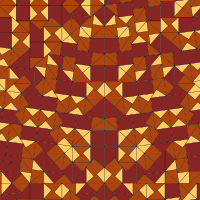
A simple example of an infinite series of substitutions with tilings of statistical circular symmetry. It is shown in [Frettloeh:STWCS not found], that all tilings in this series posses statistical circular symmetry. The substitution factors are $s2m$, where s is the largest root of $xm-xk-1$. Each …
Finite Local Complexity Polytopal Tiles Self Similar Substitution
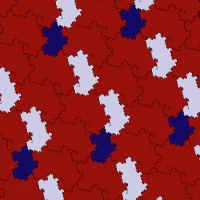
As well as showing that there are substitution rules with any Perron
inflation factor, in [Ken96]
, R. Kenyon
gives an explicit construction for the Perron numbers that satsify:
$xn - a xn-1 + b x + c$, where $a, b$, and $c$ are natural numbers.
This is an example of that method given in that paper. …
Finite Rotations Self Similar Substitution Kenyons Construction
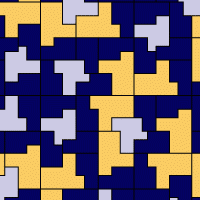
In 1977 Robert Ammann discovered a number of sets of aperiodic prototiles, i.e., prototiles with matching rules forcing nonperiodic tilings. These were published as late as 1987 in [GS87] , where they were named Ammann A2 (our Ammann Chair), Ammann A3, Ammann A4 and Ammann A5 (better known as Ammann …
Without Decoration Finite Rotations Euclidean Windowed Tiling Polytopal Tiles Self Similar Substitution